
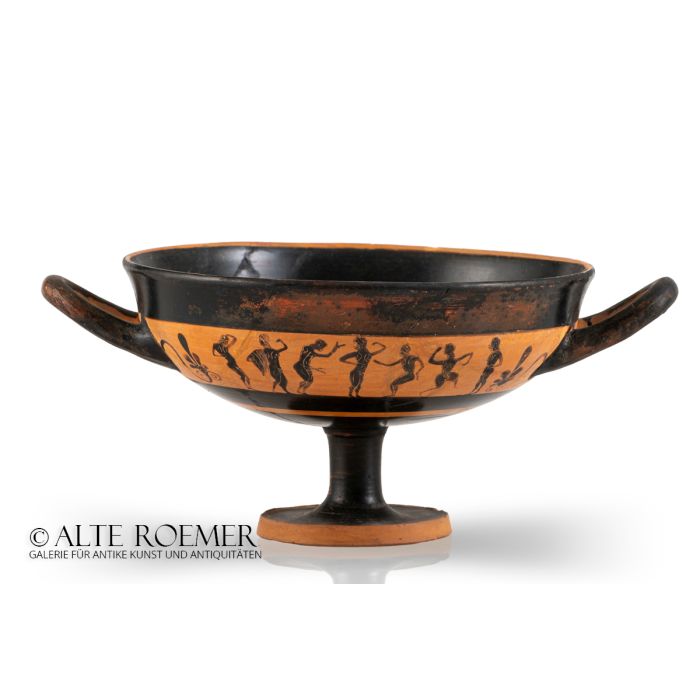
Black figure Athenian little master cup
€6,500
available
Object number
AR3381
| Object: |
Cup with a high foot (Kylix)
|
| Material: |
Red clay with black slip. So-called black figure vase |
| Date: |
About 550 - 500 century B.C. Archaic period of Ancient Greece |
| Description: |
Delicately crafted, deep, hemispherical bowl with a high base and high rim, which tapers to a suggested lip. Two very slightly curved handles extend just below the rim. Light red clay with a glossy black glaze. The interior is completely covered in black, except for the offset rim and a small, bare tondo, with a dot and two concentric circles in the tondo. On the exterior, between the handles, is a figurative frieze. This shows seven figures on each side between vine palmettes. In the center on each side is a male figure, probably Dionysus, surrounded left and right by three dancing figures. Below, a wide band of black slip, a thin, bare band, and then completely covered by black slip up to the top of the base. |
| Size: |
Diameter 290mm with and 220mm without handles, height 130mm.
|
| Historical: note |
This piece belongs to the so-called Attic Little Master cups. These are a genre of Attic black-figure cups named for their delicate, small-format painting. Well-known masters of this genre include Klitias (one of the first artists to introduce this vase form in Athens) and the so-called Cassandra Painter. He is the first vase painter to whom, according to current research, Little Master cups could be attributed. The kylix itself, incidentally, enjoyed its greatest popularity from the end of the 6th century to the 4th century. It probably originates from more cumbersome protogeometric vessels with a deeper bowl and a higher, conical base. The term "kylix" for this cup shape is ancient, as evidenced by the inscription "I am the kylix decorated for the lovely Philtos" on the piece (inv.). No. B450 in the British Museum. |
| Condition: |
Professionally restored from fragments, with only minor imperfections repaired. Most of the body is preserved in the original material, including the still very beautiful original paintwork. A superb specimen.
|
| Reference: |
Corpus Vasorum Antiquorum, Paris, Musee du Louvre 9, III.H.E.67, PL.(622) 81.1-2
|
| Provenance: |
Acquired 2022 in a German auction house. Ex German private collection K. H. K. (1949 - 2005). Acquired before 1990, probably even before 1982 from the collection of Dr. Johannes Christof Roselt (1926 - 2004), director of the Bergisch Museum, Burg an der Wupper, Germany.
|
| Authenticity: |
We unconditionally guarantee the authenticity of every artefact, all items are subject to our lifetime return policy on authenticity.
|