
Egypt and North Africa - Fotogalerie - Sold antiquities
Archive of sold antiquities
All artefacts sold in our gallery are fully documented in our online archive and database. Being a specialist ancient art dealer, preserving also the more recent history of each and every piece sold in our shop is at our heart. That is particularly useful for artefacts that changed owners in the meantime. Information that may have been lost in the process can be easily restored from our archives. Please do not hesitate to contact us if you need further information about ancient items that have been sold in our gallery. We can help you with reconstructing the history of ownership for those items. All information about our customers will be kept confidential, of course.-
 Decorated Skyphos found at Alexandria
Impressive, massive piece from an old German private collection. Acquired 1976 - 1978 at Davies Antiques Gallery, London.
Price: on request Egyptian Eye of Horus
Small amulet in form of the Eye of Horus. Popular type of protective amulet from Ancient Egypt.
Price: on request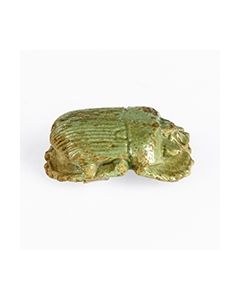 Naturalistic scarab
Funerary scarab in mint green fayence. New Kingdom of Ancient Egypt. The piece is from the famous Matouk collection.
Price: on request Egyptian ushabti for Somtus-tefnacht
The mummiform funerary figurine dates to the Late Period of ancient Egypt, 26th to 31st dynasty. It is remarkable that it probably originates from the burial of two brothers, Somtus-tefnacht and Somtus-tefnacht.
Price: on request Ushabti for Somtus-tefnacht
The mummiform funerary figurine dates to the Late Period of ancient Egypt, 26th to 31st dynasty. It is remarkable that it probably originates from the burial of two brothers, Somtus-tefnacht and Somtus-tefnacht.
Price: on request Egyptian ushabti for Somtus-tefnacht
The mummiform funerary figurine dates to the Late Period of ancient Egypt, 26th to 31st dynasty. It is remarkable that it probably originates from the burial of two brothers, Somtus-tefnacht and Somtus-tefnacht.
Price: on request Egyptian ushabti for Somtus-tefnacht
The mummiform funerary figurine dates to the Late Period of ancient Egypt, 26th to 31st dynasty. It is remarkable that it probably originates from the burial of two brothers, Somtus-tefnacht and Somtus-tefnacht.
Price: on request Egyptian palette of the Middle Kingdom
Workpiece of an artisan for grinding materials. A very similar grinding palette was found in Abydos. From the inventory of the Falmouth Museum.
Price: on request Egyptian funerary figurine for Nefer-hotep
Interesting ushabti from Memphis dating to the late 19th Dynasty, New Kingdom. The owner was an official from the Temple of Ptah.
Price: on request Egyptian ushabti for Somtus-tefnacht
The mummiform funerary figurine dates to the Late Period of ancient Egypt, 26th to 31st dynasty. It is remarkable that it probably originates from the burial of two brothers, Somtus-tefnacht and Somtus-tefnacht.
Price: on request Ushabti for Ra-mes
The mummiform funerary figurine dates to the Late Period of ancient Egypt, 26th to 31st dynasty. It is remarkable that it probably originates from the burial of two brothers, Ra-mes and Somtus-tefnacht.
Price: on request Egyptian ushabti for Ra-mes
The mummiform funerary figurine dates to the Late Period of ancient Egypt, 26th to 31st dynasty. It is remarkable that it probably originates from the burial of two brothers, Ra-mes and Somtus-tefnacht.
Price: on request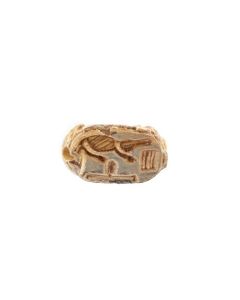 Egyptian scarab for Sobekhotep
The back of the scarboid body is shaped like a lying cat. New Kingdom of ancient Egypt, around 1000 BC.
Price: on request Faience tile of the Djoser pyramid type
Egyptian wall tile from the Old Kingdom, 2nd to 3rd dynasty. The tile type is known from the famous step pyramid of king Djoser.
Price: on request Egyptian ushabti for Ra-mes
The mummiform funerary figurine dates to the Late Period of ancient Egypt, 26th to 31st dynasty. It is remarkable that it probably originates from the burial of two brothers, Ra-mes and Somtus-tefnacht.
Price: on request Bronze statuette of nursing Isis
Isis is shown in a very typical depiction as a mother, the archetype of the later Christian Nursing Madonna. The bronze figurine dates to the 22nd to 31st dynasty of Ancient Egypt.
Price: on request Faience figurine of Isis and Horus child
Goddess on a throne nursing her child Horus. Dating to the Late Period of ancient Egypt.
Price: on request Serapis marble bust from Joachim Menant collection
Famous egyptologist who excavated in Alexandria in the 19th century. Acquired in Egypt during this time, since then and until 2016 in the Menant family collection. With Art Loss certificate.
Price: on request Roman-Egyptian portrait of a young woman
Excellent condition, original stucco and painting partially preserved. From an old collection of a Frech engineer. With Art Loss certificate
Price: on request Bronze statuette of Osiris
The figurine is in exceptional condition with a nice patina. Late Dynastic period of Ancient Egypt, 664 to 332 BC.
Price: on request Pre-Dynastic pottery of Ancient Egypt
The simple vessel is made of coarse clay. It dates to the end of the 4th millenium BC and hence witnessed the beginning of the Ancient Egyptian civilization.
Price: on request Egyptian frog lamp from very old German collection
The frog lamps developed in Egypt close to Abydos. For the Egyptians, the frog symbolized birth and resurrection, this symbolism was also adapted by the early Christians. From the German collection Becker, in this for 3 generations.
Price: on request Cowroid with decorated body
The cowroid has an interesting decoration across the upper surface. The lower surface is inscribed with hieroglyphs. This cowroid is discussed in the catalogue of Gautier-Vodoz.
Price: on request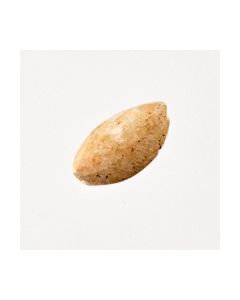 Cowroid with magic spell
The hieroglyphs of the anra type are to be interpreted as magical formula. From the Second Intermediate Period of ancient Egpyt. This scaraboid is described in the catalogue of Gautier-Vodoz.
Price: on request Roman terra sigillata dish from North Africa
Small, nicely preserved bowl from an old German collection.
Price: on request Cowroid with Ankh and papyrus
The seal is engraved with the breath of life between two papyrus plants. This scaraboid is described in the catalogue of Irène Gautier-Vodoz.
Price: on request Scaraboid from the Middle Kingdom
The stamp shows hieroglyphs with a title for the king of Upper and Lower Egypt. This scaraboid is described in the catalogue of Irène Gautier-Vodoz.
Price: on request Scarab with lion
The scene shows a walking lion. It is framed by an oval cord. This scarab is described in the catalogue of Irène Gautier-Vodoz.
Price: on request Scarab with protective formula
Amulet for protection. Stilized lotus flowers on the upper side. Magic formula on the lower side. This scarab is described in the catalogue of Irène Gautier-Vodoz.
Price: on request Scarab with geometric motive
The lower side exhibits a symmetrical arrangements of cords, two of which are wrapped around each other. This scarab is described in the catalogue of Irène Gautier-Vodoz.
Price: on request Scarab with geometric motive
The motive exhibits two symmetry axes and at least six triangles. A wonderful artistic expression of the highly evolved Egyptian maths. This scarab is described in the catalogue of Irène Gautier-Vodoz.
Price: on request Scarab with pattern of circles
The beetle stone bears a popular motive of the Middle Empire. A nice example of its kind. This scarab is described in the catalogue of Irène Gautier-Vodoz.
Price: on request Scarab with magic spell
The hieroglyphs are of the so called anra design, a magic spell in the ancient Egyptian belief. The scarab is from the 13th to 15th dynasty. It is described in the catalogue of Gautier-Vodoz.
Price: on request Egyptian shabti
Funerary statuette of faience. The opposed hands might indicate Tanis as origin. Third Intermediate Period of Ancient Egypt.
Price: on request Egyptian ushabti from the Third Intermediate Period
Funerary statuette of faience with black paint. The opposed hands might indicate Tanis as origin. Third Intermediate Period of Ancient Egypt.
Price: on request Scarab with hieroglyphic formula
The piece is from the Second Intermediate Period. It was probably meant as a good fortune or protective amulet.
Price: on request