
Egypt and North Africa - Sold antiquities
Archive of sold antiquities
All artefacts sold in our gallery are fully documented in our online archive and database. Being a specialist ancient art dealer, preserving also the more recent history of each and every piece sold in our shop is at our heart. That is particularly useful for artefacts that changed owners in the meantime. Information that may have been lost in the process can be easily restored from our archives. Please do not hesitate to contact us if you need further information about ancient items that have been sold in our gallery. We can help you with reconstructing the history of ownership for those items. All information about our customers will be kept confidential, of course.-
 Scarab with geometric motive
The lower side exhibits a symmetrical arrangements of cords, two of which are wrapped around each other. This scarab is described in the catalogue of Irène Gautier-Vodoz.
Price: on request Scarab with geometric motive
The motive exhibits two symmetry axes and at least six triangles. A wonderful artistic expression of the highly evolved Egyptian maths. This scarab is described in the catalogue of Irène Gautier-Vodoz.
Price: on request Scarab with pattern of circles
The beetle stone bears a popular motive of the Middle Empire. A nice example of its kind. This scarab is described in the catalogue of Irène Gautier-Vodoz.
Price: on request Scarab with magic spell
The hieroglyphs are of the so called anra design, a magic spell in the ancient Egyptian belief. The scarab is from the 13th to 15th dynasty. It is described in the catalogue of Gautier-Vodoz.
Price: on request Egyptian shabti
Funerary statuette of faience. The opposed hands might indicate Tanis as origin. Third Intermediate Period of Ancient Egypt.
Price: on request Egyptian ushabti from the Third Intermediate Period
Funerary statuette of faience with black paint. The opposed hands might indicate Tanis as origin. Third Intermediate Period of Ancient Egypt.
Price: on request Scarab with hieroglyphic formula
The piece is from the Second Intermediate Period. It was probably meant as a good fortune or protective amulet.
Price: on request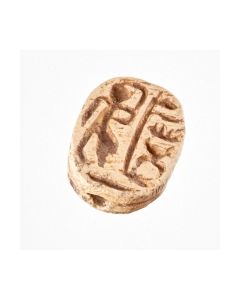 Scarab with cartouche
The scarab from the late Ramesside period shows a standing person. A cartouche in front bears the name of pharao Mencheperre, who was famous as Thutmose III.
Price: on request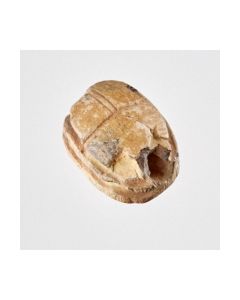 Egyptian Scarab with hieroglyphs
Interesting scarab made of steatit with inscription for Amun. Dating to the 19th to 21st dynasty of ancient Egypt.
Price: on request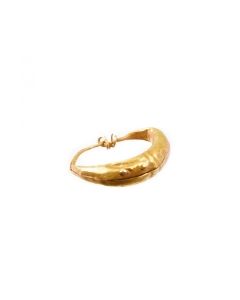 Graeco-Roman earring
The decorated earrings is made of gold sheet. It is hollow inside. The type is from Northern Africa and dates to Greek or Roman times.
Price: on request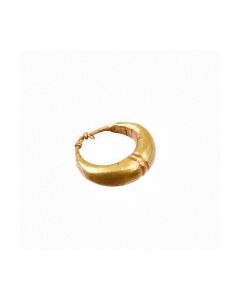 Graeco-Roman earring
The decorated earrings is made of gold sheet. It is hollow inside. The type is from Northern Africa and dates to Greek or Roman times.
Price: on request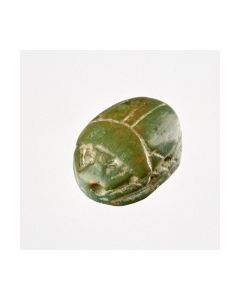 Scarab with Amun inscription
Bearing the hieroglyphs "the god Amun of Theben is lord". From the Late Period of ancient Egypt. Beautiful green stone.
Price: on request Scarab with pharao on throne
The piece dates to the Third Intermediate Period and was probably produced in Tanis. It shows a pharao with a subordinate.
Price: on request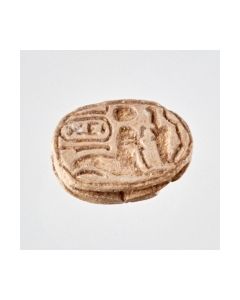 Memorial scarab for Thutmose III
A royal sphinx and Maat, the goddess of truth and justice adorn the lower side. Above them is the cartouche of Mencheperre. The piece is probably from the regin of Ramesses IV or V.
Price: on request Egyptian Scarab with sun beetle
The scarab amulet from Ramesside times has a beetle engraved in the lower side, flanked by two symbols.
Price: on request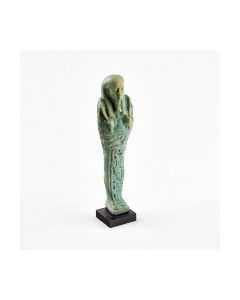 Egyptian funerary figurine of General Semataui
Very well preserved ushebti from the Late Period of ancient Egypt. An expertise from 2015 comes with this object. From an old British collection.
Price: on request Scarab with wishes
Nice scarab made of dark steatite. The hieroglyphs could be read as New Year's wishes.
Price: on request Scarab with twisted cord
Scarab amulet with a twisted cord motive. Beautiful and well preserved piece from the Second Intermediate Period.
Price: on request Scarab with cartouche
The scarab amulet has a cartouche and neb on the bottom. 18th to 20th dynasty of ancient Egypt.
Price: on request Egyptian Scarab
The scarab amulet is made of steatite. It has a hieroglyphic inscription on the lower side, including a reference to Amun-Re.
Price: on request Egyptian Scarab
The scarab amulet is made of steatite. It has a hieroglyphic inscription on the lower side.
Price: on request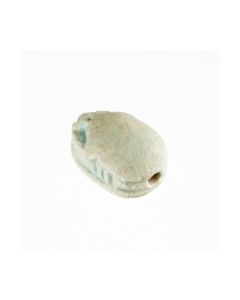 Scarab with wishes
Nice mint green scarab. The hieroglyphs could be read as New Year's wishes.
Price: on request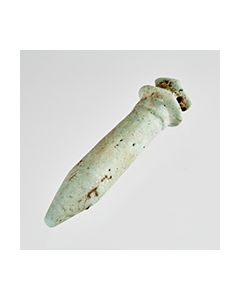 Egyptian papyrus scepter amulet
Papyrus scepter made of faience. Late Period of Ancient Egypt. It symbolizes prosperity and youth. From the stock of a british private museum.
Price: on request Egyptian papyrus scepter amulet
Papyrus scepter made of faience. Late Period of Ancient Egypt. It symbolizes prosperity and youth. From the stock of a british private museum.
Price: on request Graeco-Roman earrings
The pair of earrings is made of gold. The type is from Northern Africa and dates to Greek or Roman times.
Price: on request Graeco-Roman earrings
The decorated pair of earrings is made of gold sheet. It is hollow inside. The type is from Northern Africa and dates to Greek or Roman times.
Price: on request Nicely decorated Graeco-Roman gold earrings
The pair of earrings is made of gold. Each piece is carrying a red insert piece. A nicely decorated piece of jewellery from North Africa in Graeco-Roman times. With Art Loss Certificate.
Price: on request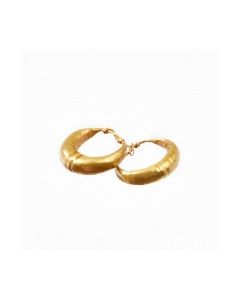 Graeco-Roman earrings
The decorated pair of earrings is made of gold sheet. It is hollow inside. The type is from Northern Africa and dates to Greek or Roman times.
Price: on request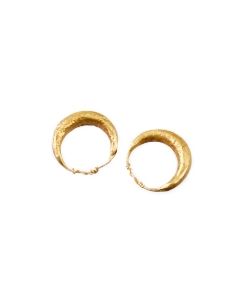 Graeco-Roman earrings
The pair of earrings is made of gold sheet. It is hollow inside. The type is from Northern Africa and dates to Greek or Roman times.
Price: on request Central part of a mummy cartonnage
Polychrome painted panel depicting the four sons of Horus and a representation of Kheper-Ra. The collar is resembling the falcon wing of Horus.
Price: on request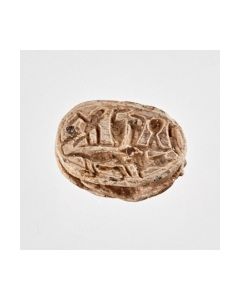 Scarab from the Ramesside period
The bottom side shows Horus, Uraeus and crocodile. The crocodile could be interpreted a the god Sobek.
Price: on request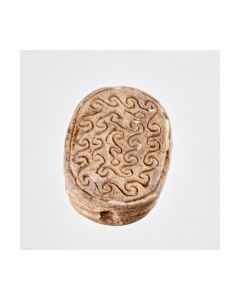 Scarab with spiral design and symbol for good luck
The Egyptian scarab from the Second Intermediate Period is decorated with a geometrical pattern. A nefer hieroglyph stands for good luck.
Price: on request Scarab with geometric design
Lovely scarab with traces of turquoise fayence. From the Second Intermediate Period of ancient Egypt.
Price: on request Roman sandstone head of a Nubian prince
Perfectly preserved impressive portrait from Californian collection, prior to this in an old German collection.
Price: on request Roman amphoriskos with Calydonian Boar
Perfectly preserved, impressive piece from old German collection
Price: on request Scarab of pharao Seti I.
The Egyptian scarab bears a hieroglyphic inscription which can be read as the name of pharao Seti I. From the Ramesside period, around 1300 BC.
Price: on request