
Fotogalerie - Sold antiquities
Archive of sold antiquities
All artefacts sold in our gallery are fully documented in our online archive and database. Being a specialist ancient art dealer, preserving also the more recent history of each and every piece sold in our shop is at our heart. That is particularly useful for artefacts that changed owners in the meantime. Information that may have been lost in the process can be easily restored from our archives. Please do not hesitate to contact us if you need further information about ancient items that have been sold in our gallery. We can help you with reconstructing the history of ownership for those items. All information about our customers will be kept confidential, of course.-
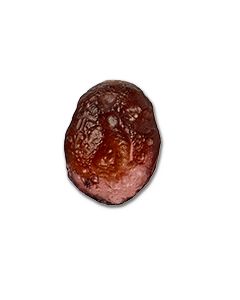 Roman intaglio with child Eros
Roman glass paste with dynamic scene. It shows the god running. Made of purple glass, imitating amethyst.
Price: on request Phoenician eye bead
Polychrome glass bead with stylized elements of a face as protection against the evil eye. Produced in Carthage or the Phoenician homeland, 4th to 3rd century BC.
Price: on request Phoenician eye bead
Polychrome glass bead with stylized elements of a face as protection against the evil eye. Produced in Carthage or the Phoenician homeland, 4th to 3rd century BC.
Price: on request Predynastic hippopotamus amulet
Wonderful figurine made of orange-red carnelian. Dating to the birth of Ancient Egypt. The rare piece was already scientifically studied in 1913.
Price: on request Three neolithic arrowheads from Egypt
The Stone Age points are beautifully crafted, with finely serrated edges. From a 100 year old museum collection.
Price: on request Roman medallion with Fortuna
The piece of gold jewellery could be worn as a pendant on the ear or on a necklace. The relief shows Fortuna, the goddess of fortune and fate, with her typical attributes. Made between the 1st and 3rd century.
Price: on request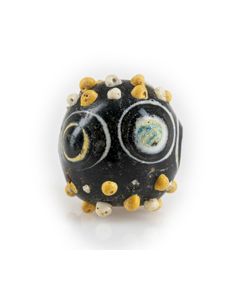 Large Phoenician eye bead
Dark and unusually large glass bead with stylized elements of a face as protection against the evil eye. Produced in Carthage or the Phoenician homeland, 4th to 3rd century BC.
Price: on request Phoenician eye bead
Polychrome glass bead with stylized elements of a face as protection against the evil eye. Produced in Carthage or the Phoenician homeland, 4th to 3rd century BC.
Price: on request Phoenician eye bead
Polychrome glass bead with stylized elements of a face as protection against the evil eye. Produced in Carthage or the Phoenician homeland, 4th to 3rd century BC.
Price: on request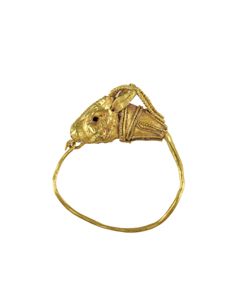 Hellenistic gold earring with antelope head
Ear pendant with plastically modeled head of an antelope. The elaborately made head is typical for hellenistic gold jewellery.
Price: on request Large Visigoth bow brooch
Impressive fibula of the Visigoths from the Migration Period. With five originally preserved glass inserts.
Price: on request Very fine Trajan sestertius with beautiful patina
The reverse shows Arabia standing to the left, holding branch and sugar cane, camel at her feet. The legend ARAB(ia) ADQ(uista) underlines that Arabia was acquired by Rome.
Price: on request Roman Terra Sigillata bowl with potters' mark from the Rhineland
Found near the Roman city of Novaesium, today's Neuss in Germany, an early Roman foundation and with this one of the oldest cities in Germany.
Price: on request Roman intaglio with satyr
Brown glass paste with white decorative band. The piece boosts a high quality depiction of a panther's skin. The upper part missing.
Price: on request Roman intaglio with winged goddess
The glass paste has a remarkably vibrant violet colour. From the Professor Brosch collection of engraved gems.
Price: on request Graeco-Roman earrings with gemstones
Matching pair of jewellery made of gold with gemstone of red garnet and white glass bead. From an ancient workshop in Egypt or the Levant.
Price: on request Neolithic stone tool from Egypt
The Stone Age weapon's point or knife blade is well crafted, with finely serrated edge. From a 100 year old museum collection.
Price: on request Three neolithic arrowheads from Egypt
The Stone Age points are beautifully crafted, with finely serrated edges. From a 100 year old museum collection.
Price: on request Egyptian ushabti for Pa-di-pepet
The tomb of Pa-di-pepet was discovered in 1893 west of the Pyramid of Teti at Saqqara. His funerary statuettes were given to important museums and into private collections. Dating to the reign of Pharaoh Psamtik I and his successor Necho II.
Price: on request Roman intaglio with warrior leaning on helmet
Interesting scene formed into an opaque blue glass paste. From the Professor Brosch collection of engraved gems.
Price: on request Roman intaglio of a silenus
The nature spirit is standing naked, depicted with a beard and bald head. Nice orange glass paste.
Price: on request Roman intaglio with lyre player
The ancient intaglio from Roman times is made of nice orange glass paste. It probably shows Eros as a young god playing the lute.
Price: on request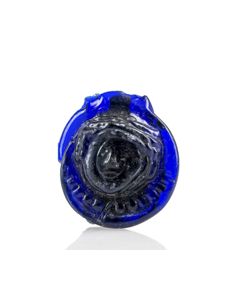 Roman glass applique with face
Striking cobalt blue glass, once decorating a 1st century glass vessel. From the Roman city of Novaesium.
Price: on request Roman brooch of the Hod Hill type
Beautifully decorated brooch from the first century. A find from the Roman city of Novaesium, today's Neuss in Germany.
Price: on request Egyptian sarcophagus mask with beard
Painted wooden relief showing a frontal view of an idealized face. A long fake beard is prominently attached. From the Late Period of Ancient Egypt.
Price: on request Egyptian alabaster vessel
Large container for this type of vessel. A thin-walled and very skilfully crafted specimen. Made between the 12th and 18th dynasty of Ancient Egypt.
Price: on request Egyptian painted panel with goddess Imentet
The painting was once on the inside of a sarcophagus lid, as a welcome to the underworld. The piece is published in an exhibition catalogue from 1972. From the 25th or 26th dynasty of Ancient Egypt.
Price: on request Roman intaglio with standing person
Nice orange brown glass paste. The person might be the god Hermes, known as Mercurius in Roman culture.
Price: on request Roman intaglio with young Satyr
Glass paste of wonderful light pink color, imitating amethyst. It shows the young Satyr with Panther's skin and mask.
Price: on request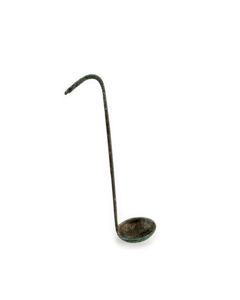 Ancient ladle with donkey head terminal
Elegant long bronze ladle, from the Greek or Etruscan culture. 5th to 4th century BC.
Price: on request Roman facade decoration shaped as theatre mask
Impressive and striking marble mask. It once adorned the upper facade of a villa or a public building during Roman Imperial times.
Price: on request Marc Aurel Denarius, found 1985 in Stonea Grange, Cambridgeshire
Nice dark patina. Rome mint, December 1176 - autumn 177 A.D. Aequitas standing to the left with cornucopiae.
Price: on request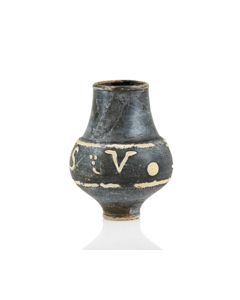 Roman terracotta beaker from the Rhineland with painted inscription
The insciption VIVAS (live!) in intense white color is perfectly preserved. Found near the Roman city of Novaesium, today's Neuss in Germany, an early Roman foundation and with this one of the oldest cities in Germany.
Price: on request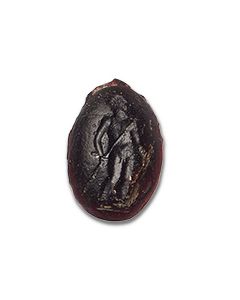 Roman intaglio with warrior
Nice dark red glass paste with strongly convex image side. From the Professor Brosch collection of engraved gems.
Price: on request Roman intaglio with Eros
An ancient intaglio from Roman times made of nicely patinated glass paste. From the Professor Brosch collection of engraved gems.
Price: on request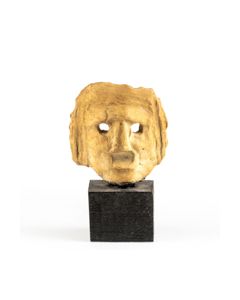 Hellenistic tragic mask of a young man
Typical wide open mouth and circular eye openings. Nicely preserved. From a German private collection, acquired between 1980 and 1985.
Price: on request