
Search results for: '400 bc'
-
 Very large Roman mortarium from the Rhineland
Found near the Roman city of Novaesium, today's Neuss in Germany, an early Roman foundation and with this one of the oldest cities in Germany.
Price: on request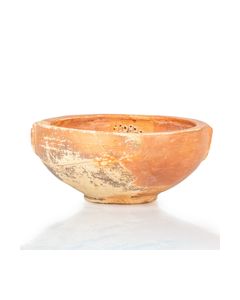 Very rare Roman clay strainer from the Rhineland
Probably a local creation; no comparable pieces are known. Found 1966 till 1981 near the Roman city of Novaesium, today's Neuss in Germany. Novaesium was an early Roman foundation and with this is one of the oldest cities in Germany.
Price: on request Egyptian coffin with snake
The small bronze votive box is modelled on top with a coiled serpent. The artefact was probably made around 400 BC in Naukratis to be devoted to Atum.
Price: on request Michelsberger culture artefacts from museum stock - found in Camp-a-Cayaux, Belgium
Funde vom Camp-a-Cayaux, bei neolithischer Flintmine in Spiennes, Belgien. Abschläge und Werkzeuge. 4500 v. Chr. bis 3500 v. Chr.
Price: on request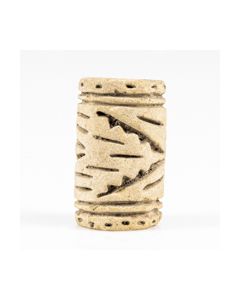 Jama-Coaque roller stamp
Clay roller stamp with relief of stylized plants used to apply skin decoration. This tool is from the early phase of the ecuadorian Jama-Coaque culture.
Price: on request Jama-Coaque roller stamp
Clay roller stamp with relief of mythological creatures to be applied as a skin decoration. This tool was used in the early phase of the ecuadorian Jama-Coaque culture and was found in Pedernales.
Price: on request Jama-Coaque roller stamp
Clay roller stamp with relief of plants to be applied as skin decoration. This tool was used in the early phase of the ecuadorian Jama-Coaque culture.
Price: on request Jama-Coaque roller stamp
Clay roller stamp with rich ornamental relief to apply skin decoration. This tool was used in the early phase of the ecuadorian Jama-Coaque culture.
Price: on request Iron Age pottery vessel in the shape of a tiger
Fantastic animal shaped vessel with the mouth serving as a spout. From Iron Age Azerbaijan. The piece comes with a TL analysis from 1981.
Price: on request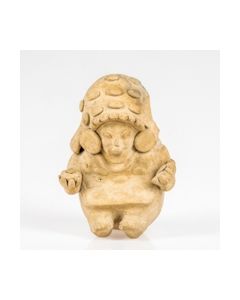 Sculpture of a Jama-Coaque chieftain
The clay figure from the earliest phase of the Jama-Coaque culture shows the preparation of coca leaves. Including TL test from Kotalla laboratory.
Price: on request Vessel of the Nazca culture
Magnificent pottery of the Nazca with polychrome paint. It shows two condors. This piece comes with a copy of a TL report from 1984.
Price: on request Pair of Achaemenid gold bracelets
Fantastic example of the gold jewellery of the first Persian Empire. Late 6th to 5th cent. BC.
Price: on request Decorative disc of the Amlash culture
Gold sheet artfully crafted in the repoussé technique, with a relief depicting reclining ibexes. Possibly the decoration of a sword pommel. Exhibited and published by the Art Institute of Chicago in the 1970s.
Price: on request Etruscan scarab with Prometheus
The highest quality work of miniature art shows how Prometheus has just formed the first human from clay. A showpiece of late Etruscan glyptics made of beautiful carnelian.
Price: on request Egyptian bronze figurine of Khonsu the Child
Rare depiction of the god of the moon Khonsu in the manner of the Egyptian child gods. From the Late Period of Ancient Egypt. A find from Karnak.
Price: on request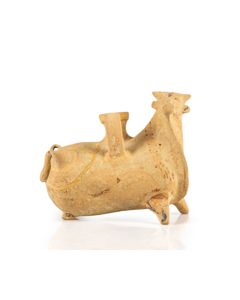 Greek bull askos from Sicily
A find from the Greek settlement of Gela in Sicily. Great example of local pottery production in the 5th century BC. The askos offered here was extensively researched and described by Prof. Dr. Isler from the University of Zurich.
Price: on request Etruscan scarab with athletes
Miniature work of art of the highest quality, a flagship of late Etruscan glyptics. Made of shimmering orange carnelian. Published several times and with provenance dating back to the 19th century.
Price: on request Imposing ushabti of Psamtik-mery-Ptah
From an early 19th century excavation in Saqqara. Psamtik-mery-Ptah was superintendent or admiral of the royal fleet during the reign of Amasis II and waged war at sea against king Nebuchadnezzar II after his troops famously invaded the Holy Land and conquered Jerusalem.
Price: on request