
Search results for: 'bei'
-
 Byzantine finger ring showing blossom
Byzantinischer Fingerring aus Silber mit schönem Blütenmotiv. In hervorragender Erhaltung und theoretisch auch heute noch als Amulett oder Fingerring tragbar. Innendurchmesser 18mm bis 19mm.
Price: on request Large Roman jug
Bauchiger Einhenkelkrug mit hohem Hals und konisch nach oben verjüngter Lippe. 1. - 3. Jh. n. Chr. Als Fundregion ist die Türkei überliefert.
Price: on request Elegant Roman glass bottle
Ancient glass with magnificent colourful iridescence. Found in a ship wreck in the eastern Mediterranean. Produced in Roman imperial times.
Price: on request Late-antique silver ring
Spätantiker Fingerring aus Silber. Auf das Ringband aufgesetzte Ringplatte mit Ritzdekor. Innendurchmesser 16mm.
Price: on request Elegant Roman glass bottle - found in a ship wreck in the Mediterranean
Elegantes Glas aus römischer Zeit. Geborgen aus einem Schiffswrack im östlichen Mittelmeer und in nahezu perfekter Erhaltung. Die gereinigte Außenseite gibt den Blick auf die antike Glassubstanz frei.
Price: on request Byzantinischer Ring mit Inschrift
Quadratische Ringplatte mit zwei konkaven und zwei konvexen Seiten. Mit Inschrift und reichen Verzierungen. Innendurchmesser 18mm bis 19mm.
Price: on request Römisches Unguentarium
Antikes Glas vom Typ der Candlestick-Unguentarien. Wundervolle, farbenfrohe Irideszenz. Fund aus einem Schiffswrack im östlichen Mittelmeer. Produktion aus römischer Zeit.
Price: on request Römisches Fläschchen aus Glas
Elegantes Glas aus römischer Zeit. Geborgen aus einem Schiffswrack im östlichen Mittelmeer und in nahezu perfekter Erhaltung. Die gereinigte Außenseite gibt den Blick auf die antike Glassubstanz frei.
Price: on request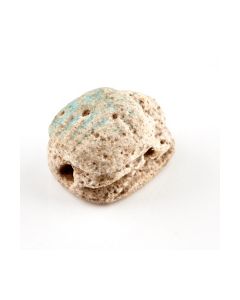 Ägyptischer Skarabäus
Stilisierte Form eines Skarabäuskäfers. Die Stempelfläche trägt Hieroglyphen. 1. Jt. v. Chr.
Price: on request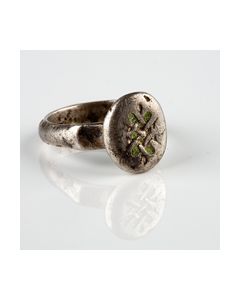 Fingerring mit grünen Einlagen
Ring aus byzantinischer Zeit mit wundervollen grünen Einlagen. Aus Silber. Innendurchmesser 18mm bis 20mm.
Price: on request Durchschimmerndes antikes Glasfläschchen
Römisches Glasfläschchen. Seltener Typ aus fast farblosem, durchschimmernden Glas. Levante, 1. bis 4. Jh. n.Chr.
Price: on request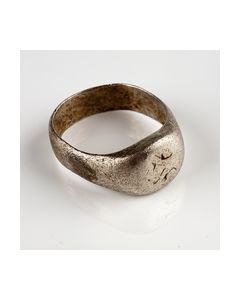 Byzantinischer Fingerring aus Silber
Das breite Ringband hat ein D-förmiges Profil und geht nahtlos in die Ringplatte über, die eine geritzte Inschrift oder Verzierung trägt. Innendurchmesser 15mm bis 16mm (oval). Ca. 5. bis 15 Jh. n. Chr.
Price: on request Antiker Fingerring aus Silber
Eleganter Fingerring aus Silber, römisch bis frühbyzantinisch. Innendurchmesser 21mm bis 22mm.
Price: on request Sehr großer Daunischer Vogelaskos
Stilisierter Vogelkörper mit aufwändigem schwarzem und rotem Dekor. Museales, vollständig intaktes Stück. Aus alter rheinländischer Sammlung.
Price: on request Publizierter Tüllenmeißel aus der Bronzezeit - England
Perfekt gearbeiteter Meißel aus Bronze. Grundform eines langgestreckten Kegelstumpfes. Wunderschöne gleichmäßige Patina. Ein Fund aus Ostanglien.
Price: on request Antike Riemenzunge
Vermutlich Teil eines Zaumzeugs. Vollständig erhalten, sehr schöne Patina. Wohl 1. Jh. n. Chr. bis 4. Jh. n. Chr. Fund aus Deutschland aus den 1970er Jahren.
Price: on request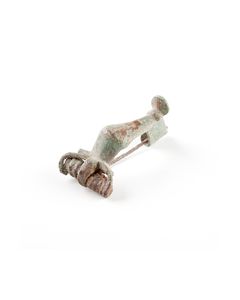 Römische Kniefibel
Kaiserzeitliche Fibel vom Typ der Kniefibeln. Variante mit ungedeckter Spiralhalterung der Feder. 2. Jh. n. Chr. 44mm lang.
Price: on request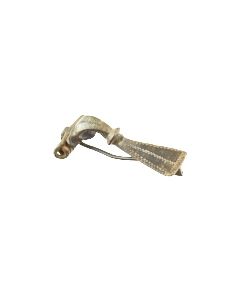 Roman fibula with decorated foot
This type of kraftig profilierte fibula has a nice trapezoidal foot with punch decor. It was popular in Central Europe during the 1st and 2nd century AD.
Price: on request Greek Attic oil lamp
6th - 5th century BC, nicely preserved example of a very early oil lamp used in ancient Europe.
Price: on request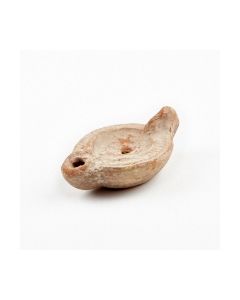 Massive roman oil lamp
Made in North Africa in the late 3rd century AD. From an old collection
Price: on request Roman oil lamp with heart-shaped nozzle
Nicely preserved oil lamp from the Roman Imperial era.
Price: on request Neolithic flint sickle
Halfmoon shaped blade with fine edges. Nice and typical example for this neolithic type of tool.
Price: on request Neolithischer Axtkopf mit Museumsschäftung
Das Steinwerkzeug stammt aus der Jungsteinzeit Nord- oder Mitteleuropas. Besonders hervorzuheben ist die moderne Schäftung in Museumsqualität, die einen großartigen Eindruck von der einstigen Verwendung des Werkzeuges gibt.
Price: on request Published cypriot kylix, ex Christie's
Excellently preserved. 1977 on exhibition in the Bielefeld Museum of Fine Arts. From an old German private collection, acquired 1972 at Christie's. Coming with an ArtLoss certificate.
Price: on request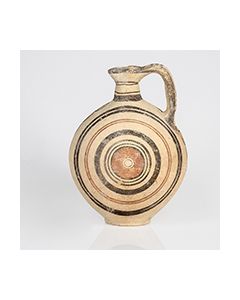 Large published Cypriot oinochoe
Dating to the early cypro-archaic period, so-called bichrome ware IV. From an old German private collection, acquired at Sotheby's in 1970. Coming with an ArtLoss certificate.
Price: on request Egyptian New Year flask with ornamentation
Hieroglyphic inscription expressing New Year wishes for Ptah at the beginning of the nile floodings. Important 26th dynasty piece associated with the Egyptian New Year rituals. The object is a fantastic example of the skilled workmanship and artistic quality of faience in ancient Egypt.
Price: on request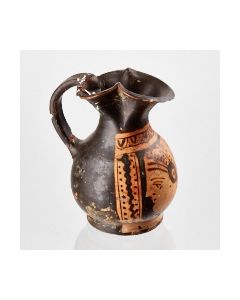 Red figure Oinochoe from a very old German collection
Excellent condition and brilliant colors. Decorated with a large red figure female head. 4th century BC.
Price: on request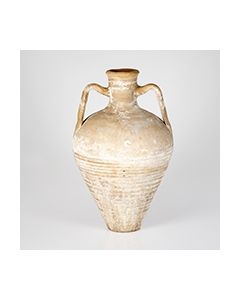 Roman transport amphora found at Cabrera island
Nicely preserved amphora from the Mediterranean sea. From an old German collection.
Price: on request Roman terra sigillata plate - found in Friedberg Germany
Roman Empire, 2nd century AD. From and old German collection, acquired btw 1905 and 1925.
Price: on request Double spiral pendant from Bronze Age Central Europe
Typical decorative element of a wealthy woman's dress in the European Middle Bronze Age. Several of these spiral pendants were worn around the waist. Similar to belt mounts or charms. 1500 to 1200 BC.
Price: on request Roman jar with flat handle
Perfectly preserved piece from a very old German collection.
Price: on request Roman beaker
Delicate piece from a very old German collection.
Price: on request Roman jar from Lopodunum
Perfectly preserved piece from the 1st - early 2nd century AD. Found in Ladenburg, Baden-Wuerttemberg, Germany.
Price: on request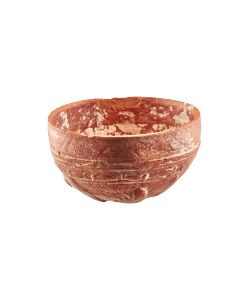 Megarian bowl decorated with a flying swan
Interesting piece, featuring a flying swan. From an old German collection
Price: on request Roman knee brooch
Prime example of this important and popular type of brooch during the 2nd century.
Price: on request Aubergine-colored Roman glass vessel - found in a ship wreck at the Cretan coast
Elegantes Fläschchen aus wunderschönem auberginfarbenen Glas mit anhaftender, dezenter weißer Meerespatina. Das Gefäß stammt aus einem Schiffswrackfund vor der Küste der Insel Kreta.
Price: on request