
Search results for: 'bronze head'
-
 Roman Hod Hill brooch
Made around the year 100 and found on the Isle of Wight, after the Roman conquest of Britain.
Price: on request Large Visigoth bow brooch
Impressive fibula of the Visigoths from the Migration Period. With five originally preserved glass inserts.
Price: on request Anglo-Saxon bow brooch
A find from the Isle of Wight from the Migration Period. Beautiful testimonial of the settlement of Britain by the Anglo-Saxons.
Price: on request Anglo-Saxon bow brooch
A find from the Isle of Wight from the Migration Period. Beautiful testimonial of the settlement of Britain by the Anglo-Saxons.
Price: on request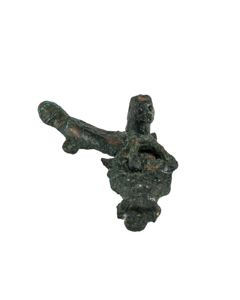 Intricate Roman fascinus amulet from the Rhineland
Exceptional are the originally preserved inserted eyes of the lion and bull. Found near the Roman city of Novaesium, today's Neuss in Germany, an early Roman foundation and with this one of the oldest cities in Germany.
Price: on request Tiberius denarius (Tribute Penny) from Wishanger hoard
Found 2021 in East Hampshire, UK. The hoard is a very impressive proof of the fact that coins were in circulation for up to several centuries in the Roman era.
Price: on request Vespasian denarius from Wishanger hoard
Found 2021 in East Hampshire, UK. The hoard is a very impressive proof of the fact that coins were in circulation for up to several centuries in the Roman era.
Price: on request Roman Republican denarius from Wishanger hoard
Anonymous, 2nd century BC. Found 2021 in East Hampshire, UK. Best condition of the five Marc Antony denarii in the hoard. The hoard is a very impressive proof of the fact that coins were in circulation for up to several centuries in the Roman era.
Price: on request Roman Republican denarius of Renius from Wishanger hoard
Biga driven by goats on reverse. Found 2021 in East Hampshire, UK. The hoard is a very impressive proof of the fact that coins were in circulation for up to several centuries in the Roman era.
Price: on request Vespasian denarius from Wishanger hoard
Beautiful dark patina. Reverse showing yoke of oxen. Found 2021 in East Hampshire, UK. The hoard is a very impressive proof of the fact that coins were in circulation for up to several centuries in the Roman era.
Price: on request Augustus denarius from Wishanger hoard
Reverse showing Caius Caesar galloping right, eagle between two vexilla behind him. Found 2021 in East Hampshire, UK. The hoard is a very impressive proof of the fact that coins were in circulation for up to several centuries in the Roman era.
Price: on request Vespasian denarius from Wishanger hoard
Found 2021 in East Hampshire, UK. The hoard is a very impressive proof of the fact that coins were in circulation for up to several centuries in the Roman era.
Price: on request Vespasian denarius from Wishanger hoard
Found 2021 in East Hampshire, UK. The hoard is a very impressive proof of the fact that coins were in circulation for up to several centuries in the Roman era.
Price: on request Roman Republican L. Flaminius Cilo Denarius from Wishanger hoard
Found 2021 in East Hampshire, UK. The hoard is a very impressive proof of the fact that coins were in circulation for up to several centuries in the Roman era.
Price: on request Augustus denarius from Wishanger hoard
Found 2021 in East Hampshire, UK. Revers showing Gaius and Lucius, the sons of M. Agrippa. The hoard is a very impressive proof of the fact that coins were in circulation for up to several centuries in the Roman era.
Price: on request Julius Caesar Denarius from Wishanger hoard
Found 2021 in East Hampshire, UK. The hoard is a very impressive proof of the fact that coins were in circulation for up to several centuries in the Roman era.
Price: on request Vespasian denarius from Wishanger hoard
The reverse shows the urn of Vespasian on a column. Great patina. Found 2021 in East Hampshire, UK. The hoard is a very impressive proof of the fact that coins were in circulation for up to several centuries in the Roman era.
Price: on request Four Roman bronze artefacts from Novaesium
Two handles, one of them beautifully incised. And one arrow head and an amulet. Finds from the Roman city of Novaesium, today's Neuss in Germany.
Price: on request Dolphin brooch from Roman Britain
The so-called dolphin brooch is very British. This specimen was probably made by the Celtic Corieltauvi tribe, shortly after the arrival of the Romans in the middle of the 1st century. Published in two works by Richard Hattatt.
Price: on request Roman bronze fibula
Brooch from the earlier Roman imperial period with a nice patina. This type of brooch was common in Central and Northern Europe. This very piece is from the Roman city of Novaesium, today's Neuss in Germany.
Price: on request