
Weapons - Middle Ages - Middle East - Photo gallery
Image database with photographs of ancient art and antiquities
Our image database provides photographs of ancient art and antiquities for press releases as well as for private use. All artefacts sold in our gallery are documented through professional photographs. The resulting image library contains numerous ancient Egyptian, Greek and Roman antiquities as well as ancient coins. The time span from Stone Age, over Bronze Age and Classical Antiquity until Late Antiquity is covered.The photo gallery aims at providing a vast visual archive equipped with filters and search tools. You are most welcome to search the constantly growing number of artefacts in the image library. We are also happy to authorize hyperlinks from your webpage / forum to the objects depicted in our gallery. For this purpose, please send us a short notification prior to placing a hyperlink. For almost every object high definition photographs are available and can be provided e.g. to document your collection or for scientific papers or popular science articles. If you are interested in using pictures for publications, print media or other purposes, please contact us and we will be happy to assist you.
-
 Werkzeug oder Pfeilspitze, Römerzeit bis Mittelalter
Spitz auslaufendes Objekt aus Eisen, möglicherweise als Werkzeug in Gebrauch. Mit Griffansatz. Teil einer Fundgruppe aus dem süddeutschen Raum.
Price: on request Antike Pfeilspitze aus Eisen
Pfeilspitzen aus Eisen, 2. Jh. v. Chr. - 13. Jh. n. Chr. Letztes Stück aus dem beliebten Lot.
Price: on request Museale Speerspitze aus Eisen
Eindrucksvolle, massive Speerspitze. Vollständig, in exzellenter Erhaltung. Eine Seite der Klinge geschärft, Heft verziert.
Price: on request Antike Pfeilspitze aus Eisen
Kleine Pfeilspitze mit quadratischem Querschnitt, sich stark zur Spitze hin verjüngend. 9. - 13. Jh. n. Chr.
Price: on request Massive antike Pfeilspitze aus Eisen
Quadratischer Querschnitt, massive Ausführung. Für Alter und Material sehr schwache Korrosion. 9. - 13. Jh. n. Chr.
Price: on request Antike Pfeilspitze aus Eisen
Kleine Pfeilspitze mit quadratischem Querschnitt, sich stark zur Spitze hin verjüngend. 9. - 13. Jh. n. Chr.
Price: on request Antike Pfeilspitze aus Eisen
Kleine Pfeilspitze mit quadratischem Querschnitt, sich stark zur Spitze hin verjüngend. 9. - 13. Jh. n. Chr.
Price: on request Antike Pfeilspitze aus Eisen
Quadratischer Querschnitt, in der Mitte verjüngt. Massiv. Kulturkreis der Kidariten oder Hephthaliten, 5. - 7. Jh. n. Chr.
Price: on request Massive antike Pfeilspitze aus Eisen
Quadratischer Querschnitt, massive Ausführung. Für Alter und Material sehr schwache Korrosion. 9. - 13. Jh. n. Chr.
Price: on request Antike Pfeilspitze aus Eisen
Kleine Pfeilspitze mit quadratischem Querschnitt, sich stark zur Spitze hin verjüngend. 9. - 13. Jh. n. Chr.
Price: on request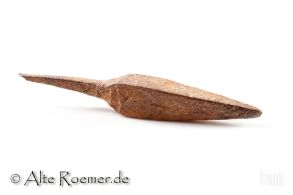 Antike Pfeilspitze aus Eisen
Kleine Pfeilspitze mit quadratischem Querschnitt, sich stark zur Spitze hin verjüngend. 9. - 13. Jh. n. Chr.
Price: on request Massive antike Pfeilspitze aus Eisen
Quadratischer Querschnitt, verjüngt sich zur Spitze hin. Massiv. Für Alter und Material sehr schwache Korrosion. 9. - 13. Jh. n. Chr.
Price: on request Massive antike Pfeilspitze aus Eisen
Quadratischer Querschnitt, in der Mitte verjüngt. Massiv. Kulturkreis der Kidariten oder Hephthaliten, 5. - 7. Jh. n. Chr.
Price: on request Massive antike Pfeilspitze aus Eisen
Klassische Formgebung, quadratischer Querschnitt, massiv. Für Alter und Material relativ schwache Korrosion.
Price: on request Antike Pfeilspitze aus Eisen mit Widerhaken
Dreiflüglige Pfeilspitze aus Eisen, die Flügel sind mit Widerhaken versehen. Post indo-skythischer Übergangstyp.
Price: on request Massive antike Pfeilspitze aus Eisen
Quadratischer Querschnitt, in der Mitte verjüngt. Massiv. Spitze leicht verbogen. Kidariten oder Hephthaliten, 5. - 7. Jh. n. Chr.
Price: on request Antike Pfeilspitze aus Eisen
Kleine Pfeilspitze mit quadratischem Querschnitt, sich stark zur Spitze hin verjüngend. 9. - 13. Jh. n. Chr.
Price: on request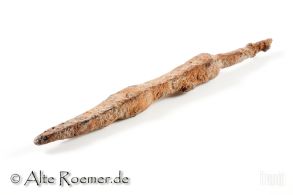 Antike Pfeilspitze aus Eisen
Quadratischer Querschnitt, in der Mitte verjüngt. Massiv. Kulturkreis der Kidariten oder Hephthaliten, 5. - 7. Jh. n. Chr.
Price: on request Antike Pfeilspitze aus Eisen
Kleine Pfeilspitze mit quadratischem Querschnitt, am Ansatz Einschnürung. 9. - 13. Jh. n. Chr.
Price: on request Römische bis mittelalterliche Pfeilspitzen aus Eisen
Einzelverkauf aus einer Gruppe massiver Pfeilspitzen aus Eisen. Diverse Typen und Formen, viele davon aus spätrömischer Zeit.
Price: on request 2 Pfeilspitzen aus Eisen, Römerzeit bis Mittelalter
Zwei massive Pfeilspitzen mit quadratischem Querschnitt, verjüngen sich zur Spitze hin. Länge: 128 mm
Price: on request Pfeilspitze, Römerzeit bis Mittelalter
Sehr schön erhaltene Pfeilspitze. Materialbedingt exzellente Erhaltung. Teil einer Fundgruppe aus dem süddeutschen Raum.
Price: on request Lanzenspitze, Römerzeit bis Mittelalter
Museales Stück. Materialbedingt korrodiert, jedoch in exzellenter Erhaltung. Typische Form, Teil einer Fundgruppe aus dem süddeutschen Raum.
Price: on request Pfeilspitze, Römerzeit bis Mittelalter
Sehr schön erhaltene, längliche Pfeilspitze. Widerhacken zum Teil erhalten. Teil einer Fundgruppe aus dem süddeutschen Raum.
Price: on request Japanese Katana forged around 1430
Excellently preserved samurai sword made in the Muromachi period. From the collection of a Munich lawyer, acquired in the 1970s.
Price: on request Large ceremonial knife of the Sican culture
The so-called Tumi was a weapon to cut the throats of humans and animals in ritual sacrifices. The knife certainly fulfilled an additional representative function in the afterlife. From the period of the Sican's cultural florescence during the 10th to 12th centuries AD.
Price: on request Ceremonial knife of the Sican culture
The so-called Tumi was a weapon to cut the throats of humans and animals in ritual sacrifices. The knife certainly fulfilled an additional representative function in the afterlife. From the period of the Sican's cultural florescence during the 10th to 12th centuries AD.
Price: on request Small ceremonial knife of the Sican culture
The so-called Tumi was a weapon to cut the throats of humans and animals in ritual sacrifices. The knife certainly fulfilled an additional representative function in the afterlife. From the period of the Sican's cultural florescence during the 10th to 12th centuries AD.
Price: on request Huge ceremonial knife of the Sican culture
The so-called Tumi was a weapon to cut the throats of humans and animals in ritual sacrifices. The knife certainly fulfilled an additional representative function in the afterlife. From the period of the Sican's cultural florescence during the 10th to 12th centuries AD.
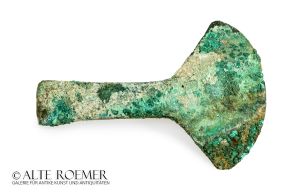 Ceremonial knife of the Sican culture
The so-called Tumi was a weapon to cut the throats of humans and animals in ritual sacrifices. The Tumi certainly fulfilled an additional representative function in the afterlife. From the period of the Sican's cultural florescence during the 10th to 12th centuries AD.
Price: on request Ceremonial knife of the Sican culture
The so-called Tumi was a weapon to cut the throats of humans and animals in ritual sacrifices. The knife certainly fulfilled an additional representative function in the afterlife. From the period of the Sican's cultural florescence during the 10th to 12th centuries AD.
Price: on request Large ceremonial knife of the Sican culture
The so-called Tumi was a weapon to cut the throats of humans and animals in ritual sacrifices. The knife certainly fulfilled an additional representative function in the afterlife. From the period of the Sican's cultural florescence during the 10th to 12th centuries AD.