
Tools - Palaeolithic - Northern Europe - Photo gallery
Image database with photographs of ancient art and antiquities
Our image database provides photographs of ancient art and antiquities for press releases as well as for private use. All artefacts sold in our gallery are documented through professional photographs. The resulting image library contains numerous ancient Egyptian, Greek and Roman antiquities as well as ancient coins. The time span from Stone Age, over Bronze Age and Classical Antiquity until Late Antiquity is covered.The photo gallery aims at providing a vast visual archive equipped with filters and search tools. You are most welcome to search the constantly growing number of artefacts in the image library. We are also happy to authorize hyperlinks from your webpage / forum to the objects depicted in our gallery. For this purpose, please send us a short notification prior to placing a hyperlink. For almost every object high definition photographs are available and can be provided e.g. to document your collection or for scientific papers or popular science articles. If you are interested in using pictures for publications, print media or other purposes, please contact us and we will be happy to assist you.
-
 Faustkeil des Homo Erectus, Palöolithikum
Altsteinzeit, um 200.000 v. Chr. Deutliche Spuren grober Werkzeugbearbeitung durch Homo Erectus. Schweres Objekt mit dunkler Patina.
Price: on request Großer Faustkeil des Homo Erectus
Altsteinzeit, um 200.000 v. Chr. Deutliche Spuren grober Werkzeugbearbeitung durch Homo Erectus. Schweres Objekt mit dunkler Patina.
Price: on request Großer Faustkeil des Homo Erectus
Altsteinzeit, um 200.000 v. Chr. Deutliche Spuren grober Werkzeugbearbeitung durch Homo Erectus. Schweres Objekt mit dunkler Patina.
Price: on request Faustkeil des Homo Erectus, Palöolithikum
Altsteinzeit, um 200.000 v. Chr. Deutliche Spuren grober Werkzeugbearbeitung durch Homo Erectus. Schweres Objekt mit dunkler Patina.
Price: on request Paläolithisches Werkzeug, Neandertaler
Schön patiniertes Steinwerkzeug aus dem mittleren Paläolithikum. Bearbeitung durch Neandertaler, 60000 v. Chr. bis 40000 v. Chr.
Price: on request Großer Faustkeil des Homo Erectus
Altsteinzeit, um 200.000 v. Chr. Deutliche Spuren grober Werkzeugbearbeitung durch Homo Erectus. Schweres Objekt mit dunkler Patina.
Price: on request Großer Faustkeil des Homo Erectus
Altsteinzeit, um 200.000 v. Chr. Deutliche Spuren grober Werkzeugbearbeitung durch Homo Erectus. Schweres Objekt mit dunkler Patina.
Price: on request Schaber, Homo Neanderthalensis
Flintartefakt, mittleres Paläolithikum. Bearbeitung durch Neanderthaler, 60000 v. Chr. bis 40000 v. Chr.
Price: on request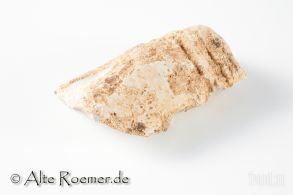 Schaber oder Messer, Homo Neanderthalensis
Flintartefakt, mittleres Paläolithikum. Bearbeitung durch Neanderthaler, 60000 v. Chr. bis 40000 v. Chr.
Price: on request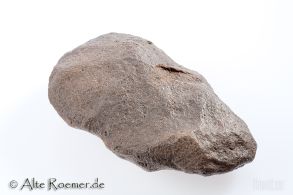 Paläolithische Handaxt des Homo Erectus
Altsteinzeit, um 200.000 v. Chr. Deutliche Spuren grober Werkzeugbearbeitung durch Homo Erectus. Schweres Objekt mit dunkler Patina.
Price: on request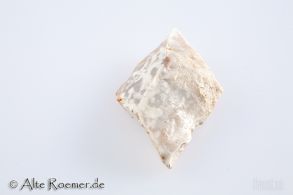 Geometrischer Stichel, Jungpaläolithikum
Seltenes Werkzeug aus dem Magdalénien, zum Ende der letzten Eiszeit. 16000 v.Chr. bis 10000 v.Chr., Mitteleuropa.
Price: on request Schaber, Homo Neanderthalensis
Schaber, mittleres Paläolithikum. Bearbeitung durch Neanderthaler, 60000 v. Chr. bis 40000 v. Chr.
Price: on request Paläolithische Handaxt des Homo Erectus
Altsteinzeit, um 200.000 v. Chr. Deutliche Spuren grober Werkzeugbearbeitung durch Homo Erectus. Schweres Objekt mit dunkler Patina.
Price: on request Paläolithische Handaxt des Homo Erectus
Altsteinzeit, um 200.000 v. Chr. Deutliche Spuren grober Werkzeugbearbeitung durch Homo Erectus. Schweres Objekt mit dunkler Patina.
Price: on request Messer, Homo Neanderthalensis
Messer, mittleres Paläolithikum. Bearbeitung durch Neandertaler, 60000 v. Chr. bis 40000 v. Chr.
Price: on request Messer, Homo Neanderthalensis
Messer, mittleres Paläolithikum. Bearbeitung durch Neandertaler, 60000 v. Chr. bis 40000 v. Chr.
Price: on request Schaber, Homo Neanderthalensis
Schaber, mittleres Paläolithikum. Bearbeitung durch Neandertaler, 60000 v. Chr. bis 40000 v. Chr.
Price: on request Hand axe from Galilee
Big paleolithic hand axe. The universal stone age tool could be use as a borer or cutting tool. Around 500,000 to 200,000 BC.
Price: on request Paleolithic hand axe
The universal tool of the older Stone age. It could be used as a borer or a cutter. Approx. 500,000 to 200,000 BC.
Price: on request Paleolithic hand axe of Homo Erectus
Big hand axe from Niger. Made during the Old Stone Age, around 200,000 years ago. The universal stone age tool could be use as a borer or cutting tool.
Price: on request Paleolithic hand axe
Small prehistoric stone tool. It was the universal tool of the older Stone age and could be used as a borer or a cutter. From a 100 year old museum collection.
Price: on request Stone Age bow scraper from Egypt
The Paleolithic tool is of beautiful shape and color. Thebes has been handed down as the place of origin. Including old museum display.
Price: on request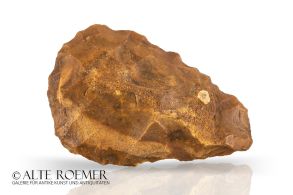 Paleolithic hand axe
Small prehistoric stone tool. It was the universal tool of the older Stone age and could be used as a borer or a cutter. From a 100 year old museum collection.
Price: on request Paleolithic hand axe
Prehistoric stone tool. It was the universal tool of the older Stone age and could be used as a borer or a cutter. From a Swiss museum collection. Found in Ouarzazate, Morocco.
Price: on request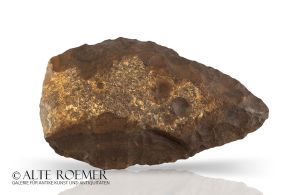 Paleolithic hand axe
Small prehistoric stone tool. It was the universal tool of the older Stone age and could be used as a borer or a cutter. From a 100 year old museum collection.
Price: on request Paleolithic hand axe
Prehistoric stone tool. It was the universal tool of the older Stone age and could be used as a borer or a cutter. From a Swiss museum collection. Found in Algeria, North Africa.
Price: on request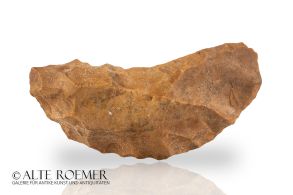 Stone Age bow scraper from Egypt
The Paleolithic tool is shaped like a sickle. Thebes has been handed down as the place of origin. From a 100 year old museum collection.
Price: on request Paleolithic hand axe
Prehistoric stone tool. It was the universal tool of the older Stone age and could be used as a borer or a cutter. From a Swiss museum collection. Found in Algeria, North Africa.
Price: on request Large Paleolithic hand axe
Prehistoric stone tool. It was the universal tool of the older Stone age and could be used as a borer or a cutter. From a Swiss museum collection. Found in Foggaret Ezzaouia, Algeria, North Africa.
Price: on request Paleolithic hand axe
Prehistoric stone tool. It was the universal tool of the older Stone age and could be used as a borer or a cutter. From a Swiss museum collection. Found in Erg Mehedjibat, Algeria, North Africa.
Price: on request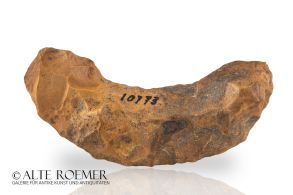 Stone Age bow scraper from Egypt
The Paleolithic tool is of beautiful shape and color. Thebes has been handed down as the place of origin. From an old museum collection.
Price: on request Paleolithic hand axe or borer
Prehistoric stone tool. It was the universal tool of the older Stone age and could be used as a borer or chisel. From a Swiss museum collection. Found in the Algerian Sahara desert.
Price: on request Large prehistoric hand axe
Massive Paleolithic stone tool. It was the universal tool of the older Stone age and could be used as a borer or a cutter. From a Swiss museum collection. Found in Algeria, North Africa.
Price: on request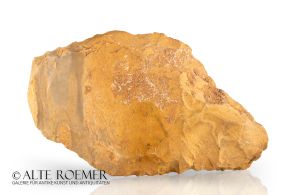 Paleolithic hand axe
Prehistoric stone tool. It was the universal tool of the older Stone age and could be used as a borer or a cutter. From a Swiss museum collection. Found in Morocco, North Africa.
Price: on request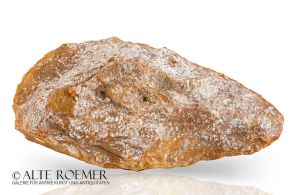 Huge Paleolithic hand axe
Prehistoric stone tool. It was the universal tool of the older Stone age and could be used as a borer or a cutter. From a Swiss museum collection. Found in Morocco, North Africa.
Price: on request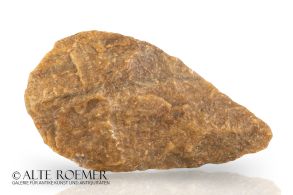 Large Paleolithic hand axe
Prehistoric stone tool. It was the universal tool of the older Stone age and could be used as a borer or a cutter. From a Swiss museum collection. Found in Erg Mehedjibat, Algeria, North Africa.
Price: on request