
Search results for: 'bei'
-
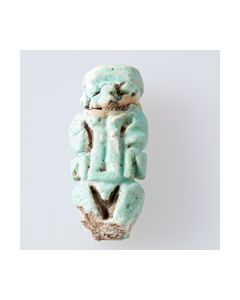 Ägyptische Patäke-Figur aus Fayence
Sehr seltene Patäken-Darstellung. Ein Mensch in Zwerggestalt, der als Gott oder Gottgleicher verehrt wurde. Schutzgott. 26. bis 30. Dynastie. Spätzeit.
Price: on request Isis-Amulett mit Horus
ägyptisches Amulett der sitzenden Isis mit Sohn Horus auf dem Schoß,blaugrüne Fayence, Kopf des Horus fehlt, ansonsten vollständig intakt. 24mm hoch.
Price: on request Faience figurine of Isis and Horus child
Goddess on a throne nursing her child Horus. Dating to the Late Period of ancient Egypt.
Price: on request Egyptian pataikos
God or god-like dwarf. The figurine was supposed to have a magical protective function. 26th to 30th dynasty of Ancient Egypt. From a British private museum.
Price: on request Egyptian amulet of a hare
This type of amulet was popular in the Late Dynastic Period of Ancient Egypt. It should endow its wearer with fertility and rapidity of movement. The piece was exhibited in an early 20th century private museum.
Price: on request Egyptian pataikos
God or god-like dwarf. The figurine was supposed to have a magical protective function. 26th to 30th dynasty of Ancient Egypt. From a British private museum.
Price: on request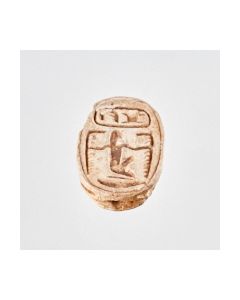 Scarab with god Heh and cartouche
Interesting motive showing the kneeling god of endlessness with palm stem in both hands. Above him the cartouche of pharao Mencheperre. Around the 18th dynasty of ancient Egypt.
Price: on request Egyptian faience figurine of the dwarf god pataikos
The figurine was supposed to have a magical protective function. 26th to 30th dynasty of Ancient Egypt. From a British private museum.
Price: on request Scarab with twisted cord
Scarab amulet with a twisted cord motive. Beautiful and well preserved piece from the Second Intermediate Period.
Price: on request Ägyptisches Amulett der Isis
Amulett aus Fayence mit Darstellung der Isis. Die Göttin trägt ein Gewand und eine dreigeteilte Perrücke, auf dem Kopf den Thronsitz. Spätzeit des Alten Ägyptens.
Price: on request Bronze statuette of nursing Isis
Isis is shown in a very typical depiction as a mother, the archetype of the later Christian Nursing Madonna. The bronze figurine dates to the 22nd to 31st dynasty of Ancient Egypt.
Price: on request Egyptian ushabti for Ra-mes
The mummiform funerary figurine dates to the Late Period of ancient Egypt, 26th to 31st dynasty. It is remarkable that it probably originates from the burial of two brothers, Ra-mes and Somtus-tefnacht.
Price: on request Ushabti for Ra-mes
The mummiform funerary figurine dates to the Late Period of ancient Egypt, 26th to 31st dynasty. It is remarkable that it probably originates from the burial of two brothers, Ra-mes and Somtus-tefnacht.
Price: on request Egyptian ushabti for Somtus-tefnacht
The mummiform funerary figurine dates to the Late Period of ancient Egypt, 26th to 31st dynasty. It is remarkable that it probably originates from the burial of two brothers, Somtus-tefnacht and Somtus-tefnacht.
Price: on request Egyptian ushabti for Somtus-tefnacht
The mummiform funerary figurine dates to the Late Period of ancient Egypt, 26th to 31st dynasty. It is remarkable that it probably originates from the burial of two brothers, Somtus-tefnacht and Somtus-tefnacht.
Price: on request Egyptian ushabti for Somtus-tefnacht
The mummiform funerary figurine dates to the Late Period of ancient Egypt, 26th to 31st dynasty. It is remarkable that it probably originates from the burial of two brothers, Somtus-tefnacht and Somtus-tefnacht.
Price: on request Ushabti for Somtus-tefnacht
The mummiform funerary figurine dates to the Late Period of ancient Egypt, 26th to 31st dynasty. It is remarkable that it probably originates from the burial of two brothers, Somtus-tefnacht and Somtus-tefnacht.
Price: on request Egyptian ushabti for Somtus-tefnacht
The mummiform funerary figurine dates to the Late Period of ancient Egypt, 26th to 31st dynasty. It is remarkable that it probably originates from the burial of two brothers, Somtus-tefnacht and Somtus-tefnacht.
Price: on request Egyptian ushabti for Somtus-tefnacht
The mummiform funerary figurine dates to the Late Period of ancient Egypt, 26th to 31st dynasty. It is remarkable that it probably originates from the burial of two brothers, Somtus-tefnacht and Somtus-tefnacht.
Price: on request Egyptian ushabti for Somtus-tefnacht
The mummiform funerary figurine dates to the Late Period of ancient Egypt, 26th to 31st dynasty. It is remarkable that it probably originates from the burial of two brothers, Somtus-tefnacht and Somtus-tefnacht.
Price: on request Egyptian scarab with papyrus plants
Scarab amulet made of bright, almost white steatite. 13th to 15th dynasty. This scarab is described in the catalogue of Irène Gautier-Vodoz.
Price: on request Scarab with scarab motive
The stamp side shows a scarab with two uraeus snakes. This scarab is described in the catalogue of Irène Gautier-Vodoz.
Price: on request Small scarab amulet with Isis hieroglyphs
The tiny amulet dates to the New Kingdom. It bears the glyphs for the goddess Isis. This scarab is described in the catalogue of Irène Gautier-Vodoz.
Price: on request Scaraboid with twisted cord
Scaraboid seal amulet with a twisted cord motive. This scarab is described in the catalogue of Irène Gautier-Vodoz.
Price: on request Scaraboid with Red Crowns of Lower Egypt
The hieroglyphs on the lower side symbolize the rule over Lower Egypt. The rising sun is symbolized above. This scaraboid is described in the catalogue of Irène Gautier-Vodoz.
Price: on request Ramesside Scarab
Egyptian scarab from the 19th to 20th dynasty. With horse and hieroglyphs.
Price: on request Scarab with inscription Amun Re
Interesting scarab from the New Kingdom. With hieroglyphs reading Amun Re, main god of Theben, and lotus flower.
Price: on request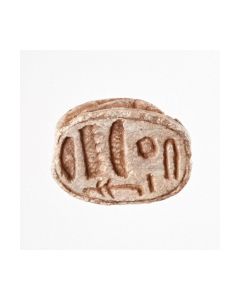 Scarab with inscription
The lower side bears a hieroglyph inscription. Nice piece from the Freemark collection. New Kingdom.
Price: on request Scarab with cross symbol
A piece from the Ramesside Period to the early Third Intermediate Period of ancient Egypt. Great early 20th century provenance.
Price: on request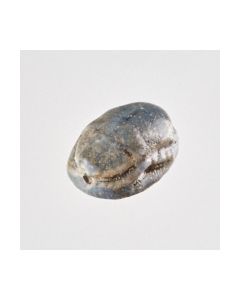 Scarab with blue fayence glaze
The piece is from the Third Intermediate Period or the Late Period of ancient Egypt. The inscription refers to Amun-Re, the main god of Theben. The glaze is shining in vivid blue colour.
Price: on request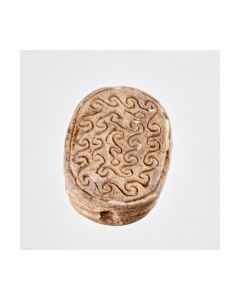 Scarab with spiral design and symbol for good luck
The Egyptian scarab from the Second Intermediate Period is decorated with a geometrical pattern. A nefer hieroglyph stands for good luck.
Price: on request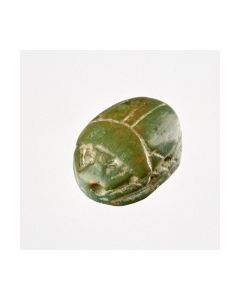 Scarab with Amun inscription
Bearing the hieroglyphs "the god Amun of Theben is lord". From the Late Period of ancient Egypt. Beautiful green stone.
Price: on request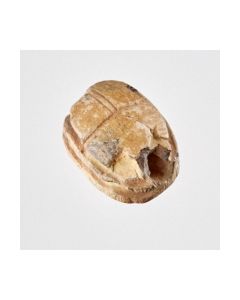 Egyptian Scarab with hieroglyphs
Interesting scarab made of steatit with inscription for Amun. Dating to the 19th to 21st dynasty of ancient Egypt.
Price: on request Scarab with geometric motive
The lower side exhibits a symmetrical arrangements of cords, two of which are wrapped around each other. This scarab is described in the catalogue of Irène Gautier-Vodoz.
Price: on request Egyptian ushabti for Ra-mes
The mummiform funerary figurine dates to the Late Period of ancient Egypt, 26th to 31st dynasty. It is remarkable that it probably originates from the burial of two brothers, Ra-mes and Somtus-tefnacht.
Price: on request Egyptian tomb relief from Memphis
The flat relief shows an offering scene and above a hieroglyphic text describing the deceased Ptah-nefer, the priest and the offerings. A translation has been made by the renowned Egyptologist professor Kurth. The work of art dates to the 26th dynasty. It is adopting the style of the Old Kingdom.
Price: on request