
Search results for: 'bei'
-
 Egyptian ushabti for Ra-mes
The mummiform funerary figurine dates to the Late Period of ancient Egypt, 26th to 31st dynasty. It is remarkable that it probably originates from the burial of two brothers, Ra-mes and Somtus-tefnacht.
Price: on request Egyptian tomb relief from Memphis
The flat relief shows an offering scene and above a hieroglyphic text describing the deceased Ptah-nefer, the priest and the offerings. A translation has been made by the renowned Egyptologist professor Kurth. The work of art dates to the 26th dynasty. It is adopting the style of the Old Kingdom.
Price: on request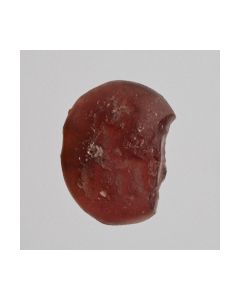 Roman intaglio with Minerva
The intaglio depicts the goddess from etrusco-italic mythology sitting on a throne with her shield. Minerva was the protector of the crafts and commerce.
Price: on request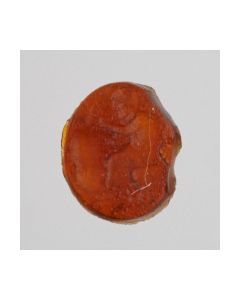 Roman intaglio with craftsman
The ancient intaglio from Roman times shows an elderly man who is working an oval shield with a hammer. It is an interesting representation of a craftsman at work.
Price: on request Domitian denarius - from an old collection founded by Prussian Prince Karl's personal physician in the 19th century
Vorzüglich, exzellente Portraitdetails. RIC II (Neuauflage) R = rare (selten). Aus Generationensammlung, vom Leibarzt des Prinzen Karl von Preußen im 19. Jh. begründet.
Price: on request Published funerary relief of Hermes from Palmyra
Grabrelief eines bärtigen Mannes aus Palmyra mit Inschrift, diese besagt „Bildnis des Hermes. Wehe!“. Museales Stück.
Price: on request Cylinder seal with wrestling scene
Stunning white seal made of shell. Mesopotamian Early Dynastic Period III.
Price: on request Mesopotamian cylinder seal
Seal made of white stone with depiction of scorpions. Late Uruk to early Jamdat Nasr period.
Price: on request Mesopotamian cylinder seal
White cylinder seal dating to the Akkadian period. A mythological scene is engraved into the cylindrical body.
Price: on request Early Old Babylonian cylinder seal
Cylinder seal made of black rock. It bears a religious scene dating shortly prior to or right at the beginnings of Old Babylonia.
Price: on request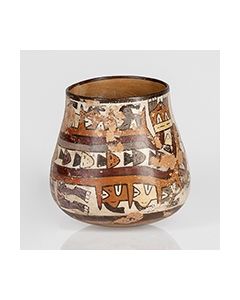 Beaker of the Nazca culture
Elegant vessel made by the precolumbian Nazca culture. The outside is decorated by a polychrome szene of geometric patterns and abstractions of animals and faces.
Price: on request Very large cypriot bowl
Dating to the early cypro-archaic period, so-called black-on-red ware II. From an old German private collection. Coming with an ArtLoss certificate.
Price: on request Large published Cypriot amphora
Very large, impressively preserved object. From an old German private collection, acquired at London art gallery or auction around 1970. Coming with an ArtLoss certificate.
Price: on request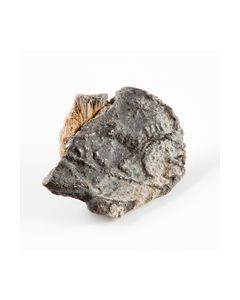 Siegelabdruck mit Resten von Flachs
Abdruck eines Siegels in Blei mit schreitendem Löwen, darüber ein Stern. Hellenistische Zeit, 2. Jh. v. Chr., aus Miletos. Außerordentlich selten ist der erhaltene Rest von antikem Flachs!
Price: on request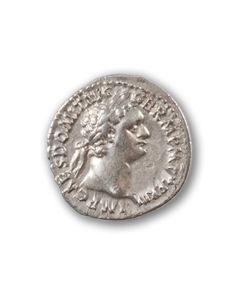 Denar des Domitian - Minerva mit Blitzbündel
Rom, 93 - 94 n. Chr. Revers: Minerva steht n. l., hält Speer und Blitzbündel, zu Füßen Schild. Fast vz, ausdrucksstarkes Portrait. Exzellente Reversdetails vom Blitzbündel und Schild.
Price: on request Bronzezeitliche Teekanne
Seltener, kugelförmiger Gefäßtyp mit kurzem Hals und Ausguss. Wichtiger Vorläufertyp für die Keramiken der kommenden Jahrhunderte. 2250 v. Chr. bis 1800 v. Chr. Fund aus Palästina.
Price: on request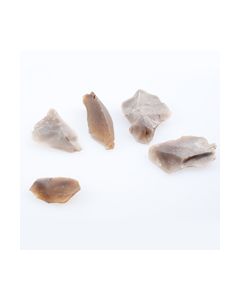 Steinwerkzeuge, Trichterbecher-Kultur
Gruppe von 5 deutlich bearbeiteten Steinwerkzeugen. Um 3400 v. Chr., von einem Wohnplatz der Älteren Trichterbecher-Kultur, Frühneolithikum (Fuchsbergstufe).
Price: on request Steinwerkzeuge, Trichterbecher-Kultur
Gruppe von 5 deutlich bearbeiteten Steinwerkzeugen. Um 3400 v. Chr., von einem Wohnplatz der Älteren Trichterbecher-Kultur, Frühneolithikum (Fuchsbergstufe).
Price: on request Applique of the Horus son Duamutef
Bright turquise fayence. Duamutef is one of the four sons of Horus, well-known from the Canopic jars. He had an important protective function for the dead. Egypt, 8th to 4th cent. BC.
Price: on request Scarab with cartouche
Amulet from the Late Period. The stamp is in great condition. This scarab is described in the catalogue of Irène Gautier-Vodoz.
Price: on request Scarab with two cartouches of Thutmose III.
Interesting amulet from the New Kingdom or a later period made in archaic style. This scarab is described in the catalogue of Irène Gautier-Vodoz.
Price: on request Scarab from the Second Intermediate Period
The lower side shows a scarab, flanked by two uraeus snakes. 13th to 15th dynasty of ancient Egpyt. This scarab is described in the catalogue of Irène Gautier-Vodoz.
Price: on request Scarab with hieroglyphs arranged in a pattern
The lower side is skillfully decorated with hieroglyphs forming a geometric pattern. This scarab is described in the catalogue of Irène Gautier-Vodoz.
Price: on request Scarab with the Red Crown of Lower Egypt
The scene can be seen as worship of the Deshret, the symbol of the kings of Lower Egypt during Hyksos times. An interesting piece of evidence of the Hyksos rule over Egypt.
Price: on request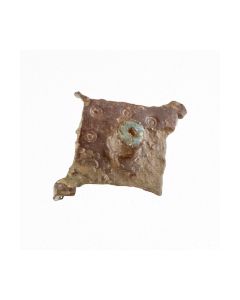 Roman fibula from the Richard Hattatt collection
Lozenge-shaped ancient roman fibula. The piece is published in the standard work "Iron Age and Roman Brooches". Found in Britain.
Price: on request Scarab with geometric motive
The lower side exhibits wrapped cords. A nice example of Egyptian art during the Second Intermediate Period. This scarab is described in the catalogue of Irène Gautier-Vodoz.
Price: on request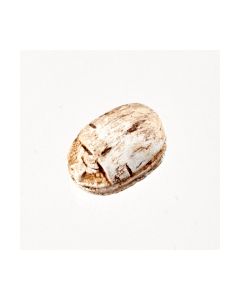 Scarab with lotus motive
Ancient Egyptian amulet seal with beautiful motive. Six lotus flowers are forming volutes. This scarab is described in the catalogue of Irène Gautier-Vodoz.
Price: on request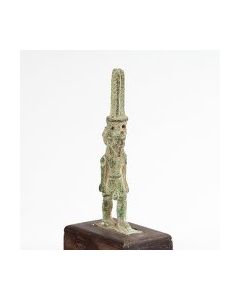 Egyptian bronze figurine of Nefertem
A major cult in Memphis saw the god related to fragrances. He is depicted here as youthful god in human form. Nice piece from the Late Period of ancient Egypt.
Price: on request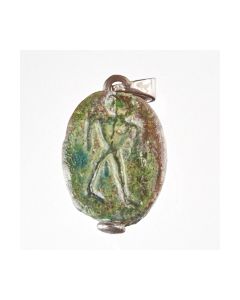 Scarab with standing figure
The scarab amulet dates to the Late Period. The lower side shows a stading figure, possibly the goddess Neith.
Price: on request Scarab with sphinx and Maat
The piece from the Ramesside period shows the goddess of truth and justice. Next to her is a name, probably that of pharao Mencheperre, who is famous as Thutmosis III.
Price: on request Cypriot bowl from the famous Severis collection
Perfectly preserved piece with very vivid bichrome decoration. Ex Christie's.
Price: on request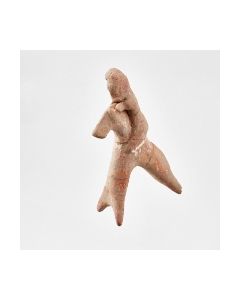 Published Parthian clay horse and rider
The clay figurine probably originates in Syria. It dates to achaemenide to parthian times. 6. cent. BC to 2nd cent. AD.
Price: on request Scarab with pharao on throne
The piece dates to the Third Intermediate Period and was probably produced in Tanis. It shows a pharao with a subordinate.
Price: on request Roman fibula from the Richard Hattatt collection
Lozenge-shaped ancient roman fibula. The piece is published in the standard work "Iron Age and Roman Brooches". Found in Norfolk, England.
Price: on request Small socketed axe head from the late Bronze Age
Bronzezeitlicher Beilkopf mit vierkantigem Querschnitt. Schön erkennbarer Grat von der Herstellung in einer Gussform. Ringöse an der Seite. Späte Bronzezeit.
Price: on request Impressive neolithic type I dagger
Wunderschön patinierter bifazieller Dolch aus rötlichem Flint. 18cm lang. Endneolithikum, Fund aus Dänemark.
Price: on request