
Search results for: 'Mittelalter'
-
 Bowl of the Ica culture
Appealing pottery made by the precolumbian Ica culture and decorated with a linear pattern. Around 1000 AD.
Price: on request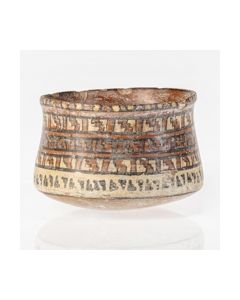 Bowl of the Ica culture
Colourfully painted pottery made by the precolumbian Ica culture. Nicely decorated by five rows of ornamentation. Around 1000 AD.
Price: on request Jaguar vessel of the Guanacaste-Nicoya peoples
The imposing vessel shows not just a jaguar but a transformed shaman in his animal form. It was made in Pre-Columbian Mesoamerica between 800 and 1200 AD and used for funeral purposes in the Guanacaste region.
Price: on request Bowl of the Chancay culture
Thin-walled pottery bowl with abstract painting. The pre-Columbian art of the Chancay seems simple at first, but radiates an elegance that still seems modern today.
Price: on request Bowl of the Chancay culture
Flat pottery bowl with abstract painting. The pre-Columbian art of the Chancay seems simple at first, but radiates an elegance that still seems modern today.
Price: on request Gourd shaped bowl of the Chimú culture
Elegant bowl with shiny black surface. Precolumbian pottery of the 10th to 15th century.
Price: on request Large ceremonial knife of the Sican culture
The so-called Tumi was a weapon to cut the throats of humans and animals in ritual sacrifices. The knife certainly fulfilled an additional representative function in the afterlife. From the period of the Sican's cultural florescence during the 10th to 12th centuries AD.
Price: on request Bowl of the Chancay culture
Thin-walled pottery bowl with abstract painting. The pre-Columbian art of the Chancay seems simple at first, but radiates an elegance that still seems modern today.
Price: on request Ceremonial knife of the Sican culture
The so-called Tumi was a weapon to cut the throats of humans and animals in ritual sacrifices. The knife certainly fulfilled an additional representative function in the afterlife. From the period of the Sican's cultural florescence during the 10th to 12th centuries AD.
Price: on request Bowl of the Chancay culture
Thin-walled pottery bowl with abstract painting and plastic animal head handles. The pre-Columbian art of the Chancay seems simple at first, but radiates an elegance that still seems modern today.
Price: on request Small ceremonial knife of the Sican culture
The so-called Tumi was a weapon to cut the throats of humans and animals in ritual sacrifices. The knife certainly fulfilled an additional representative function in the afterlife. From the period of the Sican's cultural florescence during the 10th to 12th centuries AD.
Price: on request Bowl of the Chancay culture
Flat pottery bowl with abstract painting. The pre-Columbian art of the Chancay seems simple at first, but radiates an elegance that still seems modern today.
Price: on request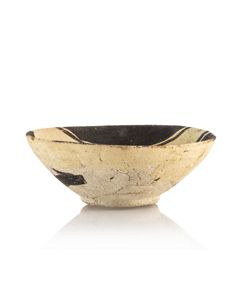 Bowl of the Chancay culture
Flat pottery bowl with abstract painting on the inside. The pre-Columbian art of the Chancay seems simple at first, but radiates an elegance that still seems modern today.
Price: on request Manabí-Perle aus dem präkolonialen Südamerika - Jaguar
Präinkazeit und Präkolonialzeit, 500 n. Chr. bis 1500 n. Chr. Darstellung eines Jaguars in Ritztechnik. Eindrucksvolle Bearbeitung.
Price: on request Manabí-Perle aus dem präkolonialen Südamerika - Seevogel
Präinkazeit und Präkolonialzeit, 500 n. Chr. bis 1500 n. Chr. Darstellung eines Seevogels in Ritztechnik. Eindrucksvolle Bearbeitung.
Price: on request Ceremonial knife of the Sican culture
The so-called Tumi was a weapon to cut the throats of humans and animals in ritual sacrifices. The Tumi certainly fulfilled an additional representative function in the afterlife. From the period of the Sican's cultural florescence during the 10th to 12th centuries AD.
Price: on request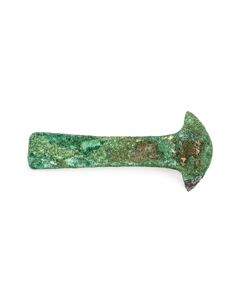 Ceremonial knife of the Sican culture
The so-called Tumi was a weapon to cut the throats of humans and animals in ritual sacrifices. The knife certainly fulfilled an additional representative function in the afterlife. From the period of the Sican's cultural florescence during the 10th to 12th centuries AD.
Price: on request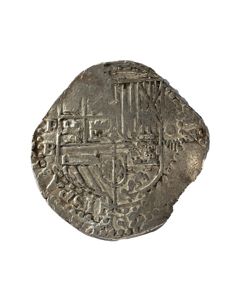 8 Reales, also known as cob coin, piece of eight or pirate money
Potosi, Bolivia. Very fine, rare quality and preservation for a cob coin.
Price: on request 8 Reales, also known as cob coin, piece of eight or pirate money
Potosi, Bolivia. Very fine, nice quality and preservation for a cob coin.
Price: on request Münze zu 8 Reales - "Piece of eight", auch bekannt als "Piratengeld"
Sevilla, Philipp IV, 1621-65 n. Chr. Außergewöhnlich gute Erhaltung. Unsterblich gemacht in Stevensons Meisterwerk "Die Schatzinsel".
Price: on request Münze zu 8 Reales - "Piece of eight", auch bekannt als "Piratengeld"
Mexiko Stadt, Philipp III, um 1610 n. Chr. Außergewöhnlich gute Erhaltung. Unsterblich gemacht in Stevensons Meisterwerk "Die Schatzinsel".
Price: on request Münze zu 8 Reales - "Piece of eight", auch bekannt als "Piratengeld"
Potosi (Bolivien), Philipp III, 1598 - 1621 n. Chr. Erhaltung: sehr schön. Unsterblich gemacht in Stevensons Meisterwerk "Die Schatzinsel".
Price: on request Exceptionally well minted 8 Reales coin
Potosi, Bolivia, ca. 1st half 17th century AD. This type of coins is also known as cob coins, pieces of eight or pirate money
Price: on request 8 Reales, also known as cob coin, piece of eight or pirate money
Potosi, Bolivia. Very fine, nice quality and preservation for a cob coin. This type of coins is also known as pieces of eight or pirate money
Price: on request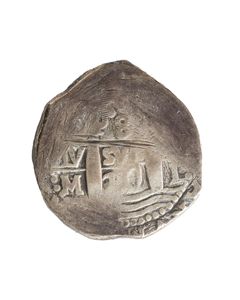 Rare 8 Reales cob coin
Lima, struck 1717 under Philipp V. Very fine, nice quality and preservation for a cob coin. Also known as piece of eight or pirate money.
Price: on request 8 Reales, also known as cob coin, piece of eight or pirate money
Charles II, Potosi (Bolivia) 1687. Very fine, great patina. Nice quality and preservation for a cob coin.
Price: on request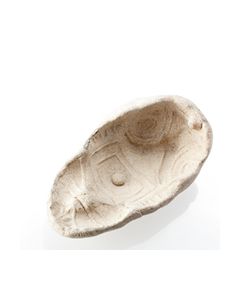 Maya-Kultur - Gussform für Fabelwesen
Die Form ergibt ein stilisiertes Tier oder ein Fabelwesen. Rückseite flach. Etwa 300 n. Chr. bis 900 n. Chr.
Price: on request Bikonische Schale, Colima
Keramik mit bichromer Glasur und interessanter bikonischer Form. 16,5cm Durchmesser. 200 v. Chr. bis 200 n. Chr. Prä-Inka und Prä-Kolonialzeit.
Price: on request Artefakt der Maya-Zivilisation aus der Präkolonialzeit
Kegelförmiger Körper, an Spitze fortgesetzt zu tailliertem Hals. Außenfläche mit Dekor aus weißen Punkten. 300 n. Chr. bis 900 n. Chr.
Price: on request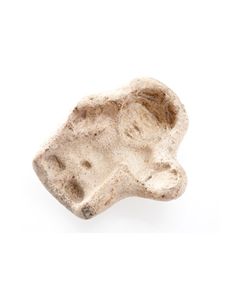 Maya-Kultur - Gussform für männliche Figur
Form ergibt eine gedrungene männliche Figur mit erhobener Hand und angedeutetem Phallus. Deutliche Gesichtszüge und Kopfbedeckung.
Price: on request Polychrom Maye pottery with zoomorph decorations
Zoomorphe Dekoration. 600 n. Chr. bis 900 n. Chr., späte Klassik der Maya-Zivilisation. Mittelamerika, Honduras. Museumswürdige Erhaltung, beeindruckende 33cm Durchmesser.
Price: on request Pre-Columbian gold earrings from Colombia
Matching pair of gold earrings from the Zenú culture. Dating to the 1st millennium. Impressive gold jewellery, once worn as earrings by the Zenú people.
Price: on request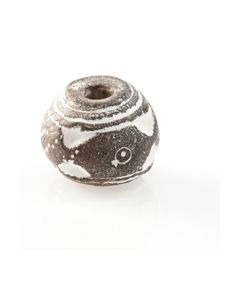 Perle der Manabí-Kultur aus der Prä-Inka-Zeit Ecuadors
500 n. Chr. bis 1500 n. Chr., Präinkazeit und Präkolonialzeit. Bichrome Tonperle mit geometrischem Dekor.
Price: on request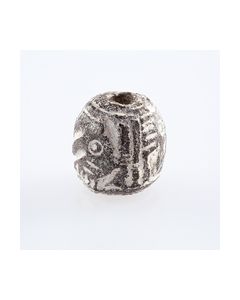 Perle der Manabí-Kultur aus Ecuador
500 n. Chr. bis 1500 n. Chr., Präinkazeit und Präkolonialzeit. Bichrome Tonperle mit kunstvoller Miniaturszene, dargestellt ist ein Pelikan.
Price: on request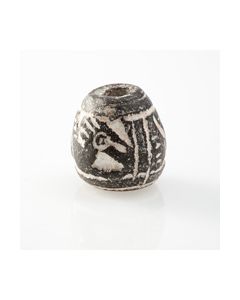 Perle der Manabí-Kultur aus der Prä-Inka-Zeit Ecuadors
500 n. Chr. bis 1500 n. Chr., Präinkazeit und Präkolonialzeit. Bichrome Tonperle mit kunstvoller Miniaturszene, dargestellt ist ein Fischreiher.
Price: on request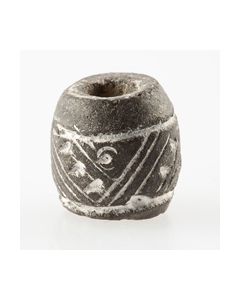 Perle der Manabí-Kultur aus der Prä-Inka-Zeit Ecuadors
500 n. Chr. bis 1500 n. Chr., Präinkazeit und Präkolonialzeit. Bichrome Tonperle mit kunstvoller Miniaturszene. Die Perle trägt ein abstraktes geometrisches Dekor.
Price: on request