
Search results for: 'Ass'
-
 Roman glass flask
Flask with voluminous body from the Late Roman period. A piece from the professor Ritschel collection.
Price: on request Roman glass cup
Glass vessel dating to the 1st century AD. Beautiful iridescent patina. From the professor Ritschel collection.
Price: on request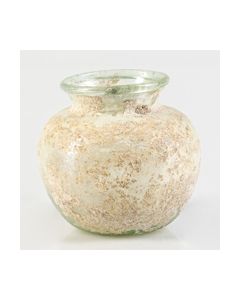 Spherical roman glass jar
The small glass from Roman Imperial times is a jar or beaker. From the professor Ritschel collection.
Price: on request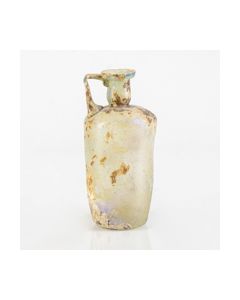 Roman glass bottle with handle
The cylindrical vessel has a nice iridescent patina. It was made in the Roman Imperial period.
Price: on request Late Roman glass flask
Very rare type of vessel from the 4th to 5th century AD. From the professor Ritschel collection.
Price: on request Roman glass bowl
Small bowl dating to the 2nd to 4th century AD. Perfect condition. From the professor Ritschel collection.
Price: on request Roman glass flask
Flask with voluminous body from the Late Roman period. A piece from the professor Ritschel collection.
Price: on request Roman glass bottle with handle
Wonderful perfectly preserved glass vessel from the Roman Imperial period. 1st to 2nd century AD.
Price: on request Early Islamic glass with spiral thread
A marvelous example for Early Islamic glass after the conquest of the Levant, during Umayyad rule. A glass from the professor Ritschel collection.
Price: on request Roman glass bowl
Delicate bowl dating to the 3rd to 4th century AD. Perfect condition. From the professor Ritschel collection.
Price: on request Mosaic glass inlay with floral motif
Skillfully arranged motif of lilies and palmettes. Made in Egypt during the early Roman Imperial period.
Price: on request Tear shaped roman glass flask
Elegant long flask from Roman Imperial times. Fantastic colourful iridescence.
Price: on request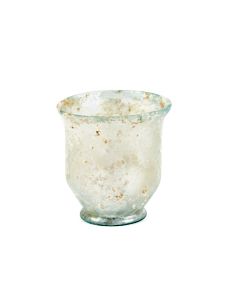 Roman glass beaker
Nice cup made of pale turquoise glass. Household item from the 1st to 3rd century.
Price: on request Neo-Assyrian seal with mythological creature
The octagonal stamp seal shows a hybrid creature and a priest. It originates from the Neo-Assyrian culture of the 8th to 7th cent. BC.
Price: on request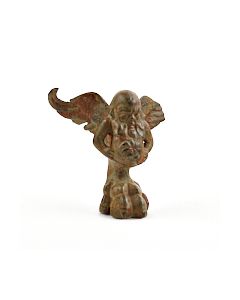 Massive hellenistic bronze figurine of a winged Silen
Originally probably used as foot for a cista. From an old German private collection, acquired 1978 in London at Davies Antiques Gallery.
Price: on request Roman glass insert for a pendant
Typical glass jewellery from one of the Eastern Mediterranean glass factories. This popular type was made with a motif stamped into each side of the glass disc. Late 4th to 5th century AD.
Price: on request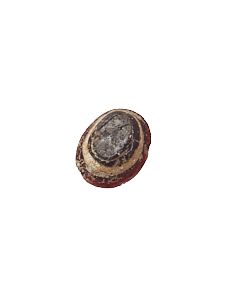 Roman glass insert for a fingerring
Banded glass imitating natural agate. The piece was once inserted into jewellery from the Roman Imperial period.
Price: on request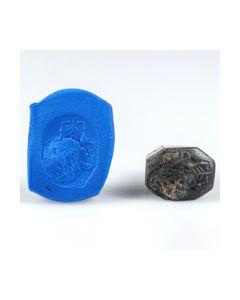 Neo-Assyrian stamp seal
The octagonal seal shows two hybrid creature around a tree of life. It originates from the Neo-Assyrian culture of the 8th to 7th cent. BC.
Price: on request Massive bronze figurine of a bull
Perfectly preserved, undamaged, with brown-green patina. Acquired 1978 at Davies Antiques Gallery, London.
Price: on request Roman glass fragments from the Rhineland
Fragments of glass vessels and rods, as well as two faience beads. Finds from the Roman city of Novaesium, today's Neuss in Germany.
Price: on request Roman-Egyptian spindle whorl from mosaic glass
Cone-shaped spindle whorl from the time of Roman rule over Egypt. The beautifully made mosaic glass weight is certainly a showpiece of every collection.
Price: on request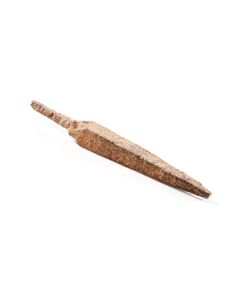 Massive antike Pfeilspitze aus Eisen
Quadratischer Querschnitt, massive Ausführung. Für Alter und Material sehr schwache Korrosion. 9. - 13. Jh. n. Chr.
Price: on request Römische Glasschale, ex-Sotheby's
Glasschale, wohl Trinknapf, aus der späten Kaiserzeit, 3. Jh. n. Chr. 140mm Durchmesser, aus durchscheinend-türkisfarbenem Glas. Perfekte Erhaltung.
Price: on request Sassanidisches Stempelsiegel mit Zebu und Mondsichel
Siegel aus schwarzem, opaken Stein. Stempel mit Darstellung eines stehenden Buckerinds. Darüber Mondsichel. 13mm Durchmesser, 11mm Höhe. Öse ca. 1,5mm Durchmesser. Aus der Sammlung Prof. H. Brosch (1923 bis 2009).
Price: on request
Sassanidisches Stempelsiegel mit stilisiertem SkorpionSiegel aus orangefarbenem, durchschimmernden Stein. Stempel mit durch Strichen stilisierter Darstellung eines Skorpions. 13mm lang, 12mm hoch, ca. 12mm Längsachse der Stempelfläche. Aus der Sammlung Prof. H. Brosch (1923 bis 2009).
Price: on request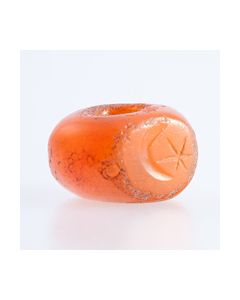 Sassanidisches Stempelsiegel mit Halbmond und Stern
Orangefarbener Karneol. Seltene Variante eines Emblem-Siegels. Hervorragender Zustand. Inklusive Stempelabdruck.
Price: on request Massive Keramikschale, Lausitzer-Kultur
Mittelgroße Schale aus dunkler Keramik. Massiv. Mit abgesetztem Standring. Oberer Rand mit Kerbdekor und zwei noppenartigen Erhebungen.
Price: on request Massives baktrisches Alabastergefäß
Zylindrische Ausführung. Schöne Steinmusterung mit mehreren parallel verlaufenden, polychromen Adern.
Price: on request Massive baktrische Schale aus Chlorit
Rundliches Schälchen aus Chlorit mit Standdiskus. Der Rand leicht nach innen gewölbt, unterhalb der Lippe mit drei tiefen, regelmäßig angeordneten Rillen verziert. 3. - 2. Jt. v. Chr.
Price: on request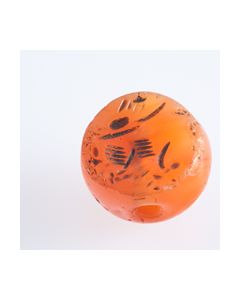 Sassanidisches Stempelsiegel aus orangem Karneol
Orangefarbener Karneol, der Stempel zeigt ein stilisiertes Tiermotiv. Guter Zustand. Inklusive Stempelabdruck. 224 n.Chr. bis 651 n. Chr.
Price: on request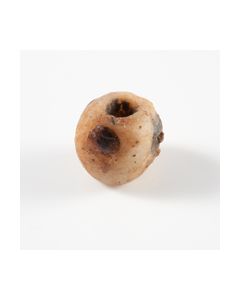 Massive hellenistische oder römische Mosaikperle
Runde Perle aus opakem Glas mit zentraler Bohrung. Minimale Abplatzungen, sonst perfekter Zustand, keine Risse.
Price: on request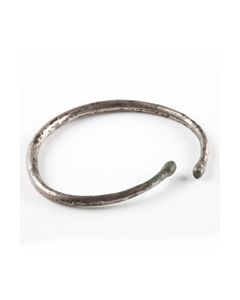 Massiver vorantiker Silberarmreif
Schwerer Armreif oder Fußreif aus Silber, Durchmesser ca. 112mm, Gewicht 105,7 Gramm. 2. bis 1. Jt. v. Chr., möglicherweise Lorestanisch.
Price: on request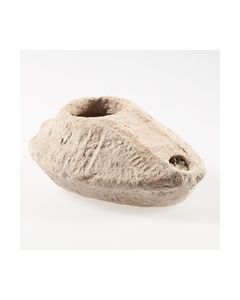 Massive spätsamaritanische Öllampe
Auf der Oberseite durch Doppellinie begrenzter Kanal. Mit Punkten, Linien und Tannenzweigen verziert.
Price: on request Massive antike Pfeilspitze aus Eisen
Quadratischer Querschnitt, verjüngt sich zur Spitze hin. Massiv. Für Alter und Material sehr schwache Korrosion. 9. - 13. Jh. n. Chr.
Price: on request Massive antike Pfeilspitze aus Eisen
Quadratischer Querschnitt, in der Mitte verjüngt. Massiv. Kulturkreis der Kidariten oder Hephthaliten, 5. - 7. Jh. n. Chr.
Price: on request Sassanidisches Stempelsiegel mit Tierdarstellung
Der Stempel zeigt ein stilisiertes Tier. Siegel aus weißlichem Chalcedon oder Achat. Hervorragender Zustand. Inklusive Stempelabdruck.
Price: on request