
Search results for: 'mit'
-
 Roman transport amphora found at Cabrera island
Perfectly preserved, large amphora from the Mediterranean sea. From an old German collection.
Price: on request Old Babylonian cuneiform tablet
Very nicely preserved clay tablet with cuneiform legal text from Old Babylonian times.
Price: on request Roman oil lamp showing Victoria in biga
A lamp with an identical motive is on exhibition in the NATIONAL WARSAW MUSEUM. Probably found in Trier in 1913
Price: on request Large roman terra sigillata jar from Tunisia
Impressive large vase from old German collection
Price: on request Massive Bronze Age spear head
Perfectly preserved, large piece with beautiful patina. From an old German collection.
Price: on request Massive Bronze Age spear head
Perfectly preserved, large piece with beautiful patina. From an old German collection.
Price: on request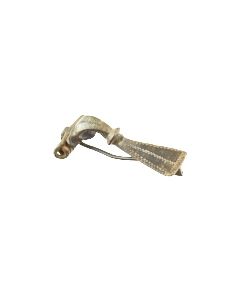 Roman fibula with decorated foot
This type of kraftig profilierte fibula has a nice trapezoidal foot with punch decor. It was popular in Central Europe during the 1st and 2nd century AD.
Price: on request Egyptian amulet of a hare
This type of amulet was popular in the Late Dynastic Period of Ancient Egypt. It should endow its wearer with fertility and rapidity of movement. The piece was exhibited in an early 20th century private museum.
Price: on request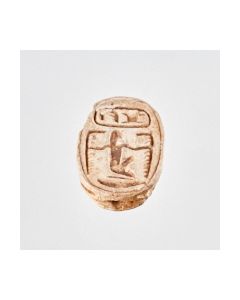 Scarab with god Heh and cartouche
Interesting motive showing the kneeling god of endlessness with palm stem in both hands. Above him the cartouche of pharao Mencheperre. Around the 18th dynasty of ancient Egypt.
Price: on request Scarab with twisted cord
Scarab amulet with a twisted cord motive. Beautiful and well preserved piece from the Second Intermediate Period.
Price: on request Stamped Roman tile found in Trier
The tile belongs to the ADIVTE/ADIVTICE group and was produced in the late 3rd or early 4th century AD. Found in Trier, Germany.
Price: on request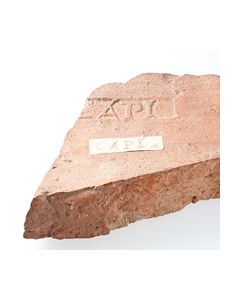 Stamped Roman tile found in Treves
Perfectly preserved with deeply carved stamp. From the CAPIONACI group.
Price: on request Interessanter Beilkopf aus dem späten Neolithikum
Bemerkenswert ist die grobe Bearbeitung ohne Politur, möglicherweise handelt es sich um ein unfertiges Werkstück. Etwa 2800 bis 2300 v. Chr.
Price: on request Münze zu 8 Reales - "Piece of eight", auch bekannt als "Piratengeld"
Mexiko Stadt, Philipp III, um 1610 n. Chr. Außergewöhnlich gute Erhaltung. Unsterblich gemacht in Stevensons Meisterwerk "Die Schatzinsel".
Price: on request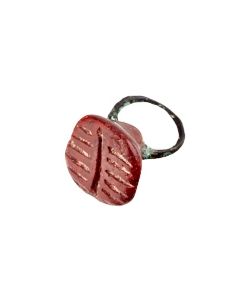 Anatolian porphyry stamp seal
Basic shape of a four sided pyramid. Made of wonderful intensely red stone. Middle Bronze Age of Anatolia.
Price: on request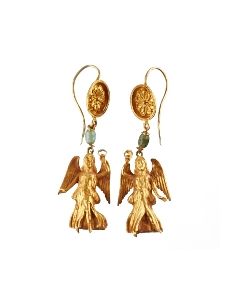 Gold earrings with Nike pendants
Greek hellenistic earring pair made of gold and emerald. Beautiful jewellery with granulated rosettes, emerald beads and plastic Nike statuettes. Including material analysis report.
Price: on request Large Roman mosaic of a capricorn hunt
Very large, perfectly preserved polychrome mosaic from a Jerusalem collection.
Price: on request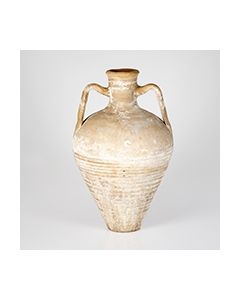 Roman transport amphora found at Cabrera island
Nicely preserved amphora from the Mediterranean sea. From an old German collection.
Price: on request Roman jar with flat handle
Perfectly preserved piece from a very old German collection.
Price: on request Roman jar from Lopodunum
Perfectly preserved piece from the 1st - early 2nd century AD. Found in Ladenburg, Baden-Wuerttemberg, Germany.
Price: on request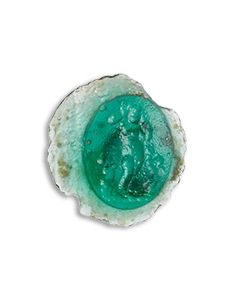 Roman intaglio in beautiful turquoise
The scene shows a standing Aphrodite surrounded by Erotes. Quality glass paste dating to Roman Imperial times.
Price: on request Rare plate brooch with millefiori enamel
Brooch from Roman Imperial time, found in Roman Britain. It is an extremely rare and interesting type. The brooch is published in Richard Hattatt's standard work "Ancient Brooches and Other Artefacts" and discussed in detail.
Price: on request Egyptian ushabti for Ra-mes
The mummiform funerary figurine dates to the Late Period of ancient Egypt, 26th to 31st dynasty. It is remarkable that it probably originates from the burial of two brothers, Ra-mes and Somtus-tefnacht.
Price: on request Ushabti for Ra-mes
The mummiform funerary figurine dates to the Late Period of ancient Egypt, 26th to 31st dynasty. It is remarkable that it probably originates from the burial of two brothers, Ra-mes and Somtus-tefnacht.
Price: on request Egyptian ushabti for Somtus-tefnacht
The mummiform funerary figurine dates to the Late Period of ancient Egypt, 26th to 31st dynasty. It is remarkable that it probably originates from the burial of two brothers, Somtus-tefnacht and Somtus-tefnacht.
Price: on request Egyptian ushabti for Somtus-tefnacht
The mummiform funerary figurine dates to the Late Period of ancient Egypt, 26th to 31st dynasty. It is remarkable that it probably originates from the burial of two brothers, Somtus-tefnacht and Somtus-tefnacht.
Price: on request Egyptian ushabti for Somtus-tefnacht
The mummiform funerary figurine dates to the Late Period of ancient Egypt, 26th to 31st dynasty. It is remarkable that it probably originates from the burial of two brothers, Somtus-tefnacht and Somtus-tefnacht.
Price: on request Egyptian scarab with papyrus plants
Scarab amulet made of bright, almost white steatite. 13th to 15th dynasty. This scarab is described in the catalogue of Irène Gautier-Vodoz.
Price: on request Scarab with scarab motive
The stamp side shows a scarab with two uraeus snakes. This scarab is described in the catalogue of Irène Gautier-Vodoz.
Price: on request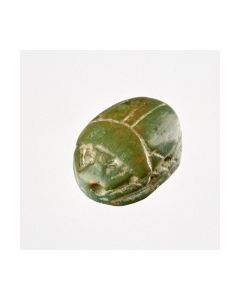 Scarab with Amun inscription
Bearing the hieroglyphs "the god Amun of Theben is lord". From the Late Period of ancient Egypt. Beautiful green stone.
Price: on request Spitznackiges Beil der Älteren Trichterbecherkultur
Spitzovales Längsprofil, grob bearbeitete Seiten, teilweise poliert. Typische für die Ältere Trichterbecherkultur, 4200 bis 3300 v. Chr.
Price: on request Egyptian ushabti for Ra-mes
The mummiform funerary figurine dates to the Late Period of ancient Egypt, 26th to 31st dynasty. It is remarkable that it probably originates from the burial of two brothers, Ra-mes and Somtus-tefnacht.
Price: on request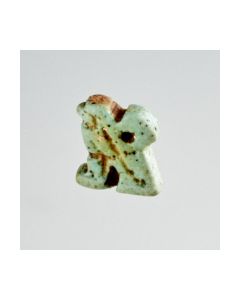 Egyptian amulet of a falcon
The falcon in Egyptian art can be a depiction of the god Horus or symbolize the soul of the pharao. Falcon amulets are known from the earliest times in Egyptian history. However this speicmen dates to the Late Dynastic Period of Ancient Egypt.
Price: on request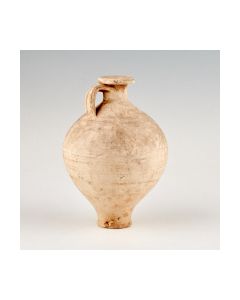 Large Roman jar from Lopodunum
Perfectly preserved piece from the second half of the 2nd century AD. Found in Ladenburg, Baden-Wuerttemberg, Germany.
Price: on request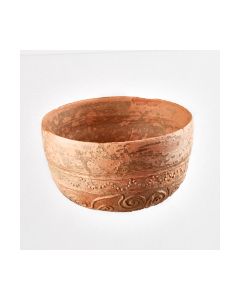 Megarian bowl with floral decoration
Nicely preserved piece from a private Columbus (Ohio, USA) collection
Price: on request Roman bronze statuette of Venus
Left arm and pigtail missing, otherwise perfectly preserved. From an Austrian collection, in this since the 1960s.
Price: on request