
Ancient Near East - Portraiture and sculpture - Sold antiquities
Archive of sold antiquities
All artefacts sold in our gallery are fully documented in our online archive and database. Being a specialist ancient art dealer, preserving also the more recent history of each and every piece sold in our shop is at our heart. That is particularly useful for artefacts that changed owners in the meantime. Information that may have been lost in the process can be easily restored from our archives. Please do not hesitate to contact us if you need further information about ancient items that have been sold in our gallery. We can help you with reconstructing the history of ownership for those items. All information about our customers will be kept confidential, of course.-
 Hittite bronze zebu figurine
Massive, perfectly preserved figurine with beautiful dark patina. Second to early first millenium BC. Ex Karl Kress auction 147 (May 5th 1969) Nr. 57.
Price: on request Bronze zebu figurine with pedestal
Nicely preserved bronze figurine. About 1st half 1st millenium BC. Iron Age culture, Western Asia.
Price: on request Hittite bronze zebu figurine
Massive, perfectly preserved figurine with beautiful dark patina. End of 2nd to early 1st millenium BC. Ex Karl Kress auction 147 (May 5th 1969) Nr. 54.
Price: on request Massive bronze panther figurine
Perfectly preserved with beautiful dark patina. End of 2nd to 1st half 1st millenium BC. Iron Age culture, Western Asia.
Price: on request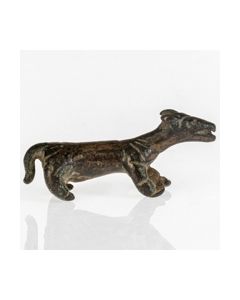 Massive bronze panther figurine
Perfectly preserved with beautiful dark patina. About 1st half 1st millenium BC. Iron Age culture, Western Asia.
Price: on request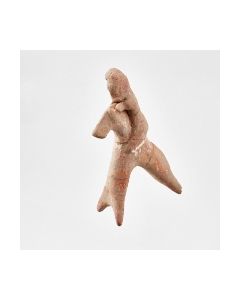 Published Parthian clay horse and rider
The clay figurine probably originates in Syria. It dates to achaemenide to parthian times. 6. cent. BC to 2nd cent. AD.
Price: on request Clay idol from Syria
Female figurine from Bronze Age Syria, 3rd to beginning of 2nd millenium BC. With characteristic bird shaped head.
Price: on request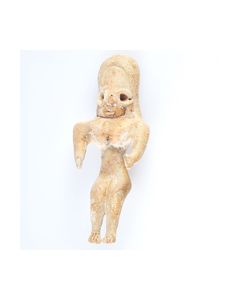 Idol der Harappa-Kultur
Sehr rares Zeugnis einer der ältesten Stadtkulturen der Menschheit. Keramik-Figur einer Göttin, um 2000 v. Chr.
Price: on request Weibliches Idol der Harappa-Kultur
Figur in perfektem Zustand. Volgeartiges Gesicht, aufwändiges Kollier mit Amulett um den Hals. Vermutlich aus Baluchistan. Um 2000 v. Chr.
Price: on request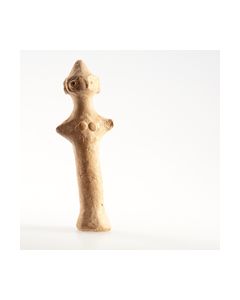 Baal-Figur, Levante
Götterfigur von der Levante, vermutlich Syrien. Bronzezeit, 3000 bis 1200 v. Chr. Seltenes Zeugnis einer frühen, bronzezeitlichen Religion.
Price: on request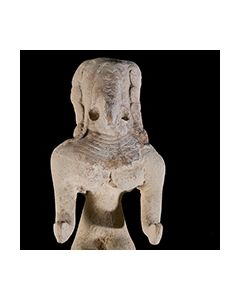 Idol - Figur der Harappa - Kultur
Sehr rares Zeugnis einer der ältesten Stadtkulturen der Menschheit. Keramik-Figur einer Göttin, 3. bis 2. Jt. v. Chr.
Price: on request Zoomorphe Tonfigur aus der Levanteregion
Abstrakte Ausführung, möglicherweise Antilope oder Gazelle. Wahrscheinlich rituelle Verwendung. Altersbedingt sehr gute Erhaltung.
Price: on request Tonfigur eines Stiers aus Belutschistan
Stilisierte Darstellung eines Stiers. 85 mm x 45 mm x 80 mm groß und fein gearbeitet. Dunkelroter Ton, 4. bis 2. Jt. v. Chr.
Price: on request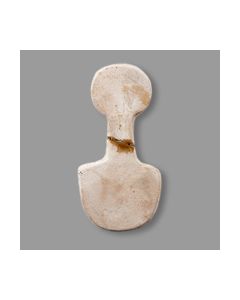 Idol vom Kusura-Typ
Idol aus weißem, feinkristallinem Marmor vom sogenannten Kusura-Typus. Aus der Bronzezeit Anatoliens, 3. Jt. v. Chr. Begutachtet durch Professor W. G. Lambert. Restauriert.
Price: on request Minoische Votivfigur in Form eines Hundes
Stehender Hund, der Kopf nach vorne gereckt, nach oben stehende Ohren. Orangefarbener Ton mit Resten eines roten Überzugs. Sehr gute Erhaltung.
Price: on request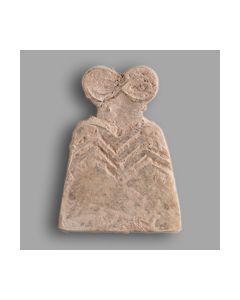 Syrisches Augenidol vom Tell Brak-Typ
Hervorragender Zustand mit schön erhaltener Oberfläche. Begutachtet durch Prof. Lambert, mit Notiz aus seiner Hand. Fund aus Tell Brak in den 1920er Jahren.
Price: on request Kusura-type idol from 3rd millenium BC Anatolia examined by Prof. Lambert
Idol aus weißem, feinkristallinem Marmor vom sogenannten Kusura-Typus. Aus der Bronzezeit Anatoliens, 3. Jt. v. Chr. Begutachtet durch Professor W. G. Lambert. Museumswürdig.
Price: on request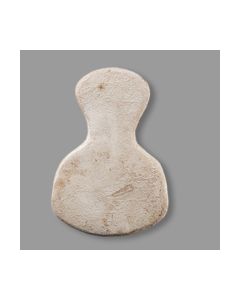 Kusura-type idol from 3rd millenium BC Anatolia examined by Prof. Lambert
Idol vom sogenannten Kusura-Typus, aus weißem, feinkristallinem Marmor. Bronzezeit Anatoliens, 3. Jt. v. Chr. Begutachtet durch Professor W. G. Lambert. Museumswürdig.
Price: on request