
Search results for: 'bei'
-
 Blauer Skarabäus aus Israel
Skarabäusförmiges Siegel aus türkiser Fayence. Stempelfläche mit Käfer-, Nefer- und Nebsymbolen. 7. Jh. v. Chr. bis 5. Jh. v. Chr.
Price: on request Skarabäus des Pharao Siamun
Skarabäusförmiges Siegel aus Israel. Stempelfläche mit hieroglyphischer Inschrift Siamun. 10. Jh. v. Chr.
Price: on request Tonstatuette des Harpokrates aus dem Fayum
Frontal dargestelter Kopf des Harpokrates mit Doppelkrone und Blumenkranz. Hohe Stirn, pausbäckiges Gesicht. Gut erhaltenes, massives Stück.
Price: on request Römischer Terra Sigillata Teller aus Sfax (Tunesien)
Teller mit schräg ansteigender Wandung und nach innen geneigter Lippe. Aus alter niederländischer Sammlung, aufgebaut in den 1950er-90er Jahren.
Price: on request Große ägyptische Bronzefigur der Sachmet
Eine wundervoll dunkel-patinierte Bronze der “Göttin des Zitterns ”, Sachmet, in beeindruckender Erhaltung. Vollständig erhalten mit erkennbaren feinen Details.
Price: on request Tonstatuette des Harpokrates aus dem Fayum
Nach rechts geneigter Kopf einer Harpokrates-Statuette. Sehr gut erhalten, detailliert und aufwendig gearbeitet.
Price: on request Lapis lazuli head of a pharao
Extremely rare finely carved royal head made of blue stone with bronze beard. Late Period to Ptolemaic period of ancient Egypt.
€3,450 Ägyptischer Skarabäus aus blauer Fayence
Ca 1000 v.Chr., 21. Dynastie, Dritte Zwischenzeit. Der Stempel zeigt ein Muster aus 10 Kreisen, Ober- und Unterseite vollständig und museal erhalten.
Price: on request Scarab of pharao Seti I.
The Egyptian scarab bears a hieroglyphic inscription which can be read as the name of pharao Seti I. From the Ramesside period, around 1300 BC.
Price: on request Scarab with geometric design
Lovely scarab with traces of turquoise fayence. From the Second Intermediate Period of ancient Egypt.
Price: on request Scarab with cartouche
The scarab amulet has a cartouche and neb on the bottom. 18th to 20th dynasty of ancient Egypt.
Price: on request Scarab with wishes
Nice scarab made of dark steatite. The hieroglyphs could be read as New Year's wishes.
Price: on request Clay figurine of an Orans from the Fayum
Aus dem Fayum. Kopf einer Frau mit rundem Gesicht, breiter Knollennase und wulstigem Hals. In den Ohren Löcher für Aufnahme von Ohrringen. Exzellent erhalten.
Price: on request Amulett des Bes aus der 18. Dynastie
Plastisches Relief des stehenden Gottes für Musik und Tanz. Bes war darüber hinaus auch Beschützer der Kinder und Schwangeren. Dieser Funktion diente vermutlich auch das Amulett.
Price: on request Große Sammlung von Münzen aus aller Welt
Insgesamt ca. 950 Stücke. Besonders hervorzuheben sind Reichspfennige, Belegstücke aus den beiden Weltkriegen und Kolonialprägungen.
Price: on request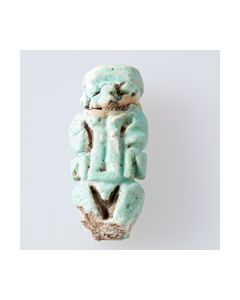 Ägyptische Patäke-Figur aus Fayence
Sehr seltene Patäken-Darstellung. Ein Mensch in Zwerggestalt, der als Gott oder Gottgleicher verehrt wurde. Schutzgott. 26. bis 30. Dynastie. Spätzeit.
Price: on request Isis-Amulett mit Horus
ägyptisches Amulett der sitzenden Isis mit Sohn Horus auf dem Schoß,blaugrüne Fayence, Kopf des Horus fehlt, ansonsten vollständig intakt. 24mm hoch.
Price: on request Faience figurine of Isis and Horus child
Goddess on a throne nursing her child Horus. Dating to the Late Period of ancient Egypt.
Price: on request Egyptian pataikos
God or god-like dwarf. The figurine was supposed to have a magical protective function. 26th to 30th dynasty of Ancient Egypt. From a British private museum.
Price: on request Egyptian amulet of a hare
This type of amulet was popular in the Late Dynastic Period of Ancient Egypt. It should endow its wearer with fertility and rapidity of movement. The piece was exhibited in an early 20th century private museum.
Price: on request Egyptian pataikos
God or god-like dwarf. The figurine was supposed to have a magical protective function. 26th to 30th dynasty of Ancient Egypt. From a British private museum.
Price: on request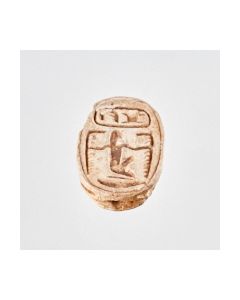 Scarab with god Heh and cartouche
Interesting motive showing the kneeling god of endlessness with palm stem in both hands. Above him the cartouche of pharao Mencheperre. Around the 18th dynasty of ancient Egypt.
Price: on request Egyptian faience figurine of the dwarf god pataikos
The figurine was supposed to have a magical protective function. 26th to 30th dynasty of Ancient Egypt. From a British private museum.
Price: on request Scarab with twisted cord
Scarab amulet with a twisted cord motive. Beautiful and well preserved piece from the Second Intermediate Period.
Price: on request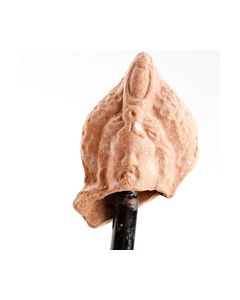 Clay figurine of Harpokrates from the Fayum
Exzellente Erhaltung. Sehr fein gearbeitetes Stück, auch kleine Details von Mimik und Kopfschmuck sind vollständig herausgearbeitet.
Price: on request Ägyptisches Amulett der Isis
Amulett aus Fayence mit Darstellung der Isis. Die Göttin trägt ein Gewand und eine dreigeteilte Perrücke, auf dem Kopf den Thronsitz. Spätzeit des Alten Ägyptens.
Price: on request Bronze statuette of nursing Isis
Isis is shown in a very typical depiction as a mother, the archetype of the later Christian Nursing Madonna. The bronze figurine dates to the 22nd to 31st dynasty of Ancient Egypt.
Price: on request Egyptian ushabti for Ra-mes
The mummiform funerary figurine dates to the Late Period of ancient Egypt, 26th to 31st dynasty. It is remarkable that it probably originates from the burial of two brothers, Ra-mes and Somtus-tefnacht.
Price: on request Ushabti for Ra-mes
The mummiform funerary figurine dates to the Late Period of ancient Egypt, 26th to 31st dynasty. It is remarkable that it probably originates from the burial of two brothers, Ra-mes and Somtus-tefnacht.
Price: on request Egyptian ushabti for Somtus-tefnacht
The mummiform funerary figurine dates to the Late Period of ancient Egypt, 26th to 31st dynasty. It is remarkable that it probably originates from the burial of two brothers, Somtus-tefnacht and Somtus-tefnacht.
Price: on request Egyptian ushabti for Somtus-tefnacht
The mummiform funerary figurine dates to the Late Period of ancient Egypt, 26th to 31st dynasty. It is remarkable that it probably originates from the burial of two brothers, Somtus-tefnacht and Somtus-tefnacht.
Price: on request Egyptian ushabti for Somtus-tefnacht
The mummiform funerary figurine dates to the Late Period of ancient Egypt, 26th to 31st dynasty. It is remarkable that it probably originates from the burial of two brothers, Somtus-tefnacht and Somtus-tefnacht.
Price: on request Ushabti for Somtus-tefnacht
The mummiform funerary figurine dates to the Late Period of ancient Egypt, 26th to 31st dynasty. It is remarkable that it probably originates from the burial of two brothers, Somtus-tefnacht and Somtus-tefnacht.
Price: on request Egyptian ushabti for Somtus-tefnacht
The mummiform funerary figurine dates to the Late Period of ancient Egypt, 26th to 31st dynasty. It is remarkable that it probably originates from the burial of two brothers, Somtus-tefnacht and Somtus-tefnacht.
Price: on request Egyptian ushabti for Somtus-tefnacht
The mummiform funerary figurine dates to the Late Period of ancient Egypt, 26th to 31st dynasty. It is remarkable that it probably originates from the burial of two brothers, Somtus-tefnacht and Somtus-tefnacht.
Price: on request Egyptian ushabti for Somtus-tefnacht
The mummiform funerary figurine dates to the Late Period of ancient Egypt, 26th to 31st dynasty. It is remarkable that it probably originates from the burial of two brothers, Somtus-tefnacht and Somtus-tefnacht.
Price: on request