
Search results for: 'bei'
-
 Bronze Age axe head
Very well preserved axe head. Late Bronze Age, 10th to 9th cent. BC.
Price: on request Celtic fibula
Rare fibula from the La Tène culture with beautiful enamel inlays. The main material is well preserved for an iron fibula.
Price: on request Scarab with twisted cord
Scarab amulet with a twisted cord motive. Beautiful and well preserved piece from the Second Intermediate Period.
Price: on request Ägyptisches Amulett der Isis
Amulett aus Fayence mit Darstellung der Isis. Die Göttin trägt ein Gewand und eine dreigeteilte Perrücke, auf dem Kopf den Thronsitz. Spätzeit des Alten Ägyptens.
Price: on request Kunstvoll verzierter Stilus
Römischer Wachstafelstift aus massiver Bronze. Hinten Ansatz für Radierungen. Hervorragender Zustand, originale Kette noch am Körper befestigt. 1. bis 3. Jh. n. Chr.
Price: on request Bronze Age Elamite ceramic vessel
Bowl from the Middle Elamite period with painted geometric design. From the area of ancient Iran.
Price: on request Bronze Age axe head
Very well preserved axe head. Late Bronze Age, 10th to 9th cent. BC.
Price: on request Bronze statuette of nursing Isis
Isis is shown in a very typical depiction as a mother, the archetype of the later Christian Nursing Madonna. The bronze figurine dates to the 22nd to 31st dynasty of Ancient Egypt.
Price: on request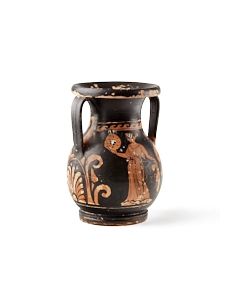 Perfectly preserved Apulian pelike
From the collection of Prof. Dr. Schmid, acquired 1977 at the Aloys Faust Gallery, Cologne. With ArtLoss Certificate.
Price: on request Egyptian ushabti for Ra-mes
The mummiform funerary figurine dates to the Late Period of ancient Egypt, 26th to 31st dynasty. It is remarkable that it probably originates from the burial of two brothers, Ra-mes and Somtus-tefnacht.
Price: on request Ushabti for Ra-mes
The mummiform funerary figurine dates to the Late Period of ancient Egypt, 26th to 31st dynasty. It is remarkable that it probably originates from the burial of two brothers, Ra-mes and Somtus-tefnacht.
Price: on request Egyptian ushabti for Somtus-tefnacht
The mummiform funerary figurine dates to the Late Period of ancient Egypt, 26th to 31st dynasty. It is remarkable that it probably originates from the burial of two brothers, Somtus-tefnacht and Somtus-tefnacht.
Price: on request Published cypriot milk bowl
1977 on exhibition in the Bielefeld Museum of Fine Arts. Nicely preserved piece, from an old German private collection, acquired prior to 1972. Coming with an ArtLoss certificate.
Price: on request Egyptian ushabti for Somtus-tefnacht
The mummiform funerary figurine dates to the Late Period of ancient Egypt, 26th to 31st dynasty. It is remarkable that it probably originates from the burial of two brothers, Somtus-tefnacht and Somtus-tefnacht.
Price: on request Egyptian ushabti for Somtus-tefnacht
The mummiform funerary figurine dates to the Late Period of ancient Egypt, 26th to 31st dynasty. It is remarkable that it probably originates from the burial of two brothers, Somtus-tefnacht and Somtus-tefnacht.
Price: on request Egyptian scarab with papyrus plants
Scarab amulet made of bright, almost white steatite. 13th to 15th dynasty. This scarab is described in the catalogue of Irène Gautier-Vodoz.
Price: on request Scarab with scarab motive
The stamp side shows a scarab with two uraeus snakes. This scarab is described in the catalogue of Irène Gautier-Vodoz.
Price: on request Ramesside Scarab
Egyptian scarab from the 19th to 20th dynasty. With horse and hieroglyphs.
Price: on request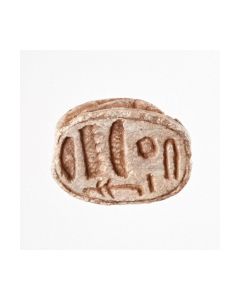 Scarab with inscription
The lower side bears a hieroglyph inscription. Nice piece from the Freemark collection. New Kingdom.
Price: on request Scarab with cross symbol
A piece from the Ramesside Period to the early Third Intermediate Period of ancient Egypt. Great early 20th century provenance.
Price: on request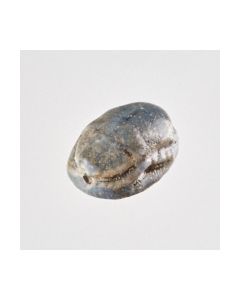 Scarab with blue fayence glaze
The piece is from the Third Intermediate Period or the Late Period of ancient Egypt. The inscription refers to Amun-Re, the main god of Theben. The glaze is shining in vivid blue colour.
Price: on request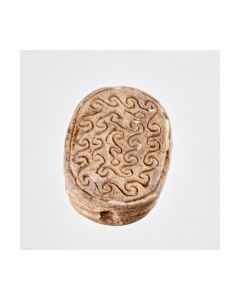 Scarab with spiral design and symbol for good luck
The Egyptian scarab from the Second Intermediate Period is decorated with a geometrical pattern. A nefer hieroglyph stands for good luck.
Price: on request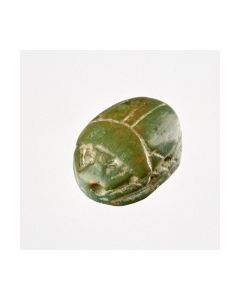 Scarab with Amun inscription
Bearing the hieroglyphs "the god Amun of Theben is lord". From the Late Period of ancient Egypt. Beautiful green stone.
Price: on request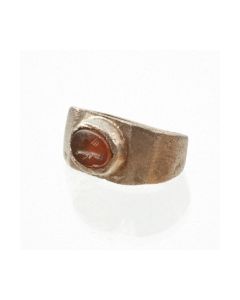 Roman silver wedding ring with intaglio showing dextrarum iunctio
Schönes Intaglio aus durchscheinend-rotem Karneol. Es zeigt die dextrarum iunctio, welche symbolisch für Verlobung oder Hochzeit steht. 16mm x 10mm Innenmaße. 3. Jh. n. Chr.
Price: on request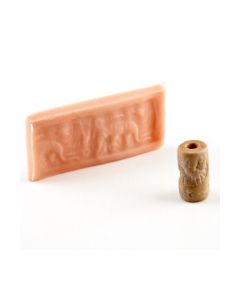 Cylinder seal from early dynastic Mesopotamia
Das frühdynastische Rollsiegel aus Mesopotamien zeigt eine Szene mit zwei Personen im Boot, eine davor stehende mit Stab. Es ist aus schönem karamellfarbenem Stein geschnitten. Mitte 3. Jt. v. Chr.
Price: on request Roman gold ring with beautiful intaglio
Hervorragend erhaltener Fingerring aus Gold mit hohler Ringschiene. Schönes Intaglio aus Karneol mit dem Treuesymbol dextrarum iunctio. 10mm x 8mm Innenmaße.
Price: on request Gladiatorenlampe aus der römischen Kaiserzeit - Fund aus Deutschland
Museales Stück. Erhabenes Spiegeldekor mit feinen Details, tiefer, gut lesbarer Stempel. Fund aus Region der Limeskastelle Pförring, Eining, Pfünz, Kösching und Weißenburg.
Price: on request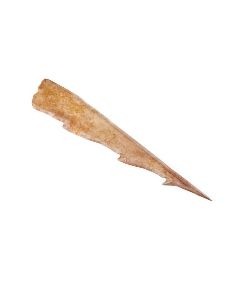 Harpoon of the Maglemosian culture
Fine craftsmanship hunting weapon. Important evidence of the beginnings of fishing in Northern Europe. Mesolithic, 9000 to 6500 BC.
Price: on request Egyptian ushabti for Ra-mes
The mummiform funerary figurine dates to the Late Period of ancient Egypt, 26th to 31st dynasty. It is remarkable that it probably originates from the burial of two brothers, Ra-mes and Somtus-tefnacht.
Price: on request Cylinder seal with wrestling scene
Stunning white seal made of shell. Mesopotamian Early Dynastic Period III.
Price: on request Early Old Babylonian cylinder seal
Cylinder seal made of black rock. It bears a religious scene dating shortly prior to or right at the beginnings of Old Babylonia.
Price: on request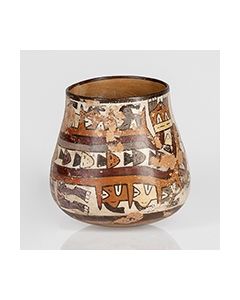 Beaker of the Nazca culture
Elegant vessel made by the precolumbian Nazca culture. The outside is decorated by a polychrome szene of geometric patterns and abstractions of animals and faces.
Price: on request Very large cypriot bowl
Dating to the early cypro-archaic period, so-called black-on-red ware II. From an old German private collection. Coming with an ArtLoss certificate.
Price: on request Large published Cypriot amphora
Very large, impressively preserved object. From an old German private collection, acquired at London art gallery or auction around 1970. Coming with an ArtLoss certificate.
Price: on request Applique of the Horus son Duamutef
Bright turquise fayence. Duamutef is one of the four sons of Horus, well-known from the Canopic jars. He had an important protective function for the dead. Egypt, 8th to 4th cent. BC.
Price: on request Scarab with two cartouches of Thutmose III.
Interesting amulet from the New Kingdom or a later period made in archaic style. This scarab is described in the catalogue of Irène Gautier-Vodoz.
Price: on request