
Search results for: 'roman in'
-
 Roman specillum
The so-called specillum is a surgical probe. It was standard issue for roman doctors. Similar probes are still in use today. 1st to 4th cent. AD.
Price: on request Roman Celtic seal box
Lozenge shaped body with lid in Celtic design. A piece from the 1st or 2nd century, found near the Celtic settlement and later Roman town of Lindum. Published in a standard work by Richard Hattatt.
Price: on request Roman surgical probe made of silver
The so-called specillum was standard issue for roman doctors. Similar probes are still in use today. Ancient surgical instruments made of silver are extremely rare.
Price: on request Roman terra sigillata bowl with wild boar reliefs
Roman Empire, 1st - 3rd century AD, excellently preserved. From and old German collection, acquired in the 1960s - 1970s.
Price: on request Roman Republican denarius from Wishanger hoard
Anonymous, 2nd century BC. Found 2021 in East Hampshire, UK. Best condition of the five Marc Antony denarii in the hoard. The hoard is a very impressive proof of the fact that coins were in circulation for up to several centuries in the Roman era.
Price: on request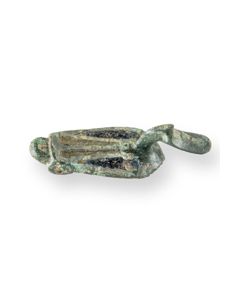 Bird brooch from Roman Britain
Nice fibula in the shape of a stylized water bird. A find from Britain and probably also a local Roman provincial production.
Price: on request Roman terra sigillata jar
Roman Empire, 1st - 3rd century AD, excellently preserved. From and old German collection, acquired in the 1960s - 1970s.
Price: on request Roman Kraeftig Profilierte fibula
Fibula with noble green patina. An import from mainland Europe to Roman Britain. From the 1st century AD. Published in two stardard works on ancient brooches by Richard Hattatt.
Price: on request Roman plate brooch
Oval bronze brooch with a setting for a glass insert. From the Roman imperial period. Published in two stardard works on ancient brooches by Richard Hattatt.
Price: on request Roman glass bracelet
The bangle or hair ring from the Roman Imperial period is made of dark blue glass. Produced in the Eastern Mediterranean.
Price: on request Augustus denarius from Wishanger hoard
Found 2021 in East Hampshire, UK. Revers showing Gaius and Lucius, the sons of M. Agrippa. The hoard is a very impressive proof of the fact that coins were in circulation for up to several centuries in the Roman era.
Price: on request Augustus denarius from Wishanger hoard
Reverse showing Caius Caesar galloping right, eagle between two vexilla behind him. Found 2021 in East Hampshire, UK. The hoard is a very impressive proof of the fact that coins were in circulation for up to several centuries in the Roman era.
Price: on request Harpokrates Terracotta figurine from Ptolemaic or Roman Egypt
Nice figurine from Ptolemaic or Roman Egypt. From an old German collection, acquired at Davies Antiques, London, in 1976 - 1978.
Price: on request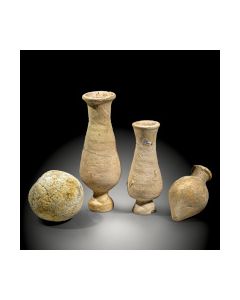 Three Roman pottery amphora plugs and one stone projectile from the Rhineland
Found 1966 till 1981 near the Roman city of Novaesium, today's Neuss in Germany. Novaesium was an early Roman foundation and with this is one of the oldest cities in Germany.
Price: on request Vespasian denarius from Wishanger hoard
The reverse shows the urn of Vespasian on a column. Great patina. Found 2021 in East Hampshire, UK. The hoard is a very impressive proof of the fact that coins were in circulation for up to several centuries in the Roman era.
Price: on request Roman gold earring
The earring is skillfully garmented with granular gold beads. The craftsmanship and decorations are a typical example of jewellery in Roman times.
Price: on request Three Roman pottery vessels from the Rhineland
Found 1966 till 1981 near the Roman city of Novaesium, today's Neuss in Germany. Novaesium was an early Roman foundation and with this is one of the oldest cities in Germany.
Price: on request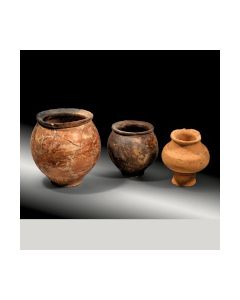 Three Roman pottery vessels from the Rhineland
Found 1966 till 1981 near the Roman city of Novaesium, today's Neuss in Germany. Novaesium was an early Roman foundation and with this is one of the oldest cities in Germany.
Price: on request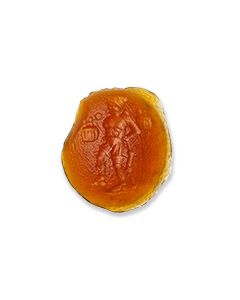 Roman intaglio with Odysseus as a beggar
The roman intaglio shows an important scene from the Odyssey in which Odysseus returns home after his long journey. The hero is disguised as a beggar. He wears his pilos hat and is resting his weight on a stick.
Price: on request Roman headstud brooch
Interesting fibula with a covered hinge mechanism and enamel decoration on the bow. From the 2nd century Roman Britain. Published in two stardard works on ancient brooches by Richard Hattatt.
Price: on request Mosaic glass inlay with half mask
Skillfully arranged motif that could be combined with a plate of the same motif to show a full face. Made in Egypt during the early Roman Imperial period.
€4,700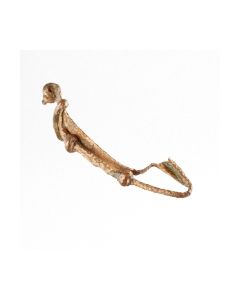 Celtic fibula from the famous Hattatt collection
Fibula from the La Tène II period. Found in Celtic Carnuntum. The piece is published in the standard work "Iron Age and Roman Brooches".
Price: on request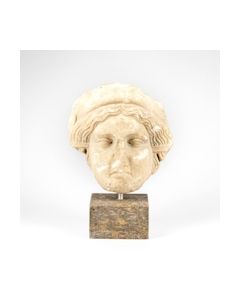 Large Roman marble head of a woman
Very well preserved fragment of a larger group. Ca. 1st - 2nd century AD, Roman Empire. From an old German collection, acquired in 1987 from Helmut Liebert in Krefeld, Germany.
Price: on request North African oil lamp with rare mirror scene, ex Christie's
The mirror shows the harvest of grapes, a symbol for Autumn in the Ancient Roman iconography. Very nicely preserved, from an old US-American collection. Ex Christie's.
Price: on request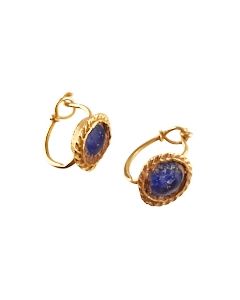 Pair of Roman gold earrings
Nice golden earrings with blue glass inserts from late Roman Imperial times. It is a belonging pair of earrings which is in itself a rarity.
Price: on request Perfectly preserved ampulla of Saint Menas
Ampulla of Saint Menas, a late-third-century Egyptian Roman soldier who was martyred for his Christian faith. From the collection of Prof. Dilling, acquired in the early 1900s.
Price: on request Early Christian pilgrim flask with St. Menas
Ampulla of Saint Menas, a late-third-century Egyptian Roman soldier who was martyred for his Christian faith. From the collection of Prof. Dilling, acquired in the early 1900s.
Price: on request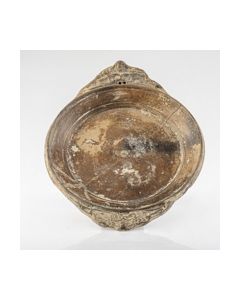 Greek or Roman plate with richly decorated handles
Made in 2nd - 1ct century B.C., Roman Republic. Handles decorated with tendrils and Silen heads. From the Austrian collection of Prof. Ritschel, carrier of the Large Cross of Honor of the Austrian Republic and many other prizes and honors.
Price: on request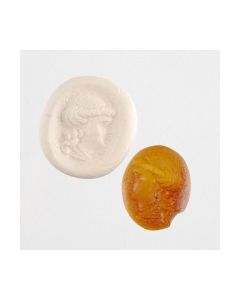 Roman intaglio with portrait of a lady
Finely worked Roman ring stone from bright orange glass. An artwork in great detail from Roman times.
Price: on request Black figure Etruscan Stamnos from Toledo Museum collection
Ex collection Prof. G. Olcott, the first Columbia University professor for Roman archeology. Acquired from his estate 1912 by the Toledo Museum (Ohio), in the museum collection until 2017. Found in Bolseno area, Italy.
Price: on request Rare plate brooch with millefiori enamel
Brooch from Roman Imperial time, found in Roman Britain. It is an extremely rare and interesting type. The brooch is published in Richard Hattatt's standard work "Ancient Brooches and Other Artefacts" and discussed in detail.
Price: on request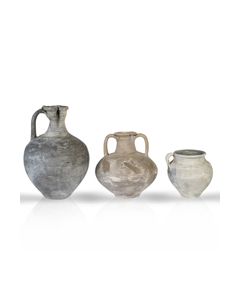 Three Roman pottery vessels from the Rhineland
Found 1966 till 1981 near the Roman city of Novaesium, today's Neuss in Germany. Novaesium was an early Roman foundation and with this is one of the oldest cities in Germany.
Price: on request Two Roman jugs from the Rhineland
Found 1966 till 1981 near the Roman city of Novaesium, today's Neuss in Germany. Novaesium was an early Roman foundation and with this is one of the oldest cities in Germany.
Price: on request Roman marble portrait, possibly Traianus Decius
Extraordinarily preserved marble head. Comparable in quality with portraits of Roman emperors on exhibition in large museums. Either a portrait type not yet surely attributed to Traianus Decius, or a private portrait of the Decius era imitating the official imperial portraits.
Price: on request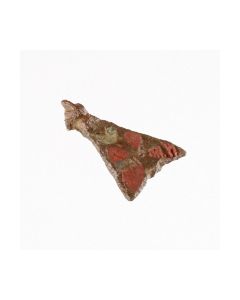 Roman cicada brooch
Brooch in the shape of an insect. Popular type in the northern Roman provinces during the 2nd century.
Price: on request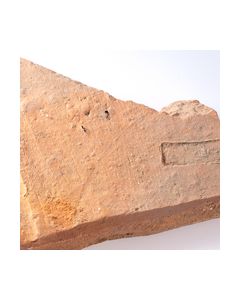 Fragment of a stamped Roman tile
Probably manufactured in Treves area, Germany. Roman Empire, 3rd - 4th century A.D.
Price: on request