
Search results for: 'bei'
-
 Römischer Terra Sigillata Teller aus Sfax (Tunesien)
Teller mit schräg ansteigender Wandung und nach innen geneigter Lippe. Aus alter niederländischer Sammlung, aufgebaut in den 1950er-90er Jahren.
Price: on request Zwei antike Spinnwirtel
Gruppe antiker bis spätantiker Spinnwirtel aus Bein oder Holz. Interessanter Typ. Auch Verwendung als Perlenschmuck denkbar.
Price: on request Große ägyptische Bronzefigur der Sachmet
Eine wundervoll dunkel-patinierte Bronze der “Göttin des Zitterns ”, Sachmet, in beeindruckender Erhaltung. Vollständig erhalten mit erkennbaren feinen Details.
Price: on request Tonstatuette des Harpokrates aus dem Fayum
Nach rechts geneigter Kopf einer Harpokrates-Statuette. Sehr gut erhalten, detailliert und aufwendig gearbeitet.
Price: on request Interessanter Spinnwirtel aus Stein
Antiker Spinnwirtel für Handspindel, aus dunklem Naturstein. Hellenistische bis römische Zeit.
Price: on request Messerklinge aus Stein, Mesolithikum
5100 - 4100 v.Chr., Flintwerkzeug der Ertebölle-Ellerbek-Kultur. Die Kultur ist ein wichtiges Bindeglied zwischen Mesolithikum und Neolithikum.
Price: on request Spätmesolithischer Kratzer oder Schaber
5100 - 4100 v.Chr., Flintwerkzeug der Ertebölle-Ellerbek-Kultur. Die Kultur ist ein wichtiges Bindeglied zwischen Mesolithikum und Neolithikum.
Price: on request Terra Sigillata Boden mit Stempel ANISATVSF
Aus der Werkstatt des Anisatus (ANISATVSF = anisatus fecit) aus Heiligenberg (heutiges Frankreich), Pont des Rèmes und Trier.
Price: on request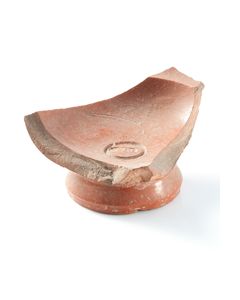 Terra Sigillata Boden mit Stempel CERI
Stempel einer Werkstätte in Lezoux oder Pozzuoli, 1. Jh. v. Chr. - 2. Jh. n. Chr.
Price: on request Roman crossbow brooch
With its silver body and the formerly gold plated bronze knobs the brooch must have been a beautiful sight. Early variant dating to the 3rd century.
Price: on request Lapis lazuli head of a pharao
Extremely rare finely carved royal head made of blue stone with bronze beard. Late Period to Ptolemaic period of ancient Egypt.
€3,450 Lekythos from Toledo Museum collection
Ex collection Prof. G. Olcott, the first Columbia University professor for Roman archeology. Acquired from his estate 1912 by the Toledo Museum (Ohio), in the museum collection until 2017. Found in Apulia.
Price: on request Large early Etruscan decorated jar
Nicely preserved, from an old German collection, acquired in the late1950s. Found in Latium region (Italy) near Sezze.
Price: on request Villanova culture urn found at Tarquinia
Perfectly preserved, beautifully decorated piece. From an old German private collection, in Germany since the 1970s.
Price: on request Cult vessel of the Yortan culture
Wonderful double vessel with incised decoration. From the Early Bronze Age of Western Anatolia.
Price: on request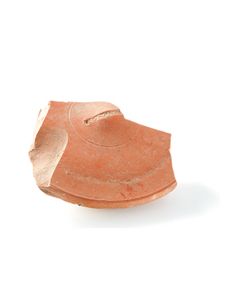 Terra Sigillata Boden mit Stempel CONIVSF
Aus der Werkstatt des Conus aus Trier. 140 - 160 n. Chr. Eine Variante des ansonsten üblichen Typus CONVS FE. Großer, tiefer Stempel.
Price: on request Großer, antiker Spinnwirtel
Spinnwirtel aus Ton. Bikonische Form, Durchmesser 48 mm. Keltische bis römsiche Zeit.
Price: on request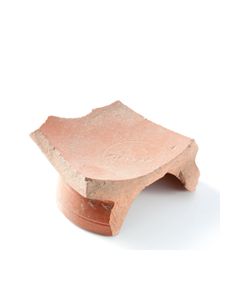 Terra Sigillata Boden mit Stempel OF SEVERI
La Graufesenque, 65 - 85 n. Chr., zu lesen als OF[FICINA] SEVERI. Sehr gute Erhaltung, Stempel in Kreis.
Price: on request Luristan ceremonial pick
The elaborate decorations are contrary to the actual use as a pick. The object is from the class of pseudo tools common in Iran at the end of the 2nd millenium BC. It probably served a ritualistic purpose.
Price: on request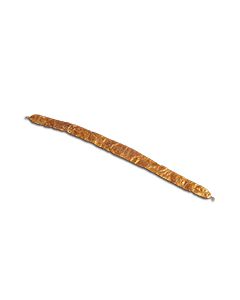 Mycenaean gold diadem
Delicate piece of ancient jewelry made of gold foil
Price: on request Disc-headed pin from Luristan
Important and unique pin type of Luristan. This specimen is decorated by bumps forming a seven-pointed star.
Price: on request Scarab of pharao Seti I.
The Egyptian scarab bears a hieroglyphic inscription which can be read as the name of pharao Seti I. From the Ramesside period, around 1300 BC.
Price: on request Scarab with geometric design
Lovely scarab with traces of turquoise fayence. From the Second Intermediate Period of ancient Egypt.
Price: on request Scarab with cartouche
The scarab amulet has a cartouche and neb on the bottom. 18th to 20th dynasty of ancient Egypt.
Price: on request Scarab with wishes
Nice scarab made of dark steatite. The hieroglyphs could be read as New Year's wishes.
Price: on request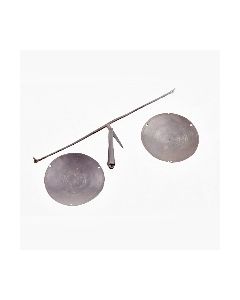 Roman scale balance with pans
Well preserved small bronze scale. Including two dished pans decorated with incised concentric rings.
Price: on request Roman bronze strainer from "Museum fuer Morgenlandfahrer"
Large piece in very good condition with nice patina. On display in "Ex Oriente Lux" exhibition, published in the corresponding catalogue.
Price: on request Clay figurine of an Orans from the Fayum
Aus dem Fayum. Kopf einer Frau mit rundem Gesicht, breiter Knollennase und wulstigem Hals. In den Ohren Löcher für Aufnahme von Ohrringen. Exzellent erhalten.
Price: on request Amulett des Bes aus der 18. Dynastie
Plastisches Relief des stehenden Gottes für Musik und Tanz. Bes war darüber hinaus auch Beschützer der Kinder und Schwangeren. Dieser Funktion diente vermutlich auch das Amulett.
Price: on request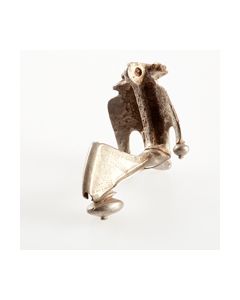 Kräftig profilierte Silberfibel, 2. bis 3. Jh. n. Chr.
Römische Fibel vom Typ der kräftig profilierten Fibeln. Massives Silber, 34,2g, 100 bis 250 n. Chr. Museumswürdiger Zustand.
Price: on request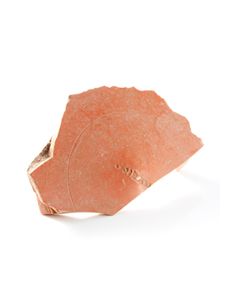 Terra Sigillata Boden mit Stempel RVFINI
Aus der Werkstatt einer Rufinus aus La Graufesenque bzw. Banassac. 55 - 95 n. Chr. Sehr gute Erhaltung, nicht restauriert.
Price: on request römisches Unguentarium aus Ton
Birnenförmiges Unguentarium, mit Resten roter Engobe. Langer Hals, ausladende, runde Lippe. Abgeflachte Standfläche. Perfekt erhalten.
Price: on request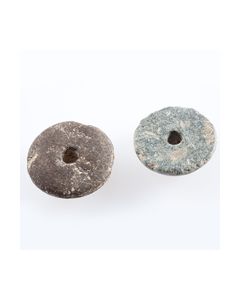 Gruppe von 2 Spinnwirteln aus Stein
Seltene kegelförmige Wirtel. Hellenistische bis römische Zeit, Fund von der Levante, östlicher Mittelmeerraum.
Price: on request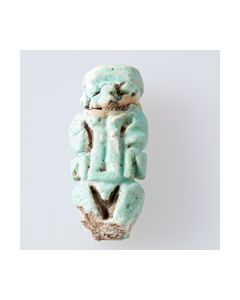 Ägyptische Patäke-Figur aus Fayence
Sehr seltene Patäken-Darstellung. Ein Mensch in Zwerggestalt, der als Gott oder Gottgleicher verehrt wurde. Schutzgott. 26. bis 30. Dynastie. Spätzeit.
Price: on request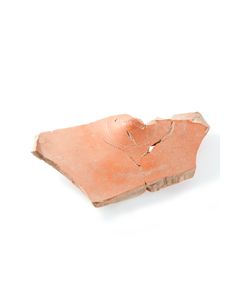 Terra Sigillata Boden mit Stempel MAINIVSFE
Aus der Werkstatt des Mainius, eines bekannten Töpfers aus Trier. 150 - 170/180 n. Chr.
Price: on request Römischer Spinnwirtel aus Trier
Antiker Spinnwirtel aus Bronze, Fund aus Trier. Gewicht 22,1g.
Price: on request