
Classical antiquity - Fotogalerie - Sold antiquities
Archive of sold antiquities
All artefacts sold in our gallery are fully documented in our online archive and database. Being a specialist ancient art dealer, preserving also the more recent history of each and every piece sold in our shop is at our heart. That is particularly useful for artefacts that changed owners in the meantime. Information that may have been lost in the process can be easily restored from our archives. Please do not hesitate to contact us if you need further information about ancient items that have been sold in our gallery. We can help you with reconstructing the history of ownership for those items. All information about our customers will be kept confidential, of course.-
 Greek Boeotian rider
The painted clay sculpture shows a stylized horse and rider. The rider figurine from Greece dates to the archaic period.
Price: on request Extraordinary rare Julia Domna bronze from Paphlagonia
The only specimen currently offered on the international numismatic market known to us. The coin praises the city of Gangra-Germanikopolis as the "altar of gods" and the oldest city of all Paphlagonia.
Price: on request Rare Nero Aureus
Rome, 64 - 65 AD. The reverse shows the emperor with his second wife, Poppaea Sabina. Rare (R2).
Price: on request Egyptian scarab amulet
Nice amulet from the Late Dynastic Period of Ancient Egypt. The scarab was exhibited in an early 20th century private museum.
Price: on request Zeugitania - Carthage bronze
Perfectly preserved extremely fine piece with nice green patina
Price: on request Egyptian amulet of a hare
This type of amulet was popular in the Late Dynastic Period of Ancient Egypt. It should endow its wearer with fertility and rapidity of movement. The piece was exhibited in an early 20th century private museum.
Price: on request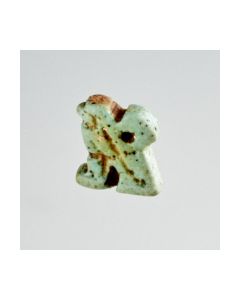 Egyptian amulet of a falcon
The falcon in Egyptian art can be a depiction of the god Horus or symbolize the soul of the pharao. Falcon amulets are known from the earliest times in Egyptian history. However this speicmen dates to the Late Dynastic Period of Ancient Egypt.
Price: on request Egyptian amulet of Shu
God of the air and the sun. The highly stylized figurine shows the ancient Egyptian god on his knees, the arms raised towards the sun. From a British private museum.
Price: on request Egyptian pataikos
God or god-like dwarf. The figurine was supposed to have a magical protective function. 26th to 30th dynasty of Ancient Egypt. From a British private museum.
Price: on request Marcus Aurelius Sestertius
Rome, 162-163 AD. AV: Bust of Marcus Aureius, RV: Salus standing left holding scepter and patera, to her feet altar with snake.
Price: on request Roman oil lamp found 1913 in Trier
Perfectly preserved piece with a particularly old known history.
Price: on request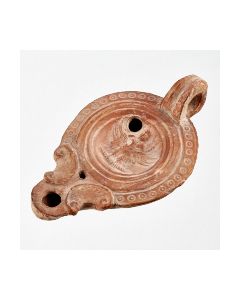 Roman oil lamp from FETVS workshop
From a very old German collection. Probably manufactured in North Africa.
Price: on request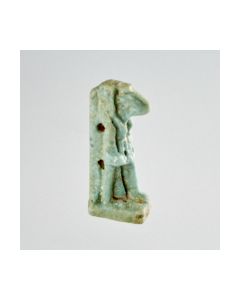 Egyptian amulet of Thoth
Ibis headed god of knowledge and writing. 26th to 30th dynasty of Ancient Egypt. From a British private museum.
Price: on request Roman oil lamp showing Victoria in biga
A lamp with an identical motive is on exhibition in the NATIONAL WARSAW MUSEUM. Probably found in Trier in 1913
Price: on request Roman jar, probably found in Trier area.
Perfectly preserved piece from a German collection.
Price: on request Egyptian amulet of Taweret
It shows the goddess of childbirth in the form of a pregnant hippopotamus. The amulet from the Late Period of Ancient Egypt should exert a protective function. From a British private museum.
Price: on request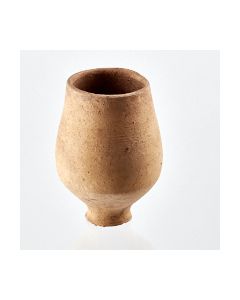
 Egyptian amulet of Anubis
The amulet from the Late Period of Ancient Egypt was supposed to protect the dead on their way to the afterlife. From a British private museum.
Price: on request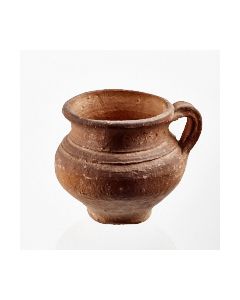 Massive small Roman pot with handle
Impressive, perfectly preserved piece from a very old German collection.
Price: on request Roman jar with flat handle
Perfectly preserved piece from a very old German collection.
Price: on request
 Roman jar with flat handle
Perfectly preserved piece from a very old German collection.
Price: on request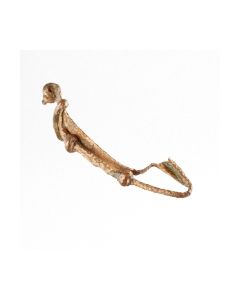 Celtic fibula from the famous Hattatt collection
Fibula from the La Tène II period. Found in Celtic Carnuntum. The piece is published in the standard work "Iron Age and Roman Brooches".
Price: on request Roman jar or beaker, probably found in Trier area.
Interesting piece from a German collection.
Price: on request Rare Roman bronze askos
Small massive duck-shaped jug with lovely decorated handle showing an animal mask.
Price: on request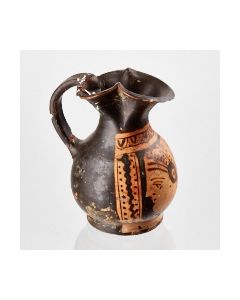 Red figure Oinochoe from a very old German collection
Excellent condition and brilliant colors. Decorated with a large red figure female head. 4th century BC.
Price: on request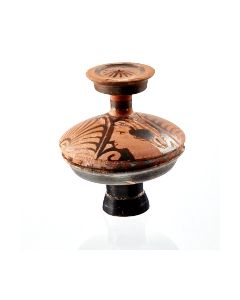 Red figure Apulian lekanis
Shallow Greek bowl with high foot, lid with high knob handle. Richly decorated with red figure paintings of female heads and shells. Apulia, 4th century BC
Price: on request Rare plate brooch with millefiori enamel
Brooch from Roman Imperial time, found in Roman Britain. It is an extremely rare and interesting type. The brooch is published in Richard Hattatt's standard work "Ancient Brooches and Other Artefacts" and discussed in detail.
Price: on request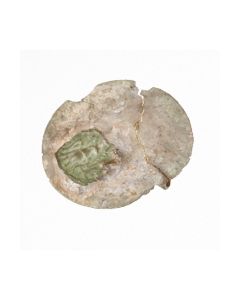 Ancient fibula from the Hattatt collection
Ancient fibula of the rare adlocutio type. Repoussé work of a scene from a Roman sestertius of Hadrian in celtic style. Find from Dorset in Roman Britain. Published in Hattatts famous book series on ancient fibulae.
Price: on request Published Roman fibula with celtic design
Ancient fibula from the Roman province of Britain. The design can be attributed to the celtic tribe of the Trinovantes or Iceni. From the famous Hattatt collection. Published twice.
Price: on request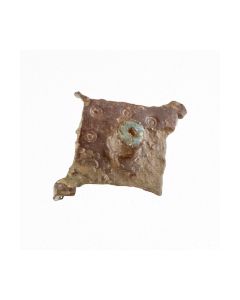 Roman fibula from the Richard Hattatt collection
Lozenge-shaped ancient roman fibula. The piece is published in the standard work "Iron Age and Roman Brooches". Found in Britain.
Price: on request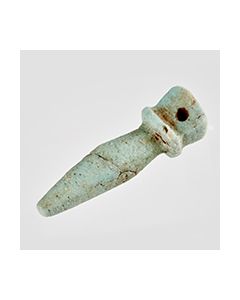 Egyptian papyrus scepter amulet
Amulet in the shape of a papyrus scepter. Late Period of Ancient Egypt. It symbolizes prosperity and youth. From the stock of a british private museum.
Price: on request Egyptian papyrus scepter amulet
Amulet in the shape of a papyrus scepter. Late Period of Ancient Egypt. It symbolizes prosperity and youth. From the stock of a british private museum.
Price: on request Scarab with two cartouches of Thutmose III.
Interesting amulet from the New Kingdom or a later period made in archaic style. This scarab is described in the catalogue of Irène Gautier-Vodoz.
Price: on request Scarab with cartouche
Amulet from the Late Period. The stamp is in great condition. This scarab is described in the catalogue of Irène Gautier-Vodoz.
Price: on request Scarab with breath of life
The Ankh on the bottom side of this ancient egyptian scarab symbolized life or afterlife. The symbol is framed by volutes.
Price: on request