
Sold - Sold antiquities
Archive of sold antiquities
All artefacts sold in our gallery are fully documented in our online archive and database. Being a specialist ancient art dealer, preserving also the more recent history of each and every piece sold in our shop is at our heart. That is particularly useful for artefacts that changed owners in the meantime. Information that may have been lost in the process can be easily restored from our archives. Please do not hesitate to contact us if you need further information about ancient items that have been sold in our gallery. We can help you with reconstructing the history of ownership for those items. All information about our customers will be kept confidential, of course.-
 Bowl of the Nazca culture
With polychrome abstract depiction of people and masks, possibly a deity. Wonderful vessel from the Nazca Golden Age.
Price: on request Richly painted pottery in the Nazca style
A magnificent modern product imitating the style of the pre-Columbian Nazca culture. It depicts a deity, a hybrid creature of mythical beast and human.
Price: on request Beaker of the Nazca culture
Elegant vessel of the pre-Columbian Nazca culture. The polychrome painting is of high artistic quality and shows a mask.
Price: on request Beaker of the Nazca culture
Tall and slender vessel from the pre-Columbian Nazca culture. The polychrome painting shows abstract patterns, as well as abstracted animals and faces.
Price: on request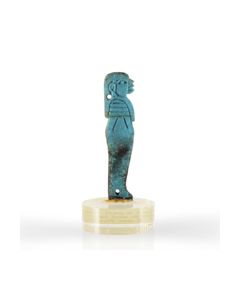 Appliqué of the Horus Son Imsety from Faiyum
Made of nice turquoise faience. Protective god responsible for the liver of a deceased. From the family of Lawrence of Arabia.
Price: on request Egyptian amulet of Bes
Protective amulet of the dwarf god Bes made of turquoise faience. Great specimen from Ptolemaic or Roman Egypt.
Price: on request Egyptian double-sided Bes amulet
Protective amulet of the dwarf Bes made of mint green faience. Very detailed example from Ancient Egypt.
Price: on request Late Roman glass flask
Flat bottle with double handle from the Eastern Mediterranean. Made between the 3rd and 6th century.
Price: on request Glass bottle with nub decoration
The pear-shaped glass comes from the late Roman or early Byzantine period. Presumably from the Eastern Roman province of Palaestina.
Price: on request Etruscan scarab with horses
Gem stone and seal made of beautiful carnelian. It shows two horses in a frontal view in a highly stylized manner. From the famous Giorgio Sangiorgi collection.
Price: on request Etruscan scarab with Prometheus
The highest quality work of miniature art shows how Prometheus has just formed the first human from clay. A showpiece of late Etruscan glyptics made of beautiful carnelian.
Price: on request Roman intaglio with eagle
The ancient work shows an eagle in a dynamic movement spreading his wings. Beautiful orange glass paste.
Price: on request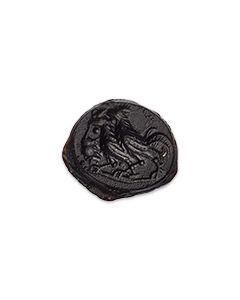 Roman intaglio with cocks
The quality work shows two standing cocks on a base line. Fantastic and crisp illustration.
Price: on request Roman glass paste
Ring stone made of beautiful orange glass. From the Professor Brosch collection of ancient gems.
Price: on request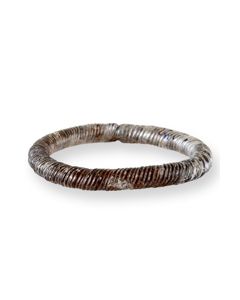 Roman glass bracelet with spiral decoration
The 4th century bangle is decorated with spiraling grooves on the outside. Made in the Eastern Mediterranean.
Price: on request Roman glass bracelet with spiral decoration
The 4th century bangle is decorated with spiraling grooves on the outside. Made in the Eastern Mediterranean.
Price: on request Pre-Columbian gold earrings from Colombia
Matching pair of gold earrings from the Zenú culture. Dating to the 1st millennium. Impressive gold jewellery, once worn as earrings by the Zenú people.
Price: on request Huge Paleolithic hand axe
Prehistoric stone tool. It was the universal tool of the older Stone age and could be used as a borer or a cutter. From a Swiss museum collection. Found in Morocco, North Africa.
Price: on request Paleolithic hand axe
Prehistoric stone tool. It was the universal tool of the older Stone age and could be used as a borer or a cutter. From a Swiss museum collection. Found in Morocco, North Africa.
Price: on request Egyptian bronze figurine of Horus the Child
Amulet of a standing child god with crown, sun disc and horns.
Price: on request Appliqué of the Horus Son Imsety
Rare variety with wooden core and gilded linen. Protective god responsible for the liver of a deceased. From the family of Lawrence of Arabia.
Price: on request Roman knee brooch from Britannia
Well preserved example of this important fibula type that was introduced to Britain by Roman troop movements from the Rhineland. This specimen was already produced locally in Britannia province. It was published in two books on ancient fibulae.
Price: on request Roman headstud brooch
Interesting fibula with a covered hinge mechanism and enamel decoration on the bow. From the 2nd century Roman Britain. Published in two stardard works on ancient brooches by Richard Hattatt.
Price: on request Roman glass juglet
The small jug with a pear-shaped body is outstanding due to the strongly iridescent patina and the dark coating on the outside. From the Late Roman Imperial period.
Price: on request Roman legionary tile from the Rhineland
LEG XVI (Gallica), 43 - 70 AD. Found 1966 till 1981 near the Roman city of Novaesium, today's Neuss in Germany. Novaesium was an early Roman foundation and with this is one of the oldest cities in Germany.
Price: on request Roman intaglio with mythical creature
Roman jewellery insert made of beautifully shimmering blue glass paste. It shows a creature with the front part of a horse.
Price: on request Roman intaglio with biga
The glass paste shows Nike in a biga. The goddess of victory stands in the chariot, holding the reins and her laurel wreath.
Price: on request Roman intaglio with kneeling person
Nice light yellow glass paste from the Professor Brosch collection of ancient glyptics. Possibly showing a warrior.
Price: on request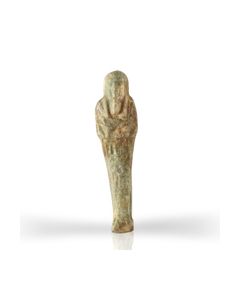 Egyptian ushabti
Well-preserved funerary statuette made of mint green faience. From the Late Period of Ancient Egypt.
Price: on request Egyptian green stone vessel
The stone vessel is made of beautiful green serpentine. From the collection of Egyptologist Professor Wiedemann. Middle Kingdom of Ancient Egypt.
Price: on request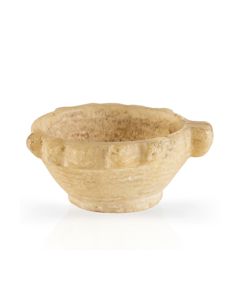 Egyptian alabaster bowl from Luxor
The small stone vessel is an offering bowl for libation. From the collection of Egyptologist Professor Wiedemann. 12th to 18th dynasty of Ancient Egypt
Price: on request Egyptian stone bowl
This wonderful and relatively large bowl of banded stone was probably used for ritual purposes. From the Early Dynastic Period or Old Kingdom of ancient Egypt.
Price: on request Roman intaglio with raven
An ancient intaglio from Roman times made of nice orange glass paste. Well preserved depiction.
Price: on request Roman intaglio with dog
The ring insert made of beautiful orange glass paste shows a standing dog that looks up with a raised paw.
Price: on request Roman glass paste with two animals
The intaglio is made of beautiful violet glass. It shows two animals facing each other.
Price: on request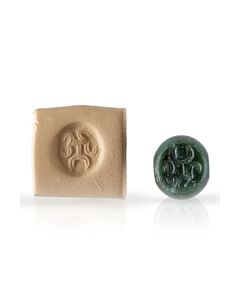 Sasanian stamp seal with emblem
Perfectly preserved seal made of noble green jasper. The piece is from the period of Sasanian rule in the Near East.
Price: on request