
Sold - Sold antiquities
Archive of sold antiquities
All artefacts sold in our gallery are fully documented in our online archive and database. Being a specialist ancient art dealer, preserving also the more recent history of each and every piece sold in our shop is at our heart. That is particularly useful for artefacts that changed owners in the meantime. Information that may have been lost in the process can be easily restored from our archives. Please do not hesitate to contact us if you need further information about ancient items that have been sold in our gallery. We can help you with reconstructing the history of ownership for those items. All information about our customers will be kept confidential, of course.-
 Massive Bronze Age spear head, possibly celtic
Perfectly preserved, large piece with beautiful patina. From an old German collection.
Price: on request Faience tile of the Djoser pyramid type
Egyptian wall tile from the Old Kingdom, 2nd to 3rd dynasty. The tile type is known from the famous step pyramid of king Djoser.
Price: on request Egyptian ushabti for Ra-mes
The mummiform funerary figurine dates to the Late Period of ancient Egypt, 26th to 31st dynasty. It is remarkable that it probably originates from the burial of two brothers, Ra-mes and Somtus-tefnacht.
Price: on request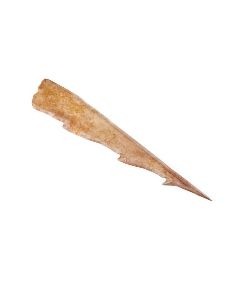 Harpoon of the Maglemosian culture
Fine craftsmanship hunting weapon. Important evidence of the beginnings of fishing in Northern Europe. Mesolithic, 9000 to 6500 BC.
Price: on request Bronze statuette of nursing Isis
Isis is shown in a very typical depiction as a mother, the archetype of the later Christian Nursing Madonna. The bronze figurine dates to the 22nd to 31st dynasty of Ancient Egypt.
Price: on request Faience figurine of Isis and Horus child
Goddess on a throne nursing her child Horus. Dating to the Late Period of ancient Egypt.
Price: on request Serapis marble bust from Joachim Menant collection
Famous egyptologist who excavated in Alexandria in the 19th century. Acquired in Egypt during this time, since then and until 2016 in the Menant family collection. With Art Loss certificate.
Price: on request Roman-Egyptian portrait of a young woman
Excellent condition, original stucco and painting partially preserved. From an old collection of a Frech engineer. With Art Loss certificate
Price: on request Bronze statuette of Osiris
The figurine is in exceptional condition with a nice patina. Late Dynastic period of Ancient Egypt, 664 to 332 BC.
Price: on request Roman glass beaker
This beaker type was popular in the Holy Land during the time of Jesus Christ. But products of the local workshops were also exported.
Price: on request Neo-Assyrian cylinder seal with hunting scene
The frit cylinder seal depicts a hunter with bow and arrow pursuing a cow. A description and dating by assyriologist Prof. Mayer-Opificius is present.
Price: on request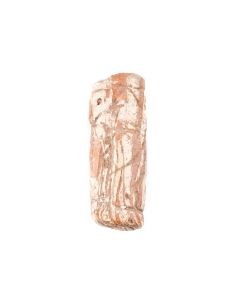 Neo-Assyrian cylinder seal with hunting scene
The glazed clay seal depicts a hunter with large bow pursuing a caprid. A description and dating by assyriologist Prof. Mayer-Opificius is present.
Price: on request Neo-Assyrian cylinder seal with preserved bronze setting
Fantastic and rare example for a cylinder seal in its original setting. From the reign of Tiglath-Pileser III in the 8th cent. BC.
Price: on request Neo-Babylonian stamp seal with religious scene
Nicely facetted seal made of bright chalcedony. It shows a man in front of the gods Marduk, Nabu and Ishtar. Typical and well documented depiction from the 6th cent. BC.
Price: on request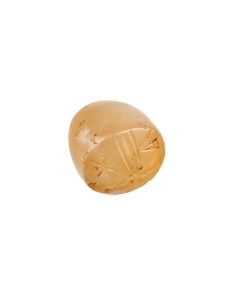 Neo-Babylonian stamp seal with religious scene
Conical seal made of snowy chalcedony. The scene shows a praying man in front of an altar or symbols for the gods Ishtar and Shamash. Canonical piece for an educational collection.
Price: on request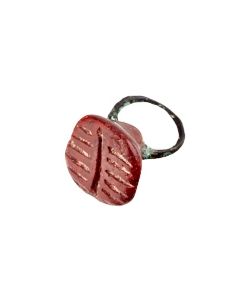 Anatolian porphyry stamp seal
Basic shape of a four sided pyramid. Made of wonderful intensely red stone. Middle Bronze Age of Anatolia.
Price: on request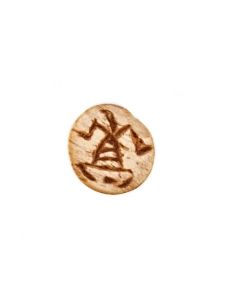 Western Asiatic button seal with scorpion
Interesting button shaped seal from the time of the ancient Assyrian trade settlements in Syria and Anatolia. 19th to 18th cent. BC. From the Dr. Langenkamp collection, with a scientific note from Prof. Mayer-Opificius.
Price: on request Western Asiatic button seal with hares
Interesting button shaped seal from the time of the ancient Assyrian trade settlements in Syria and Anatolia. 19th to 18th cent. BC. From the Dr. Langenkamp collection, with a scientific note from Prof. Mayer-Opificius.
Price: on request Pin from Luristan
Iron Age silver pin with attractive engravings. Nice dark patina.
Price: on request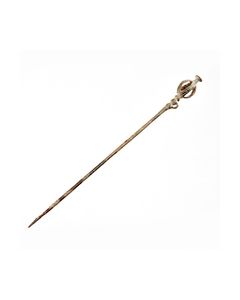 Large decorative pin from Luristan
The pin head is shaped like an open basket with a decorative knob. Bronze with attractive patina.
Price: on request Pre-Dynastic pottery of Ancient Egypt
The simple vessel is made of coarse clay. It dates to the end of the 4th millenium BC and hence witnessed the beginning of the Ancient Egyptian civilization.
Price: on request Impressive Roman imperial bronze oil lamp
Beautiful patina, very well preserved. With large leaf-shaped handle. Dating to 1st - 2nd century AD.
Price: on request Egyptian frog lamp from very old German collection
The frog lamps developed in Egypt close to Abydos. For the Egyptians, the frog symbolized birth and resurrection, this symbolism was also adapted by the early Christians. From the German collection Becker, in this for 3 generations.
Price: on request Roman oil lamp with head of a Taurus as handle
Rare type with plastic handle and large cross on base.
Price: on request Roman oil lamp showing Sol-Helios
Interesting transition type to the so-called North African oil lamps. Nicely preserved, unusual piece.
Price: on request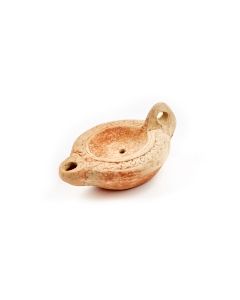 Roman oil lamp with heart-shaped nozzle
Nicely preserved oil lamp from the Roman Imperial era.
Price: on request Roman oil lamp with heart-shaped nozzle
Nicely preserved oil lamp from the Roman Imperial era.
Price: on request
 Roman oil lamp decorated with dots
Nicely preserved piece with heart-shaped nozzle.
Price: on request
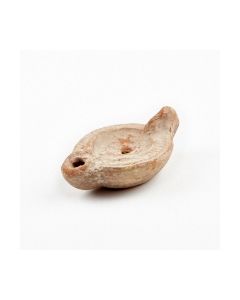 Massive roman oil lamp
Made in North Africa in the late 3rd century AD. From an old collection
Price: on request Leaden sling bullet with inscriptions
Almond shaped lead bullet of a slinger. It was part of the equipment of a Greek army from the late 5th to the 2nd century BC.
Price: on request Leaden sling bullet with inscriptions
Almond shaped lead bullet of a slinger. It was part of the equipment of a Greek army from the late 5th to the 2nd century BC.
Price: on request Bronze Age axe head
Very well preserved axe head. Late Bronze Age, 10th to 9th cent. BC.
Price: on request Cowroid with decorated body
The cowroid has an interesting decoration across the upper surface. The lower surface is inscribed with hieroglyphs. This cowroid is discussed in the catalogue of Gautier-Vodoz.
Price: on request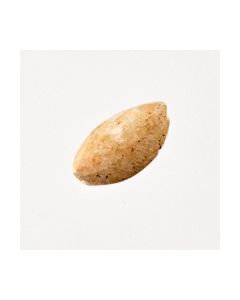 Cowroid with magic spell
The hieroglyphs of the anra type are to be interpreted as magical formula. From the Second Intermediate Period of ancient Egpyt. This scaraboid is described in the catalogue of Gautier-Vodoz.
Price: on request