

Others - Sold antiquities
Archive of sold antiquities
All artefacts sold in our gallery are fully documented in our online archive and database. Being a specialist ancient art dealer, preserving also the more recent history of each and every piece sold in our shop is at our heart. That is particularly useful for artefacts that changed owners in the meantime. Information that may have been lost in the process can be easily restored from our archives. Please do not hesitate to contact us if you need further information about ancient items that have been sold in our gallery. We can help you with reconstructing the history of ownership for those items. All information about our customers will be kept confidential, of course.-
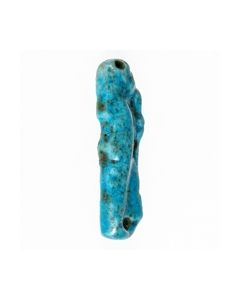 Appliqué of the Horus Son Imsety
Beautiful turquoise fayence from the Late Period of Ancient Egypt. From the Toledo Museum of Arts collection, acquired in 1924 from the famous antiquities dealer R. H. Blanchard.
Price: on request Ptolemaic sarcophagus mask
Impressive wood relief of an idealized face. Remains of paint. The mask was part of a sarcophagus lid from Ancient Egypt during ptolemaic rule.
Price: on request Egyptian sarcophagus mask
Impressive wood relief of an idealized face. Polychrome paint. The mask was part of a sarcophagus lid from the New Kingdom of Ancient Egypt.
Price: on request Central part of a mummy cartonnage
Polychrome painted panel depicting the four sons of Horus and a representation of Kheper-Ra. The collar is resembling the falcon wing of Horus.
Price: on request Roman military whistle
Historically interesting example of Roman military equipment. Whistles of this type have been used in the 1st to 2nd cent. AD. Their function is not fully understood, yet.
Price: on request Whistle from plastic bronze
Nice small whistle made of a high lead content bronze. Probably produced in the Modern Age.
Price: on request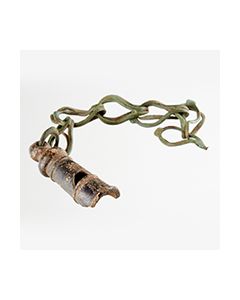 Roman military whistle
Historically interesting example of Roman military equipment. Whistles of this type have been used in the 1st to 2nd cent. AD. Their function is not fully understood, yet.
Price: on request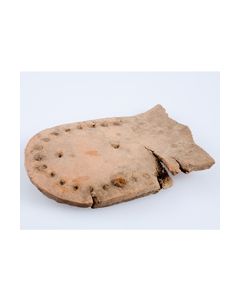 Fragment einer römischen Schuhsohle
Hintere Hälfte einer römischen Schuhsohle. Seltenes Fundstück aus einem römischen Militärlager, von römischen Caligae, den typischen Militärsandalen der Legionäre.
Price: on request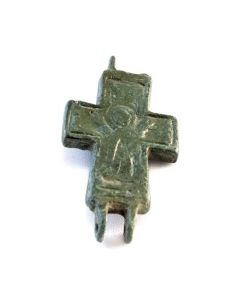 Byzantinisches Bronzekreuz
8. bis 10. Jh. n.Chr, Bronze. Teil eines Reliquienkreuzes mit stilisierter Mariendarstellung. Befestigungen weitgehend intakt. Länge: 48mm mit Ösen, 36mm nur Körper.
Price: on request Paar römischer Würfel
Zwei römische Würfel aus Bein, etwa 3. bis 4. Jhd.n.Chr., aus röm. Provinz Pannonia. Vermutlich Eigentum von Soldaten.
Price: on request Keltische Pferdeglocke
Ca. 300 v.Chr. Bis 200 v.Chr. Unter keltischer Besiedelung Galliens. Glocke aus Bronze, Pferdeglocke. 5cm lang.
Price: on request Paar römischer Würfel
Zwei römische Würfel aus Bein, etwa 3. bis 4. Jhd.n.Chr., aus röm. Provinz Pannonia. Vermutlich Eigentum von Soldaten.
Price: on request Paar römischer Würfel
Zwei römische Würfel aus Bein, etwa 3. bis 4. Jhd.n.Chr., aus röm. Provinz Pannonia. Vermutlich Eigentum von Soldaten.
Price: on request Römischer Würfel
Ein römischer Würfel aus Bein, etwa 3. bis 4. Jhd.n.Chr., aus röm. Provinz Pannonia. Vermutlich Eigentum von Soldaten.
Price: on request Anhänger, Byzantinisch bis Osmanisch
Schön verzierter Anhänger, vermutlich byzantinische oder osmanische Zeit.
Price: on request Anhänger, Byzantinisch bis Osmanisch
Schön verzierter Anhänger, vermutlich byzantinische oder osmanische Zeit.
Price: on request Haaken für Kleidung
Niederlande, um 1450. Derlei Haaken wurden an Stelle von Knöpfen verwendet. Mittelalter. Preis pro Stück. Freie Wahl.
Price: on request Paar römischer Würfel
Zwei römische Würfel aus Bein, etwa 3. bis 4. Jhd.n.Chr., aus röm. Provinz Pannonia. Vermutlich Eigentum von Soldaten.
Price: on request
 Ritueller Kelch aus der Eisenzeit
Museales Objekt, 1200 v. Chr. bis 1000 v. Chr., Eisenzeit I. Die Kelchform ist für Region und Zeit charakteristisch und vermutlich für kultische Zwecke verwendet worden. Höhe 155mm.
Price: on request Byzantinisches Bronzekreuz
8. bis 10. Jh. n.Chr, Bronze. Teil eines Reliquienkreuzes mit stilisierter Heiligendarstellung (Jesus). Höhe Kreuzkörper 34mm, Breite Kreuzkörper 24mm, Höhe mit Ösen 49mm.
Price: on request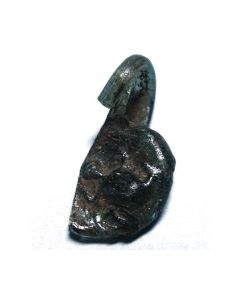 Fragment eines Anhängers mit Schildkrötendarstellung
1. Jh. v. Chr. bis 7. Jh. n. Chr., römisch bis byzantinisch. Hell-grünes, schön durchscheinendes Glas. Patiniert. Durchmesser 13mm, Länge22mm. 0,82g.
Price: on request Paar römischer Würfel
Zwei römische Würfel aus Bein, etwa 3. bis 4. Jhd.n.Chr., aus röm. Provinz Pannonia. Vermutlich Eigentum von Soldaten.
Price: on request Paar römischer Würfel
Zwei römische Würfel aus Bein, etwa 3. bis 4. Jhd.n.Chr., aus röm. Provinz Pannonia. Vermutlich Eigentum von Soldaten.
Price: on request Paar römischer Würfel
Zwei römische Würfel aus Bein, etwa 3. bis 4. Jhd.n.Chr., aus röm. Provinz Pannonia. Vermutlich Eigentum von Soldaten.
Price: on request Paar römischer Würfel aus weißem Bein
Paar römischer Würfel aus weißem Bein, selten. Vermutlich Eigentum von Offizieren.
Price: on request Hellenistische Tontafel mit der Göttin Astarte
Votivtafel, 4. Jh. v.Chr., zeigt die Göttin stehend mit noch gut erkennbaren Konturen. 129mm hoch, ca. 62mm breit.
Price: on request
Gruppe antiker ArtefakteGemischte Gruppe diverser kleiner Artefakten aus Metall. Zumeist Blei oder Bronze, Levante, Bronzezeit bis byzantinische Epoche.
Price: on request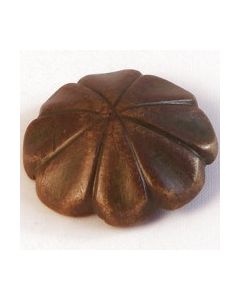 Bandelierbesetzung eines römischen Legionärs
Bronzerosette, römische Militärdekoration. 3. Jh. n.Chr., gute Erhaltung. 27mm Durchmesser.
Price: on request Diverse römische Bronzeartefakte
Fingerring und Teile römischer Militärausrüstung. 1. bis 4. Jh. n.Chr., römische Epoche. Germania Inferior.
Price: on request Vergoldete römische Gürtelschnalle
Gürteldekoration oder -schnalle, vergoldete Bronze, 1. bis 3. Jh. n.Chr, pannonische Provinzen. In sehr schöner Erhaltung. 47mm x 21mm.
Price: on request Gruppe diverser römischer Befestigungen
Diverse Befestigungen und Aufhängungen, vermutlich Teil römischer Militärausrüstung. Möglicherweise Zelthaken (oben). 1. bis 4. Jh. n.Chr., römische Epoche. Germania Inferior.
Price: on request Diverse römische Artefakte
Nicht näher bestimmte Artefakte, vermutlich Zubehör für römische Militärausrüstung. 1. bis 4. Jh. n.Chr., römische Epoche. Germania Inferior.
Price: on request Diverse römische Artefakte
Nicht näher bestimmte Artefakte, könnten Teil römischer Militärausrüstung sein. 1. bis 4. Jh. n.Chr., römische Epoche. Germania Inferior.
Price: on request Knöpfe von einer römischen Militärausrüstung
Diverse Typen. 1. bis 4. Jh. n.Chr., römische Epoche. Germania Inferior.
Price: on request Zwei römische Artefakte
Nicht näher bestimmte Artefakte, eines davon Pinnadel. 1. bis 4. Jh. n.Chr., römische Epoche. Germania Inferior.
Price: on request