
Published - Sold antiquities
Archive of sold antiquities
All artefacts sold in our gallery are fully documented in our online archive and database. Being a specialist ancient art dealer, preserving also the more recent history of each and every piece sold in our shop is at our heart. That is particularly useful for artefacts that changed owners in the meantime. Information that may have been lost in the process can be easily restored from our archives. Please do not hesitate to contact us if you need further information about ancient items that have been sold in our gallery. We can help you with reconstructing the history of ownership for those items. All information about our customers will be kept confidential, of course.-
 Large published cypriot jug, ex Christie's
Excellently preserved, rare for such a large object. 1977 on exhibition in the Bielefeld Museum of Fine Arts. From an old German private collection, acquired at Christie's in the late 1960s or early 1970s. Coming with an ArtLoss certificate.
Price: on request Published cypriot kylix, ex Christie's
Excellently preserved. 1977 on exhibition in the Bielefeld Museum of Fine Arts. From an old German private collection, acquired 1972 at Christie's. Coming with an ArtLoss certificate.
Price: on request Large published cypriot krater, ex Sotheby's
Fully preserved piece, very rare for an object of this size. 1977 on exhibition in the Bielefeld Museum of Fine Arts. From an old German private collection, acquired 1971 at Sotheby's. Coming with an ArtLoss certificate.
Price: on request Published cypriot milk bowl
1977 on exhibition in the Bielefeld Museum of Fine Arts. Nicely preserved piece, from an old German private collection, acquired prior to 1972. Coming with an ArtLoss certificate.
Price: on request Published etruscan hydria or amphora
1969 on exhibition in the Stadtsparkasse Gelsenkirchen, published in the exhibition catalogue. Perfectly preserved, from an old German private collection, acquired in the 1970s at Galerie Hermanns, Munich. Coming with an ArtLoss certificate
Price: on request Cowroid with decorated body
The cowroid has an interesting decoration across the upper surface. The lower surface is inscribed with hieroglyphs. This cowroid is discussed in the catalogue of Gautier-Vodoz.
Price: on request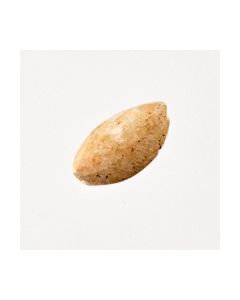 Cowroid with magic spell
The hieroglyphs of the anra type are to be interpreted as magical formula. From the Second Intermediate Period of ancient Egpyt. This scaraboid is described in the catalogue of Gautier-Vodoz.
Price: on request Cowroid with Ankh and papyrus
The seal is engraved with the breath of life between two papyrus plants. This scaraboid is described in the catalogue of Irène Gautier-Vodoz.
Price: on request Scaraboid from the Middle Kingdom
The stamp shows hieroglyphs with a title for the king of Upper and Lower Egypt. This scaraboid is described in the catalogue of Irène Gautier-Vodoz.
Price: on request Scarab with lion
The scene shows a walking lion. It is framed by an oval cord. This scarab is described in the catalogue of Irène Gautier-Vodoz.
Price: on request Scarab with protective formula
Amulet for protection. Stilized lotus flowers on the upper side. Magic formula on the lower side. This scarab is described in the catalogue of Irène Gautier-Vodoz.
Price: on request Scarab with geometric motive
The lower side exhibits a symmetrical arrangements of cords, two of which are wrapped around each other. This scarab is described in the catalogue of Irène Gautier-Vodoz.
Price: on request Scarab with geometric motive
The motive exhibits two symmetry axes and at least six triangles. A wonderful artistic expression of the highly evolved Egyptian maths. This scarab is described in the catalogue of Irène Gautier-Vodoz.
Price: on request Scarab with pattern of circles
The beetle stone bears a popular motive of the Middle Empire. A nice example of its kind. This scarab is described in the catalogue of Irène Gautier-Vodoz.
Price: on request Scarab with magic spell
The hieroglyphs are of the so called anra design, a magic spell in the ancient Egyptian belief. The scarab is from the 13th to 15th dynasty. It is described in the catalogue of Gautier-Vodoz.
Price: on request Published bracelet with Luristan ram heads
Nicely worked zoomorphic terminals with close parallels to achaemenide art. Dating to the early 1st Millenium BC.
Price: on request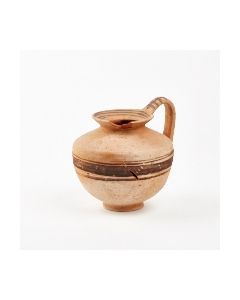 Hellenistic vase from "Museum fuer Morgenlandfahrer"
Nice example of ancient pottery, good condition. From an old museum collection.
Price: on request Roman fibula from the Richard Hattatt collection
Lozenge-shaped ancient roman fibula. The piece is published in the standard work "Iron Age and Roman Brooches". Found in Norfolk, England.
Price: on request Roman bronze strainer from "Museum fuer Morgenlandfahrer"
Large piece in very good condition with nice patina. On display in "Ex Oriente Lux" exhibition, published in the corresponding catalogue.
Price: on request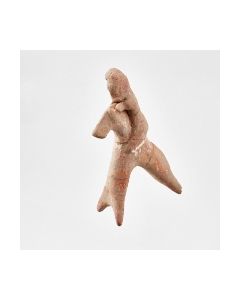 Published Parthian clay horse and rider
The clay figurine probably originates in Syria. It dates to achaemenide to parthian times. 6. cent. BC to 2nd cent. AD.
Price: on request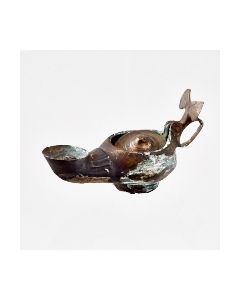 Published byzantine bronze oil lamp
From the famous "Museum für Morgenlandfahrer". An almost identical specimen is on exhibition in the Hanover Kestner Museum.
Price: on request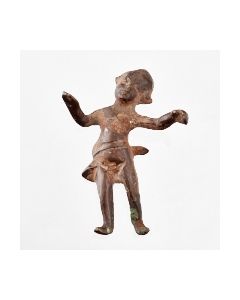 Roman bronze from famous "Museum fuer Morgenlandfahrer"
Massive bronze figurine of a dancing boy, beautiful dark patina, 1st-2nd century AD
Price: on request Egyptian tomb relief from Memphis
The flat relief shows an offering scene and above a hieroglyphic text describing the deceased Ptah-nefer, the priest and the offerings. A translation has been made by the renowned Egyptologist professor Kurth. The work of art dates to the 26th dynasty. It is adopting the style of the Old Kingdom.
Price: on request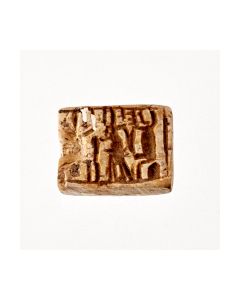 Egyptian steatite plaque
The protective amulet shows the god Bes between two seated monkeys. Late Period of ancient Egypt. This piece is described in the catalogue of Irène Gautier-Vodoz.
Price: on request Scaraboid with Red Crowns of Lower Egypt
The hieroglyphs on the lower side symbolize the rule over Lower Egypt. The rising sun is symbolized above. This scaraboid is described in the catalogue of Irène Gautier-Vodoz.
Price: on request Scaraboid with twisted cord
Scaraboid seal amulet with a twisted cord motive. This scarab is described in the catalogue of Irène Gautier-Vodoz.
Price: on request Small scarab amulet with Isis hieroglyphs
The tiny amulet dates to the New Kingdom. It bears the glyphs for the goddess Isis. This scarab is described in the catalogue of Irène Gautier-Vodoz.
Price: on request Scarab with scarab motive
The stamp side shows a scarab with two uraeus snakes. This scarab is described in the catalogue of Irène Gautier-Vodoz.
Price: on request Egyptian Scarab
The Egyptian scarab has a central cross on the stamp side. The piece dates to the 21st dynasty of Ancient Egypt. It is described in the catalogue of Gautier-Vodoz.
Price: on request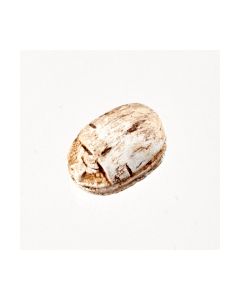 Scarab with lotus motive
Ancient Egyptian amulet seal with beautiful motive. Six lotus flowers are forming volutes. This scarab is described in the catalogue of Irène Gautier-Vodoz.
Price: on request Scarab with geometric motive
The lower side exhibits wrapped cords. A nice example of Egyptian art during the Second Intermediate Period. This scarab is described in the catalogue of Irène Gautier-Vodoz.
Price: on request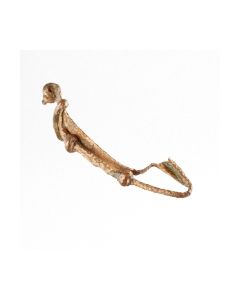 Celtic fibula from the famous Hattatt collection
Fibula from the La Tène II period. Found in Celtic Carnuntum. The piece is published in the standard work "Iron Age and Roman Brooches".
Price: on request Rare plate brooch with millefiori enamel
Brooch from Roman Imperial time, found in Roman Britain. It is an extremely rare and interesting type. The brooch is published in Richard Hattatt's standard work "Ancient Brooches and Other Artefacts" and discussed in detail.
Price: on request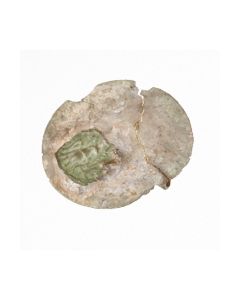 Ancient fibula from the Hattatt collection
Ancient fibula of the rare adlocutio type. Repoussé work of a scene from a Roman sestertius of Hadrian in celtic style. Find from Dorset in Roman Britain. Published in Hattatts famous book series on ancient fibulae.
Price: on request Published Roman fibula with celtic design
Ancient fibula from the Roman province of Britain. The design can be attributed to the celtic tribe of the Trinovantes or Iceni. From the famous Hattatt collection. Published twice.
Price: on request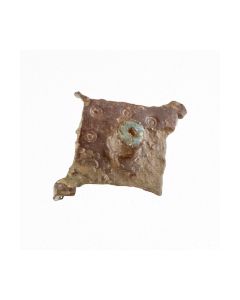 Roman fibula from the Richard Hattatt collection
Lozenge-shaped ancient roman fibula. The piece is published in the standard work "Iron Age and Roman Brooches". Found in Britain.
Price: on request