
Search results for: 'Roman a'
-
 Roman gold ring with eagle
The beautiful ring from Roman Imperial times is decorated by a black stone intaglio. The gem shows a standing eagle.
Price: on request Roman gold ring with intaglio
Nice fingerring with a glass paste showing a standing figure. Characteristic type for the 1st century CE, early Roman Imperial period.
Price: on request Roman lock bolts from Novaesium
Part of a key lock, e.g. for a door or chest. Finds from the Roman city of Novaesium, today's Neuss in Germany.
Price: on request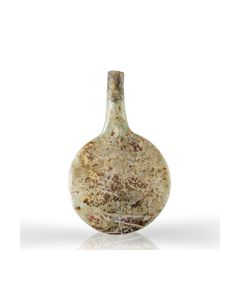 Roman lentoid glass flask
The flat bottle has a lentoid or discoid body with a long neck. Probably from the Roman province Judaea.
Price: on request Roman intaglio with mythical creature
Roman jewellery insert made of transparent glass paste. It shows a creature with the front part of a horse.
Price: on request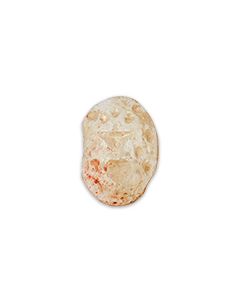 Roman intaglio with mixing vessel for wine
The Roman glass paste shows a tall vase surrounded by vine leaves. It is a mixing vessel for wine.
Price: on request Roman intaglio with galley
The skillful work shows a Roman galley with rowers. It is a very rare depiction for an ancient glass paste.
Price: on request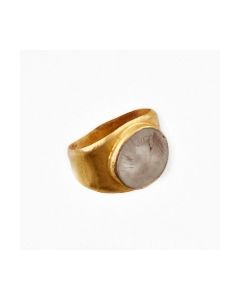 Roman gold ring with intaglio
A lovely piece of Roman jewellery in good condition. The chalcedony intaglio shows a portrait head. Dating to the 3rd century AD.
Price: on request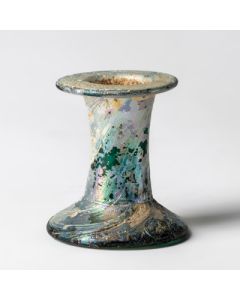 Roman glass
Beautifully iridescent turquoise-green glass in a cylindrical shape. From the Roman Imperial period.
Price: on request Roman jug made of aubergine glass
Beautiful glass with a violet colour. From the Roman Imperial period.
Price: on request Large impressive Terra Sigillata bowl found 1971 in the Rhineland with hunt scenes and Roman eagle
Found 1971 near the Roman city of Novaesium, today's Neuss in Germany, an early Roman foundation and with this one of the oldest cities in Germany. The decoration shows bears, hares, hounds, a wild boar, eros with hare and a Roman Imperial Eagle.
Price: on request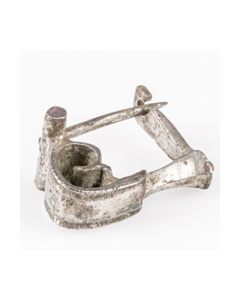 Roman silver fibula from Pannonia
Interesting brooch type from the Roman Pannonian provinces. A very similar piece was found near the Roman camp and settlement of Carnuntum in what is now Austria.
Price: on request Roman glass paste with young satyr
The ring insert shows a hybrid being standing on tiptoe, pouring from a shouldered amphora. A prime example of Roman glass pastes in almost perfect condition.
Price: on request Roman intaglio with mythical creature
Roman jewellery insert made of transparent glass paste, imitating amethyst. It shows a creature with the front part of a griffin.
Price: on request Roman intaglio with child Eros
Roman glass paste with nice depiction of the Greek god of love as a child, probably a lyre in his hands.
Price: on request Roman intaglio with mythical creature
Roman jewellery insert made of beautifully shimmering blue glass paste. It shows a creature with the front part of a horse.
Price: on request Roman intaglio with lion
Nice depiction of a lion on an orange glass paste from the Roman period.
Price: on request Clay impressions of Roman seals
The ancient impressions in clay are from papyrus documents issued and sealed in Roman times. A fantastic testimonial to Roman bureaucracy.
Price: on request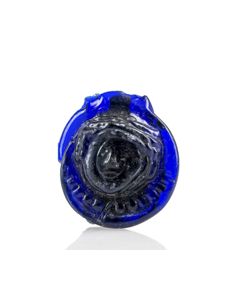 Roman glass applique with face
Striking cobalt blue glass, once decorating a 1st century glass vessel. From the Roman city of Novaesium.
Price: on request Roman intaglio with cornucopia
The Roman decorative insert made of orange glass paste shows a rich scene. Wonderful preservation.
Price: on request Roman intaglio with cornucopia
The Roman decorative insert made of orange glass paste shows a rich scene. Wonderful preservation.
Price: on request Roman intaglio with birds at water basin
The Roman glass paste shows an interesting scene with a water basin, birds and column.
Price: on request Roman glass paste with god
The roman intaglio shows a standing god. From the Professor Brosch collection of engraved gems.
Price: on request Two Roman lock bolts from Novaesium
Each was part of a key lock, e.g. for a door or chest. Finds from the Roman city of Novaesium, today's Neuss in Germany.
Price: on request Roman intaglio with person in mantle
An ancient intaglio from Roman times made of nice orange glass paste. It shows a person leaning on a sword or rudder stock.
Price: on request Roman intaglio with goat
Roman jewellery insert made of light blue glass paste, imitating Nicolo. It shows a he-goat with a smaller animal in front of it.
Price: on request Roman intaglio with suckling horse
Roman jewellery insert made of dark glass paste. It depicts a horse with a foal. From the Professor Brosch collection of engraved gems.
Price: on request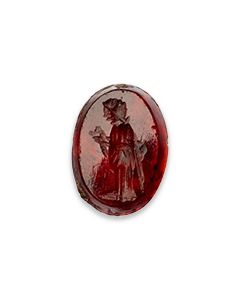 Roman intaglio of carnelian
The gem stone from the Late Roman Imperial period is engraved in linear style. It shows a standing person in a cloak.
Price: on request Roman glass rod
The object had a function as a distaff, a tool for spinning. Particularly noteworthy is the beautiful spiral decoration and the complete preservation of the fragile material. From the Roman Imperial period.
Price: on request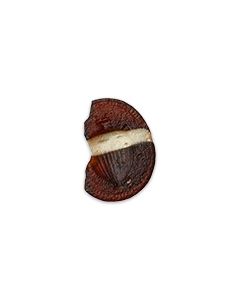 Roman intaglio with vase
The Roman ring insert is made of beautiful dark purple glass paste with a white band. It shows a bulbous vase with taeniae.
Price: on request Roman bronze chain
Fox tail type chain fragment. A Find from the Roman city of Novaesium, today's Neuss in Germany.
Price: on request Roman intaglio with horse protome and Silenus head
Illustration of a hybrid creature from the Roman Imperial period. Magical powers were attributed to it.
Price: on request Large Roman roof tile from the Rhineland
Great condition, very rare for a Roman tile of this size. Found near the Roman city of Novaesium, today's Neuss in Germany, an early Roman foundation and with this one of the oldest cities in Germany.
Price: on request Roman ribbed glass bowl
Of beautiful, thick-walled glass of a bright light green color. The glass was mold made in a Roman factory of the eastern Mediterranean.
Price: on request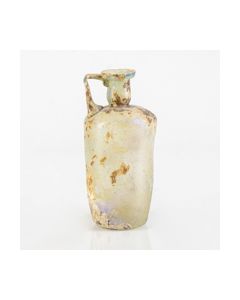 Roman glass bottle with handle
The cylindrical vessel has a nice iridescent patina. It was made in the Roman Imperial period.
Price: on request Roman indented beaker
Glass beaker with pitting. A popular type across the whole roman empire. Mid 1st to 2nd cent. AD.
Price: on request