

Search results for: 'bronze pin'
-
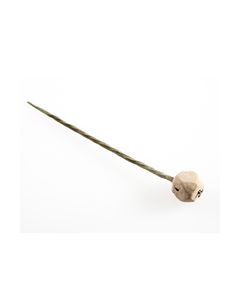 Römischer Bronzepin mit Keramikkopf
Spiralförmig dekorierte Nadel, an einem Ende polygonale Keramikperle als Kopfschmuck. Perfekt erhalten, schöne Patina.
Price: on request Massive römische Pinzette aus Bronze, außergewöhnliche Erhaltung
Die Seiten sind durch ein Rautenmuster verziert. Mit schöner Fundpatina. Flexibel und auch heute noch uneingeschränkt nutzbar.
Price: on request Roman bronze figurine of a jumping dog
Very realistic and detailed ancient piece of art. Perfectly preserved, nice patina.
Price: on request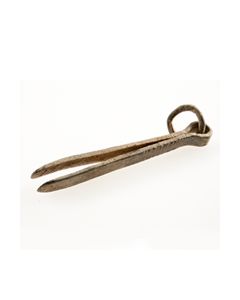 Griechische Pinzette aus Bronze
Antike Pinzette aus Bronze mit Tragering. Im oberen Bereich mit Linien verziert. Exzellente Erhaltung, schöne Patina.
Price: on request Römische Pinzette aus Bronze
Typische Pinzette der späten Kaiserzeit, nicht restauriert und perfekt erhalten. Schöne, dunkle Patina.
Price: on request Early Etruscan fibula
The early Etruscan bronze brooch is characterized by its artistically decorated bow. A find from northern Italy.
€140 massiver antiker Haken mit Verzierung
Massiver Haken, Länge ca. 120 mm. Unterhalb des als stark abgeflachte Kugel gestalteten Kopfes Ziermuster.
Price: on request Römische Diskusbrosche aus Bronze
In Form eines Rades. Gekrümmte Speichen zwischen zentralem Diskus und Randring. Musealer Zustand mit schöner Patina und Spuren von Silberauflage.
Price: on request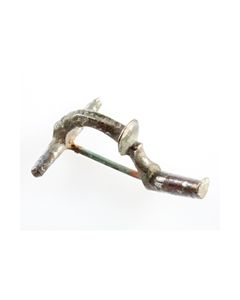 Römische Armbrustfibel aus Silber und Bronze
P-förmiger Fibelkörper mit Zierelementen. Vorform der Zwiebelkopffibel aus dem 3. Jh. n. Chr.
Price: on request Brooch from Roman Britain
A rare mixture of cicada fibula and trumpet fibula, from the 2nd century. Found on the Isle of Wight.
Price: on request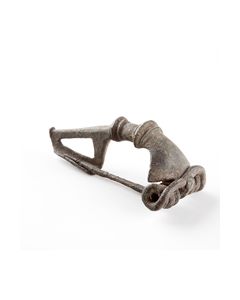 Römische Kräftig Profilierte Fibel
Fibeltyp der frühen römischen Kaiserzeit, sogenannte kräftig-profilierte Fibel. 1. Jh. n. Chr., 58mm lang, in museumswürdiger Erhaltung.
Price: on request Römische Scheibenfibel mit Glaskamee
Antike Brosche mit Glasverzierung in Gesichtsform. Sehr seltenes Schmuckstück, Kamee von hervorragender Qualität. 2. bis 5. Jh. n. Chr. 32mm Durchmesser, 7,3g.
Price: on request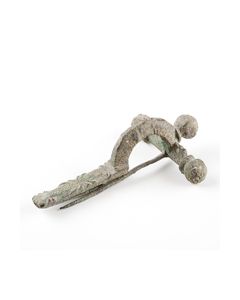 Römische Armbrustfibel
Prominente kugelförmige Knöpfe. Direkter Vorläufer der Zwiebelknopffibeln. Soldatenfibel aus der 1. Hälfte des 4. Jh. n. Chr. 76mm lang.
Price: on request Egyptian bronze figurine of Isis with Horus
Isis is shown in a very typical depiction as a mother, the archetype of the later Christian Nursing Madonna. This bronze figurine comes from an old museum collection.
Price: on request Bronze statuette of nursing Isis
Isis is shown in a very typical depiction as a mother, the archetype of the later Christian Nursing Madonna. The bronze figurine dates to the 22nd to 31st dynasty of Ancient Egypt.
Price: on request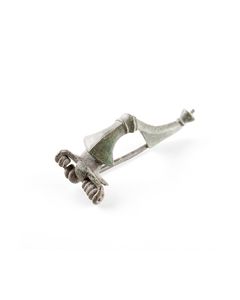 Römische Kräftig Profilierte Fibel
Fibeltyp der späten römischen Kaiserzeit, sogenannte kräftig-profilierte Fibel. 1. bis Mitte 3. Jh. n. Chr., 66mm lang, in museumswürdiger Erhaltung.
Price: on request Dolphin brooch from Roman Britain
The so-called dolphin brooch is very British. This specimen was probably made by the Celtic Corieltauvi tribe, shortly after the arrival of the Romans in the middle of the 1st century. Published in two works by Richard Hattatt.
Price: on request Römische Kniefibel
Antike Gewandnadel vom Typ der Kniefibeln. Körper aus schön patinierter Bronze, 35mm lang. 2. Jh. n. Chr., römische Kaiserzeit.
Price: on request Disc brooch from Roman Britain
Nicely enameled brooch with a Romano-Celtic sunburst design. From the 2nd century AD. Published in two stardard works on ancient brooches by Richard Hattatt.
Price: on request Etruscan bronze figurine of a man with pan pipes
Scarce, early depiction, stylistically still strongly influenced by the kouroi of the 6th century BC, but incorporating the pan flute as an element of daily life or a ritual context. Very good condition, with a fine dark green patina. Ex Cahn AG.
€6,980 Roman silver fibula
Interesting type of brooch from the Roman Imperial period. Nice specimen made of silver.
Price: on request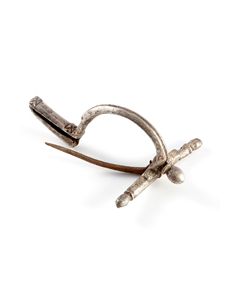 Römische Zwiebelknopf-Fibel aus Silber
Beliebter Fibeltyp des 3. und 4. Jh. n. Chr. Typischerweise von römischen Männern getragen. Der Träger dieser Fibel aus Silber hatte sicher eine gehobene soziale Stellung.
Price: on request Roman Hod Hill brooch
Made around the year 100 and found on the Isle of Wight, after the Roman conquest of Britain.
Price: on request Disc brooch from Roman Britain
Brooch with a Romano-Celtic sunburst design. Circa 2nd century. A find from Roman Britain
Price: on request Brooch from Roman Britain
This rare variant of the T-shaped brooches was found in Lechlade, Gloucestershire. It dates to the 1st or 2nd century AR. From the famous Hattatt collection and published in two standard works for ancient fibulae.
Price: on request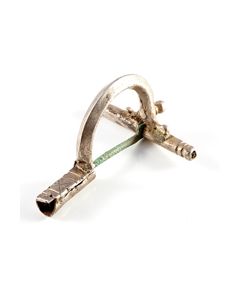 Römische Zwiebelknopf-Fibel aus Silber
Beliebter Fibeltyp des 3. und 4. Jh. n. Chr. Typischerweise von römischen Männern getragen. Der Träger dieser Fibel aus Silber hatte sicher eine gehobene soziale Stellung.
Price: on request Roman plate brooch
Beautiful example with orange and turquoise enamel. A find from 2nd century Roman Britain.
Price: on request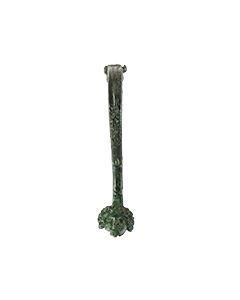 Published Hellenistic bronze handle with figurative decorations
Featuring a three-dimensional depiction of a grim satyr's head and Medusa's head. On both sides of the handle are three-dimensional volutes culminating in the depiction of a charging boar. The workmanship is of exceptionally fine quality.
€1,800 Roman brooch of the Hod Hill type
Beautifully decorated brooch from the first century. A find from the Roman city of Novaesium, today's Neuss in Germany.
Price: on request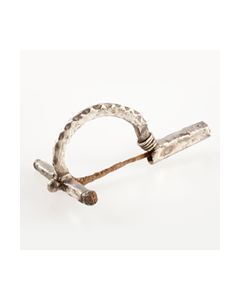 Silberne Armbrust-Fibel um 300 n. Chr.
Römische Fibel vom Typ der Armbrust-Fibeln. Massives Silber, 14,6g, 280 bis 320 n. Chr. Hervorragender Zustand.
Price: on request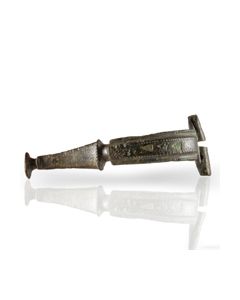 Roman Hod Hill brooch from the Hattatt collection
Nice and rare enameled variant of the Hod Hill type. Found in Norfolk, UK. The piece is published in two books by Richard Hattatt.
Price: on request Enameled disc brooch from Britain
Colourful enameled brooch from the Roman Imperial period. Published in two stardard works on ancient brooches by Richard Hattatt.
Price: on request Roman seal box with phallus
Circular body with protective phallus in high relief on the lid. A piece from the Roman Imperial period, found in North East England. Published in a standard work by Richard Hattatt.
Price: on request