
Tools - Iron Age - Southern Europe - Photo gallery
Image database with photographs of ancient art and antiquities
Our image database provides photographs of ancient art and antiquities for press releases as well as for private use. All artefacts sold in our gallery are documented through professional photographs. The resulting image library contains numerous ancient Egyptian, Greek and Roman antiquities as well as ancient coins. The time span from Stone Age, over Bronze Age and Classical Antiquity until Late Antiquity is covered.The photo gallery aims at providing a vast visual archive equipped with filters and search tools. You are most welcome to search the constantly growing number of artefacts in the image library. We are also happy to authorize hyperlinks from your webpage / forum to the objects depicted in our gallery. For this purpose, please send us a short notification prior to placing a hyperlink. For almost every object high definition photographs are available and can be provided e.g. to document your collection or for scientific papers or popular science articles. If you are interested in using pictures for publications, print media or other purposes, please contact us and we will be happy to assist you.
-
 Egyptian amulet mould from the Amarna period
Gussform aus Terrakotta, für ein Amulett in Form eines Blütenblatts. 18. bis 19. Dynastie, 1600 v. Chr. bis 1100 v. Chr., Altes Ägypten.
Price: on request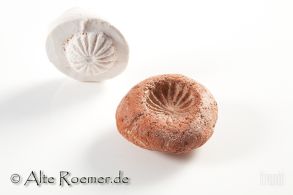 Egyptian amulet mould from the Amarna period
Gussform aus Terrakotta, für ein Amulett in Form eines Blütenblatts. 18. bis 19. Dynastie, 1600 v. Chr. bis 1100 v. Chr., Altes Ägypten.
Price: on request Egyptian scarab amulet mould
Gussform aus Terrakotta, für ein Amulett in Form eines Skarabäuskäfers. Neues Reich bis ptolemäische Zeit.
Price: on request Gruppe von 8 Bronzewerkzeugen
Etwa 2. Jt. v. Chr. bis 5. Jh. n. Chr., Bronzezeit bis Spätantike. Diverse Gegenstände aus Bronze, darunter Haarpins, zwei Nadeln, ein Spatulum.
Price: on request Antike Bronzenadel
Antike Nadel aus Bronze. 16cm lang. Vorne spitz zulaufend, hinten verbreitertes Ende mit vorgelagerter Öse. Vermutlich als Nähnadel verwendet.
Price: on request Großer, antiker Spinnwirtel
Spinnwirtel aus Ton. Bikonische Form, Durchmesser 48 mm. Keltische bis römsiche Zeit.
Price: on request Antike Bronzenadel
Antike Nadel aus Bronze. 15cm lang. Vorne spitz zulaufend, hinten verbreitertes Ende mit vorgelagerter Öse. Vermutlich als Nähnadel verwendet.
Price: on request Antike Bronzenadel
Antike Nadel aus Bronze. 14cm lang. Vorne spitz zulaufend, hinten verbreitertes Ende mit vorgelagerter Öse. Vermutlich als Nähnadel verwendet.
Price: on request Antike Bronzenadel
Antike Nadel aus Bronze. 15cm lang. Vorne spitz zulaufend, hinten verbreitertes Ende mit vorgelagerter Öse. Vermutlich als Nähnadel verwendet.
Price: on request Antike Bronzenadel
Antike Nadel aus Bronze. 16cm lang. Vorne spitz zulaufend, hinten verbreitertes Ende mit vorgelagerter Öse. Vermutlich als Nähnadel verwendet.
Price: on request Antike Bronzenadel
Antike Nadel aus Bronze. 17cm lang. Vorne spitz zulaufend, hinten verbreitertes Ende mit vorgelagerter Öse. Vermutlich als Nähnadel verwendet.
Price: on request Ägyptische Gussform aus der Amarna-Zeit
Gussform aus Terrakotta, für ein Amulett in Form eines Blütenblatts. 18. bis 19. Dynastie, 1600 v. Chr. bis 1100 v. Chr., Altes Ägypten.
Price: on request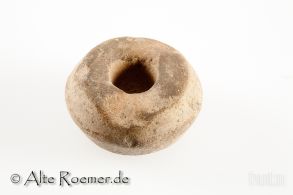 Keltischer Spinnwirtel
Spinnwirtel aus Ton. Bikonische Form, Durchmesser 28 mm. Aus keltischer Zeit.
Price: on request Keltischer Spinnwirtel aus Ton
Großer Tonwirtel, antikes Spinnzubehör, ca. 200 v. Chr., Fund aus Posen, Polen. 30mm Durchmesser.
Price: on request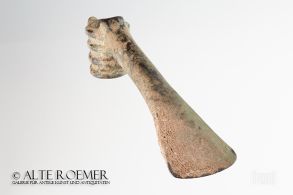 Luristan ceremonial pick
The elaborate decorations are contrary to the actual use as a pick. The object is from the class of pseudo tools common in Iran at the end of the 2nd millenium BC. It probably served a ritualistic purpose.
Price: on request Luristan hatchet with eyes
Axe head originating from the Luristan region during Iron Age. The piece is decorated with eyes to form a stylized bird's head.
 Luristan bronze axe
Nicely decorated axe head originating from the Luristan region. From the Sasson family collection.