
Recent acquisitions - Sold antiquities
Archive of sold antiquities
All artefacts sold in our gallery are fully documented in our online archive and database. Being a specialist ancient art dealer, preserving also the more recent history of each and every piece sold in our shop is at our heart. That is particularly useful for artefacts that changed owners in the meantime. Information that may have been lost in the process can be easily restored from our archives. Please do not hesitate to contact us if you need further information about ancient items that have been sold in our gallery. We can help you with reconstructing the history of ownership for those items. All information about our customers will be kept confidential, of course.-
 Two Roman lock bolts from Novaesium
Each was part of a key lock, e.g. for a door or chest. Finds from the Roman city of Novaesium, today's Neuss in Germany.
Price: on request Egyptian faience figurine of Sekhmet
Protective amulet in the form of a statuette of the lion-headed goddess with a hieroglyphic inscription on the back. A wonderful and large faience from the Third Intermediate Period of Ancient Egypt.
Price: on request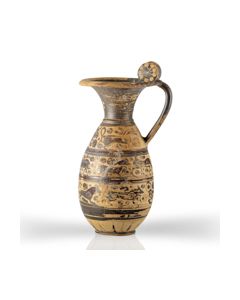 Large etrusco-corinthian Olpe with animals
Impressive, extremely well preserved piece showing various animals. Ex Mara Scotoni-Coppetti collection, acquired 1971 at S.A.D.A. Volterra's Gallery, Florence.
Price: on request Very large Roman mortarium from the Rhineland
Found near the Roman city of Novaesium, today's Neuss in Germany, an early Roman foundation and with this one of the oldest cities in Germany.
Price: on request Group of 10 Roman sestertii from Wishanger hoard
Found 2021 in East Hampshire, UK. The hoard is a very impressive proof of the fact that coins were in circulation for up to several centuries in the Roman era.
Price: on request Roman Republican denarius from Wishanger hoard
Anonymous, 2nd century BC. Found 2021 in East Hampshire, UK. Best condition of the five Marc Antony denarii in the hoard. The hoard is a very impressive proof of the fact that coins were in circulation for up to several centuries in the Roman era.
Price: on request Byzantine glass pendant from Judaea
The pendant with a lion and crescent motif was worn as a lucky charm or protective amulet. Made in the early Byzantine period in a glass workshop in Judaea.
Price: on request Roman globular glass bottle
Beautifully decorated with bands of incised decorative grooves. Spherical body and funnel-shaped neck.
Price: on request Roman intaglio with lion or lioness
Roman jewellery insert made of dark glass paste with a slim white band. From the Professor Brosch collection of engraved gems.
Price: on request Roman intaglio with horse protome and Silenus head
Illustration of a hybrid creature from the Roman Imperial period. Magical powers were attributed to it.
Price: on request Roman intaglio with Hercules
The ring insert is made glass paste with a dark surface. It shows Heracles wrestling with the Nemean lion.
Price: on request Very fine Domitian sestertius
The reverse shows Jupiter seated left, holding Victory and sceptre. Ex Gerhard Hirsch Nachf. Auktion 163 (1989), Lot Nr. 899.
Price: on request Herodian oil lamp from Adler collection
So-called Herodian oil Lamp, from a type dating to the lifetime of Jesus Christ. From the famous Judge Dr. Steve Adler collection. Exported from Israel with IAA permit Nr. 53397.
Price: on request Roman Terra Sigillata plate from workshop of Virilis from the Rhineland
With potter's mark OF VIRILI. Found near the Roman city of Novaesium, today's Neuss in Germany, an early Roman foundation and with this one of the oldest cities in Germany.
Price: on request Marc Antony legionary Denarius from Wishanger hoard
LEG V or X. Found 2021 in East Hampshire, UK. The hoard is a very impressive proof of the fact that coins were in circulation for up to several centuries in the Roman era.
Price: on request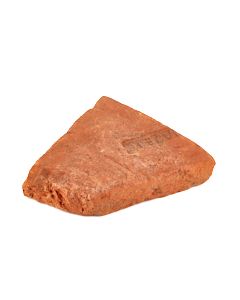 Roman legionary tile from the Rhineland
LEG VI (Victrix), 70 - 104 AD. Found 1966 till 1981 near the Roman city of Novaesium, today's Neuss in Germany. Novaesium was an early Roman foundation and with this is one of the oldest cities in Germany.
Price: on request Very large Athenian kylix
Impressive vessel, measuring over 40cm with handles. From the German private collection Dr. Dietrich, acquired 1978.
Price: on request Two Roman glass unguentaria
The early imperial perfume bottles are from the eastern Mediterranean. Acquired in 1974 from art dealer Albrecht Neuhaus.
Price: on request Roman ribbed glass bowl
Of beautiful, thick-walled glass of a bright light green color. The glass was mold made in a Roman factory of the eastern Mediterranean.
Price: on request Almost extremely fine Septimius Serverus denarius with beautiful black patina
Rare (RIC R1). Ex Gerhard Hirsch Nachf. Auktion 141 (1984), Lot Nr. 701.
Price: on request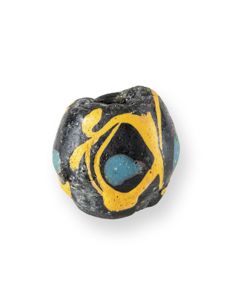 Glass bead with polychrome decoration
Large bead made of opaque dark blue glass decorated with yellow lines and light blue eyes.
Price: on request Roman intaglio with rider
Exciting depiction of a winged rider on the back of a griffin. Orange glass paste.
Price: on request Roman intaglio with wading bird
The skillful work shows a wading bird, possibly a heron. Its legs bent beneath the body. The neck drawn back towards the body.
Price: on request Roman intaglio with butterfly
The dark glass paste shows a butterfly sitting on an object. Beautiful motif.
Price: on request Roman intaglio with cornucopia
The Roman decorative insert made of orange glass paste shows a rich scene. Wonderful preservation.
Price: on request Roman oil lamp with theatre mask from the Rhineland
So-called "Factory Lamp". Found 1968 near the Roman city of Novaesium, today's Neuss in Germany. Novaesium was an early Roman foundation and with this is one of the oldest cities in Germany.
Price: on request Very fine Domitian denarius
The reverse shows Minerva with spear. Ex Gerhard Hirsch Nachf. Auktion 159 (1988), Lot Nr. 675.
Price: on request Roman jug made of aubergine glass
Beautiful glass with a violet colour. From the Roman Imperial period.
Price: on request Roman glass beaker
Rare cup made of almost colourless glass. A 4th century product from the eastern Mediterranean.
Price: on request Roman glass bracelet with spiral decoration
The 4th century bangle is decorated with white spiraling glass inlay. Made in the Eastern Mediterranean.
Price: on request Roman glass bottle with handle
The cylindrical vessel has a nice iridescent patina. Made between 50 and 200 AD on the Black Sea coast or in the Near East.
Price: on request Roman intaglio with mythical creature
Roman jewellery insert made of transparent glass paste, imitating amethyst. It shows a creature with the front part of a griffin.
Price: on request Roman intaglio with horse
Fragmentary roman jewellery insert made of transparent orange glass paste with a white band. From the Professor Brosch collection of engraved gems.
Price: on request Roman intaglio with raven
Wonderful rich blue glass paste. Well-preserved illustration of the bird.
Price: on request Egyptian chalice
The thin-walled stone cup is reminiscent of a lotus bud. From the collection of Egyptologist Professor Wiedemann. 18th dynasty of Ancient Egypt.
Price: on request Slender Egyptian stone beaker
The small and tall stone vessel is made of alabaster. From the collection of Egyptologist Professor Wiedemann.
Price: on request