
Sold antiquities
Archive of sold antiquities
All artefacts sold in our gallery are fully documented in our online archive and database. Being a specialist ancient art dealer, preserving also the more recent history of each and every piece sold in our shop is at our heart. That is particularly useful for artefacts that changed owners in the meantime. Information that may have been lost in the process can be easily restored from our archives. Please do not hesitate to contact us if you need further information about ancient items that have been sold in our gallery. We can help you with reconstructing the history of ownership for those items. All information about our customers will be kept confidential, of course.-
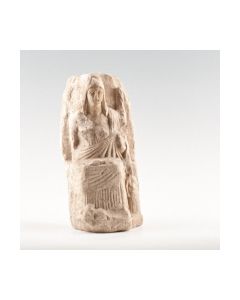 Stone statue of a seated Isis
Very fine condition, from an important London collection
Price: on request Terra Sigillata head vase from El Djem
Impressive, perfectly preserved vase from old German collection. Coming with an Art Loss certificate.
Price: on request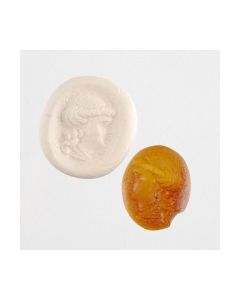 Roman intaglio with portrait of a lady
Finely worked Roman ring stone from bright orange glass. An artwork in great detail from Roman times.
Price: on request Roman oil lamp showing Diana with two dogs
Perfectly preserved oil lamp from an old German collection
Price: on request Roman oil lamp showing Jupiter with eagle and thunderbolt
Image which, together with the she-wolf, stands out most prominently for ancient Rome. From old German collection
Price: on request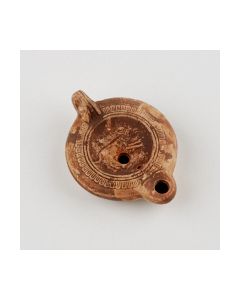 Perfectly preseved imperial roman oil lamp with dog
Extraordinary fine and detailed dog depiction. From old German collection
Price: on request Roman oil lamp with standing goddess
Goddess dressed in long robe, holding cornucopia. From old German collection
Price: on request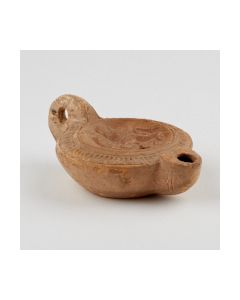 Roman oil lamp with imperial equestrian statue
Impressive, perfectly preserved lamp from old German collection
Price: on request Luristan ceremonial pick
The elaborate decorations are contrary to the actual use as a pick. The object is from the class of pseudo tools common in Iran at the end of the 2nd millenium BC. It probably served a ritualistic purpose.
Price: on request Egyptian protective amulet and seal with Pataikos
Dwarf god with knifes in his hands and Eye of Horus on his belly. The bottom side is made as a stamp seal with hieroglyphic inscription. Work of highest quality with fine details. Dating to the Third Intermediate Period.
Price: on request Roman military whistle
Historically interesting example of Roman military equipment. Whistles of this type have been used in the 1st to 2nd cent. AD. Their function is not fully understood, yet.
Price: on request Roman specillum
The so-called specillum is a surgical probe. It was standard issue for roman doctors. Similar probes are still in use today. 1st to 4th cent. AD.
Price: on request Double spiral pendant from Bronze Age Central Europe
Typical decorative element of a wealthy woman's dress in the European Middle Bronze Age. Several of these spiral pendants were worn around the waist. Similar to belt mounts or charms. 1500 to 1200 BC.
Price: on request Byzantine earring
Nice bronze earring with interesting conical decoration. 9th to 13th century AD. Damaged.
Price: on request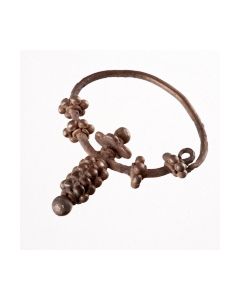 Byzantine earring
Nice bronze earring with interesting conical decoration. 9th to 13th century AD.
Price: on request Byzantine earring
Nice bronze earring with interesting conical decoration. 9th to 13th century AD.
Price: on request Byzantine earring
Nice bronze earring with interesting conical decoration. 9th to 13th century AD.
Price: on request Egyptian heart scarab
Big beetle stone from the Late Period of Ancient Egypt. Scarabs of this kind have been placed next to the heart on mummies. Nice mint green fayence.
Price: on request Ancient intaglio with head of a Black African
Engraved gem of beautiful pink glass. The portrait head has dreadlocks and a strongly characterized face. Intaglio from Roman times.
Price: on request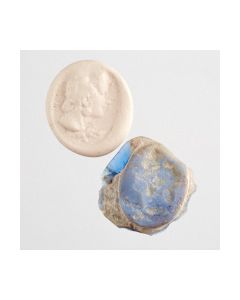 Roman intaglio with a young woman
Miniature work in a colourful glass paste changing from bright blue to an opaque light blue. The intaglio from Roman times exhibits the portrait head of a young woman.
Price: on request Herodian oil lamp found in the Negev desert
Prominent oil lamp type which was used in the Holy Land during the lifetime of Jesus Christ. Found during an early Paleochristian excavation by Dr. Willi Korte in the Negev desert, Israel.
Price: on request Perfectly centered Domitian aureus
Reverse showing cornucopiae, in field COS IIII. Almost extremely fine, Rome 76-77 AD
Price: on request Celtic gold stater from the age of Caesar's Gallic Wars
Extremely fine Ambiani gold stater, 60-25 BC. AV: Plain bulge (remnants of the head of Apollo); RV: Abstract horse right, below and above dots and sickles.
Price: on request Roman Republic - Denarius - P. Accoleius Lariscolus
Rome, 43 BC. AV: Bust of Diana Nemorensis, RV: Triple cult statue of Diana Nemorensis facing, supporting on hands and shoulders beam with five cypress trees; the figure on the left holding poppy, the figure on the right holding lily. Attractive dark patina.
Price: on request Rare Markus Antonius fouree denarius
Mint moving with Antonius. 42 BC, the year which has seen the 2nd triumvirat and the death of Caesar's murderer Brutus. Great cabinet patina, very rare in this condition.
Price: on request Applique of the Horus son Duamutef
Bright turquise fayence. Duamutef is one of the four sons of Horus, well-known from the Canopic jars. He had an important protective function for the dead. Egypt, 8th to 4th cent. BC.
Price: on request Whistle from plastic bronze
Nice small whistle made of a high lead content bronze. Probably produced in the Modern Age.
Price: on request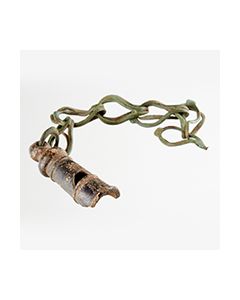 Roman military whistle
Historically interesting example of Roman military equipment. Whistles of this type have been used in the 1st to 2nd cent. AD. Their function is not fully understood, yet.
Price: on request Skarabäus mit Kartusche des Chaneferre
Skarabäus mit Namens-Kartusche des Königs Chaneferre (Sobekhotep IV.). 13. Dynastie des Alten Ägyptens, ca. 1700-1680 v. Chr.
Price: on request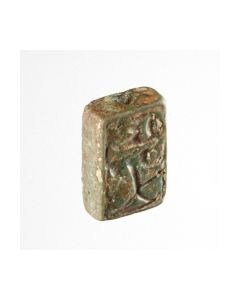 Ägyptisches Plättchen mit Kartusche des Sethos I.
Doppelseitige Platte aus grüner Fayence aus dem Neuen Reich, ramessidisch, um 1290 v. Chr. Sphinx und Kartusche (Men-Maat-Re) und Namens-Kartusche mit dem Eigennamen Meri-en-Ptah.
Price: on request Roman surgical probe made of bronze
The so-called specillum was standard issue for roman doctors. Similar probes are still in use today. Very fine craftsmanship of an ancient surgical instrument.
Price: on request Roman surgical probe made of silver
The so-called specillum was standard issue for roman doctors. Similar probes are still in use today. Ancient surgical instruments made of silver are extremely rare.
Price: on request Double spiral pendant from Bronze Age Central Europe
Typical decorative element of a wealthy woman's dress in the European Middle Bronze Age. Several of these spiral pendants were worn around the waist. Similar to belt mounts or charms. 1500 to 1200 BC.
Price: on request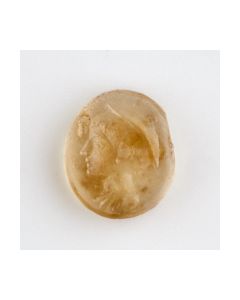 Roman Intaglio with bust of Mercury
The glass paste shows Hermes in travel garment. The motive is taken from older Greek gem stones. In Roman culture the god Hermes was known as Mercurius (Mercury).
Price: on request Roman Intaglio with helmeted bust
Nice ancient intaglio made of beautiful greenish yellow glass. The quality work shows the portrait of a young military wearing a Corinthian helmet.
Price: on request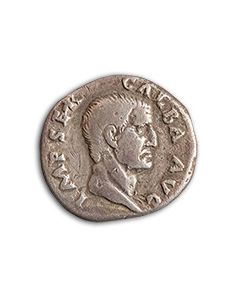 Galba Denarius, almost extremely fine
Nicely centered speciman, showing a very impressive portrait of a typical Roman aristocrat. RIC rare.
Price: on request