
Available - Lehrsammlung - Photo gallery
Image database with photographs of ancient art and antiquities
Our image database provides photographs of ancient art and antiquities for press releases as well as for private use. All artefacts sold in our gallery are documented through professional photographs. The resulting image library contains numerous ancient Egyptian, Greek and Roman antiquities as well as ancient coins. The time span from Stone Age, over Bronze Age and Classical Antiquity until Late Antiquity is covered.The photo gallery aims at providing a vast visual archive equipped with filters and search tools. You are most welcome to search the constantly growing number of artefacts in the image library. We are also happy to authorize hyperlinks from your webpage / forum to the objects depicted in our gallery. For this purpose, please send us a short notification prior to placing a hyperlink. For almost every object high definition photographs are available and can be provided e.g. to document your collection or for scientific papers or popular science articles. If you are interested in using pictures for publications, print media or other purposes, please contact us and we will be happy to assist you.
-
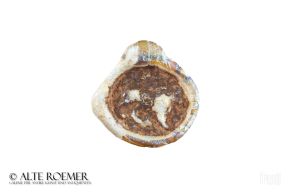 Byzantine glass pendant from Judaea
The pendant with an ibex motif was worn as a lucky charm or protective amulet. Made in the early Byzantine period in a glass workshop in Judaea.
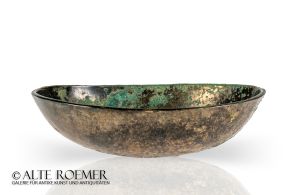 Sasanian silver bowl
Good example of high quality Sassanid craftsmanship. Acquired at Sotheby's in 1981.
 Athenian fish plate
Very nicely preserved. From an old German private collection, acquired in the early 1950s.
 Luristan hatchet with eyes
Axe head originating from the Luristan region during Iron Age. The piece is decorated with eyes to form a stylized bird's head.
 Luristan axe head
Bronze axe originating from the Luristan region during Bronze Age. From the Sasson family collection.
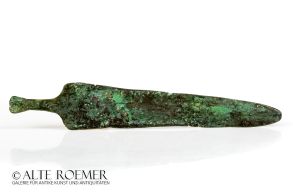 Luristan bronze dagger
Double-edged blade of a short dagger from the Luristan region in Ancient Iran. An early type from the Middle Bronze Age.
 Luristan bronze dagger
Double-edged blade of a dagger from the Luristan region in Ancient Iran. An early type from the Middle Bronze Age.
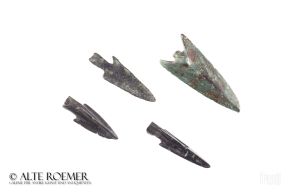 Four Scythian arrow heads
Group of four arrowheads made of bronze in excellent condition. Popular weapon of the cultures of the 1st Millennium BC.
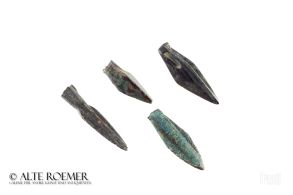 Four Scythian arrow heads
Group of four arrowheads made of bronze in excellent condition. Popular weapon of the cultures of the 1st Millennium BC.
 Very large Italic wave-shaped brooch
Made from bronze wire. A very rare brooch type from around 1000 BC.
 Early Etruscan sanguisuga fibula
The early Etruscan bronze brooch is characterized by its artistically decorated bow. A find from northern Italy.

 Neolithic flint dagger from Denmark
Double-edged blade and flat shaft made of beautiful flintstone. A status symbol from the transitional period between Late Neolithic and Early Bronze Age.
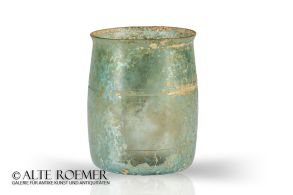 Roman glass beaker
Beautiful turquoise glass with incised decorative grooves. From the 1st or 2nd century AD.
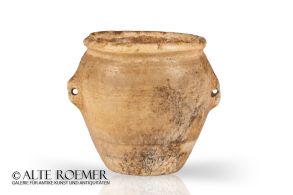 Egyptian stone beaker
Elegant stone vase made of beautifully marbled calcite alabaster. From between the 1st and 3rd dynasty of ancient Egypt.
 Apulian-Corinthian bronze helmet - ex Axel Guttmann collection
Worth the exhibition in a museum. With fine decoration including large boars. Published by H. Born (1993) and M. Junkelmann (2000). Ex Christie's London and Royal Athena Galleries New York.
 Large Italic serpentine fibula
A bronze brooch dating to the Italic Iron Age. The piece is elaborately adorned by wonderful incised decorations.
 Early Etruscan sanguisuga fibula
The early Etruscan bronze brooch is characterized by its artistically decorated bow. A find from northern Italy.

 Three neolithic arrowheads from Egypt
The Stone Age points are finely crafted. From a 100 year old museum collection.
 Luristan bronze standard with master of animals
Bronze finial from Iron Age Northern Iran. Decorated by stylized panthers and a janus headed hero or god. Possibly a teraphim, a house god, as referred to in the Old Testament.
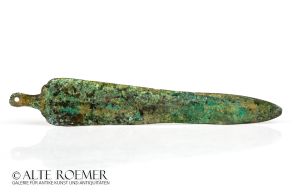 Luristan bronze dagger
Double-edged blade of a short dagger from the Luristan region in Ancient Iran. An early type from the Middle Bronze Age.
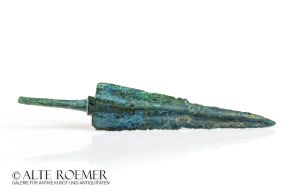 Near Eastern spearhead
Double-edged blade of a small spear or large arrow from Bronze or Early Iron Age. With a nice green patina.
 Luristan battle axe with eyes
Axe head originating from the Luristan region during Early Bronze Age. The piece is decorated with eyes to form a stylized bird's head.
 Luristan bronze axe
Nicely decorated axe head originating from the Luristan region. From the Sasson family collection.
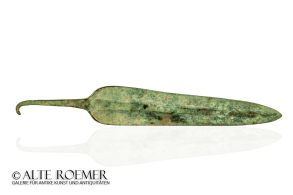 Luristan bronze dagger
Double-edged blade of a long dagger from the Luristan region in Ancient Iran. From the Sasson family collection.
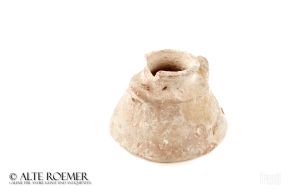 Bronze Age clay vessel
Nice small biconical vessel from the Eastern Mediterranean. Dating to the Late Bronze Age.
 Roman potsherds from the Rhineland - sold by weight
Fragments of Roman pottery. Finds from the Roman city of Novaesium, today's Neuss in Germany, an early Roman foundation and with this one of the oldest cities in Germany.
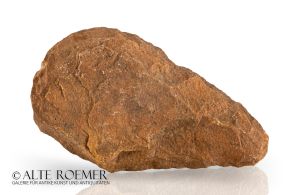 Paleolithic hand axe
Prehistoric stone tool. It was the universal tool of the older Stone age and could be used as a borer or a cutter. From a Swiss museum collection. Found in Algeria, North Africa.
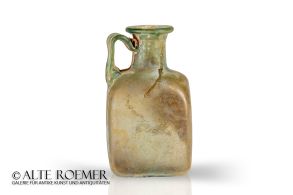 Roman square glass bottle
Typical and popular glass vessel type from the Roman Imperial period. From the Heckmann collection.
 North African Roman oil lamp with bird
Nicely preserved. From an old German private collection, acquired in the first half of the 1970s from Oberamtsrat i.R. Hans Ullrich, Stuttgart, Germany.
 Published Roman bronze serapis bust
Excellently preserved incl. surface details. Nice green patina. From the collection of the art historian Steinbock, which was composed between 1920 and 1982.
 Roman legionary tile from the Rhineland
LEG VI (Victrix), 70 - 104 AD. Found 1966 till 1981 near the Roman city of Novaesium, today's Neuss in Germany. Novaesium was an early Roman foundation and with this is one of the oldest cities in Germany.
 Four Roman roof tile fragments from the Rhineland
Found 1966 till 1981 near the Roman city of Novaesium, today's Neuss in Germany. Novaesium was an early Roman foundation and with this is one of the oldest cities in Germany.
 Bronze applique with Medusa head
Very nicely preserved, beautiful green patina. From the collection of the art historian Steinbock, composed between 1920 and 1982.
 Very long iron lance head
Excellent condition for an iron object, mainly intact with very nicely preserved surface. From an old German private collection, acquired in the early 1980s.