
Sold - Sold antiquities
Archive of sold antiquities
All artefacts sold in our gallery are fully documented in our online archive and database. Being a specialist ancient art dealer, preserving also the more recent history of each and every piece sold in our shop is at our heart. That is particularly useful for artefacts that changed owners in the meantime. Information that may have been lost in the process can be easily restored from our archives. Please do not hesitate to contact us if you need further information about ancient items that have been sold in our gallery. We can help you with reconstructing the history of ownership for those items. All information about our customers will be kept confidential, of course.-
 Large Luristan horse pendant
The spectacular creature with conjoined horse bodies is characteristic for the bronze works of Luristan. From the early 1st Millenium BC.
Price: on request Bronze dagger with double-disc hilt
Elegant weapon of the Iron Age Amlash culture with broad and short blade. It is certainly a find from the province of Gilan in northern Iran.
Price: on request Celtic penannular brooch
Possibly made by the Celtic Durotriges tribe under Roman rule in Britain. The piece is published in two books by Richard Hattatt.
Price: on request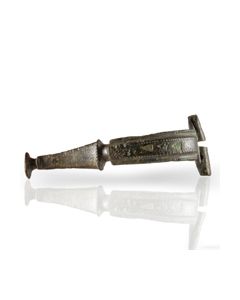 Roman Hod Hill brooch from the Hattatt collection
Nice and rare enameled variant of the Hod Hill type. Found in Norfolk, UK. The piece is published in two books by Richard Hattatt.
Price: on request Very fine Galba denarius
Ex old German private collection. Rare coin with beautiful "classical" Roman portrait.
Price: on request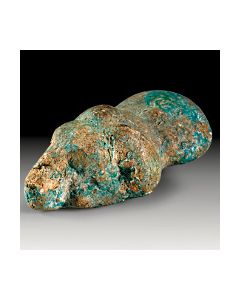 Egyptian amulet with ram head and sun disc
The rare depiction is typical of the god Khnum. From the Late Period to Ptolemaic period of Ancient Egypt.
Price: on request Flint blade and stone mould
Interesting group of two artefacts. A Neolithic flint blade from Egypt and a Bronze Age mould for casting or hammering metal.
Price: on request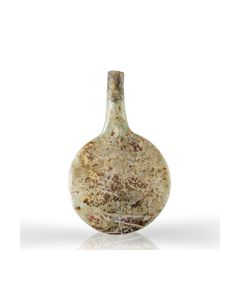 Roman lentoid glass flask
The flat bottle has a lentoid or discoid body with a long neck. Probably from the Roman province Judaea.
Price: on request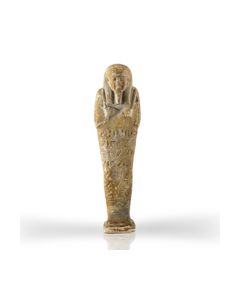 Egyptian ushabti of the Royal Scribe Hor-maa-kheru
The Egyptian funerary figurine dates to the reign of Pharaoh Amasis II, towards the end of the 26th Dynasty. Excavated in Saqqara in the mid-19th century. Shown in a 1979 Sotheby's catalogue.
Price: on request Three neolithic arrowheads from Egypt
The Stone Age points are finely crafted. From a 100 year old museum collection.
Price: on request Three neolithic arrowheads from Egypt
The Stone Age points are finely crafted. From a 100 year old museum collection.
Price: on request Three neolithic arrowheads from Egypt
The Stone Age points are beautifully crafted. From a 100 year old museum collection.
Price: on request Egyptian faience statuette of Taweret
Simplistic depiction of the protective goddess for pregnant women. It can be worn as an amulet. A piece from the Late Period of Ancient Egypt.
Price: on request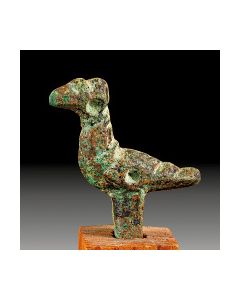 Bronze bird from Late Antiquity
Finial in the shape of a bird, probably once the head of a rod or distaff. From the Late Roman or Early Byzantine period.
Price: on request Roman clay statuette
Clay figure of a man with a spherical object in front of his stomach. From the Roman province.
Price: on request Large black-figure athenian skyphos with parallel in a museum
Very impressive, cicely preserved large vase. Painted with women dancing between sphinxes. An almost identical piece is on exhibition at the Musee National Rodin in Paris.
Price: on request Coptic bronze figurine of a standing woman
From the famous Prof. Maurice Bouvier collection, acquired in Egypt between 1929 and 1959.
Price: on request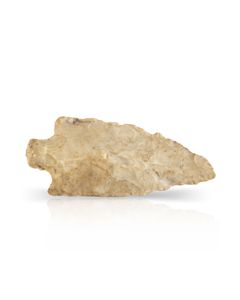 Stone Age spearhead from North America
Finely crafted flint projectile from the younger Stone Age of North America. From a swiss museum collection.
Price: on request Stone Age spearhead from North America
Finely crafted flint projectile from the Stone Age of North America. From a swiss museum collection.
Price: on request Neolithic axe head
Finely crafted tool from the New Stone Age of Europe. A specimen of the thick butted type.
Price: on request Roman gold earrings with faience beads
Belonging pair of jewellery made of gold, each decorated with shield and bead. From the Roman provinces of the eastern Mediterranean, made during the Imperial period.
Price: on request Roman key ring
Finger ring made of bronze with a key. From the Roman Imperial period, around the 2nd century. A find from the Roman city of Novaesium, today's Neuss in Germany.
Price: on request Roman intaglio with Ganymede and eagle
The dark glass paste symbolizes a famous love affair from ancient mythology. The sky father Zeus falls in love with the beautiful Ganymede, a Trojan king's son.
Price: on request Roman intaglio with Calydonian boar hunt
Nice ring insert made of composite glass. Its imprint shows the moment of the mythological boar hunt in which Meleager slays the beast.
Price: on request Roman intaglio with child Eros
Roman glass paste with nice depiction of the Greek god of love as a child, probably a lyre in his hands.
Price: on request Roman gilt crossbow brooch
Interesting silver fibula from the later Roman Imperial period. From the famous Leo Mildenberg collection.
Price: on request Phoenician eye bead
Polychrome glass bead with stylized elements of a face as protection against the evil eye. Produced in Carthage or the Phoenician homeland, 4th to 3rd century BC.
Price: on request Phoenician eye bead
Polychrome glass bead with stylized elements of a face as protection against the evil eye. Produced in Carthage or the Phoenician homeland, 4th to 3rd century BC.
Price: on request Phoenician eye bead
Polychrome glass bead with stylized elements of a face as protection against the evil eye. Produced in Carthage or the Phoenician homeland, 4th to 3rd century BC.
Price: on request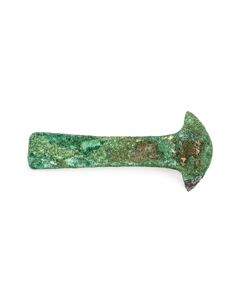 Ceremonial knife of the Sican culture
The so-called Tumi was a weapon to cut the throats of humans and animals in ritual sacrifices. The knife certainly fulfilled an additional representative function in the afterlife. From the period of the Sican's cultural florescence during the 10th to 12th centuries AD.
Price: on request Four Scythian arrow heads
Group of four arrowheads made of bronze in excellent condition. Popular weapon of the cultures of the 1st Millennium BC.
Price: on request Six neolithic stone tools
Nice group of artefacts from the Northern European Neolithic. One blade, two dagger fragments and three axe head fragments. All found in Northern Germany.
Price: on request Luristan bronze dagger with grip insert
Bronze weapon originating from the Luristan region during Iron Age. Note the grip insert in this dagger otherwise comprised of a single piece of bronze.
Price: on request Roman clay ball
Massive clay sphere, ammunition or a pistill. A find from the Roman city of Novaesium, today's Neuss in Germany.
Price: on request Paleolithic hand axe
Prehistoric stone tool. It was the universal tool of the older Stone age and could be used as a borer or a cutter. From a Swiss museum collection. Found in Algeria, North Africa.
Price: on request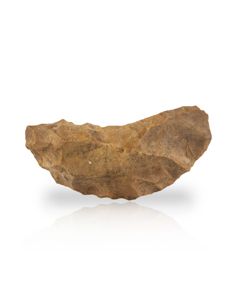 Stone Age bow scraper from Egypt
The Paleolithic tool is shaped like a sickle. Thebes has been handed down as the place of origin. From a 100 year old museum collection.
Price: on request