
Weapons - Sold antiquities
Archive of sold antiquities
All artefacts sold in our gallery are fully documented in our online archive and database. Being a specialist ancient art dealer, preserving also the more recent history of each and every piece sold in our shop is at our heart. That is particularly useful for artefacts that changed owners in the meantime. Information that may have been lost in the process can be easily restored from our archives. Please do not hesitate to contact us if you need further information about ancient items that have been sold in our gallery. We can help you with reconstructing the history of ownership for those items. All information about our customers will be kept confidential, of course.-
 Three neolithic arrowheads from Egypt
The Stone Age points are beautifully crafted. From a 100 year old museum collection.
Price: on request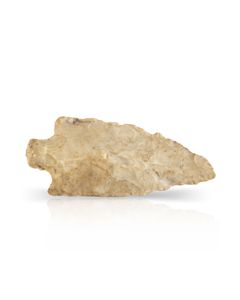 Stone Age spearhead from North America
Finely crafted flint projectile from the younger Stone Age of North America. From a swiss museum collection.
Price: on request Stone Age spearhead from North America
Finely crafted flint projectile from the Stone Age of North America. From a swiss museum collection.
Price: on request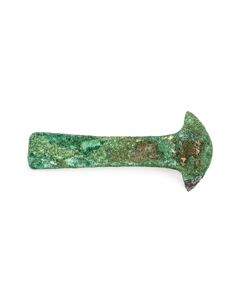 Ceremonial knife of the Sican culture
The so-called Tumi was a weapon to cut the throats of humans and animals in ritual sacrifices. The knife certainly fulfilled an additional representative function in the afterlife. From the period of the Sican's cultural florescence during the 10th to 12th centuries AD.
Price: on request Four Scythian arrow heads
Group of four arrowheads made of bronze in excellent condition. Popular weapon of the cultures of the 1st Millennium BC.
Price: on request Luristan bronze dagger with grip insert
Bronze weapon originating from the Luristan region during Iron Age. Note the grip insert in this dagger otherwise comprised of a single piece of bronze.
Price: on request Roman clay ball
Massive clay sphere, ammunition or a pistill. A find from the Roman city of Novaesium, today's Neuss in Germany.
Price: on request Paleolithic hand axe
Prehistoric stone tool. It was the universal tool of the older Stone age and could be used as a borer or a cutter. From a Swiss museum collection. Found in Algeria, North Africa.
Price: on request Near Eastern lance head
Double-edged blade of a lance from Bronze Age. With a nice green patina.
Price: on request Luristan bronze spearhead
Double-edged blade of a large spear from the Luristan region in Ancient Iran. Impressive speciment with nice patina.
Price: on request Neolithic stone tool from Egypt
The Stone Age weapon's point or knife blade is well crafted, with finely serrated edge. From a 100 year old museum collection.
Price: on request Paleolithic hand axe
Prehistoric stone tool. It was the universal tool of the older Stone age and could be used as a borer or a cutter. From a Swiss museum collection. Found in Algeria, North Africa.
Price: on request Paleolithic hand axe
Small prehistoric stone tool. It was the universal tool of the older Stone age and could be used as a borer or a cutter. From a 100 year old museum collection.
Price: on request Stone Age spearhead from North America
Finely crafted flint projectile from the Stone Age of North America. From a swiss museum collection.
Price: on request Stone Age spearhead from North America
Finely crafted flint projectile from the Stone Age of North America. From a swiss museum collection.
Price: on request Paleolithic hand axe
Prehistoric stone tool. It was the universal tool of the older Stone age and could be used as a borer or a cutter. From a Swiss museum collection. Found in Ouarzazate, Morocco.
Price: on request Near Eastern bronze sword
Double-edged blade of a Bronze Age sword, the hilt missing. From the middle of the 2nd Millennium BCE.
Price: on request Paleolithic hand axe
Small prehistoric stone tool. It was the universal tool of the older Stone age and could be used as a borer or a cutter. From a 100 year old museum collection.
Price: on request Ceremonial knife of the Sican culture
The so-called Tumi was a weapon to cut the throats of humans and animals in ritual sacrifices. The Tumi certainly fulfilled an additional representative function in the afterlife. From the period of the Sican's cultural florescence during the 10th to 12th centuries AD.
Price: on request Three neolithic arrowheads from Egypt
The Stone Age points are beautifully crafted, with finely serrated edges. From a 100 year old museum collection.
Price: on request Neolithic stone tool from Egypt
The Stone Age weapon's point or knife blade is well crafted, with finely serrated edge. From a 100 year old museum collection.
Price: on request Three neolithic arrowheads from Egypt
The Stone Age points are beautifully crafted, with finely serrated edges. From a 100 year old museum collection.
Price: on request Canaanite bronze blade from General Moshe Dayan collection
Holy Land, 3rd - 2nd millennium BC. Exhibited in the Jewish Museum in New York City in 1975. Moshe Dayan was a famous Israeli politician and military leader who served as Chief of Staff of the Israeli Defense Forces, personally commanded the Israeli forces during the 1956 Suez Crisis and served as Defense Minister.
Price: on request Celtic spear head - found 1982 near Frome, Sommerset, UK
Iron, about 2nd century BC - 1st century AD. With export permit by the Arts Council of England.
Price: on request Small ceremonial knife of the Sican culture
The so-called Tumi was a weapon to cut the throats of humans and animals in ritual sacrifices. The knife certainly fulfilled an additional representative function in the afterlife. From the period of the Sican's cultural florescence during the 10th to 12th centuries AD.
Price: on request Ceremonial knife of the Sican culture
The so-called Tumi was a weapon to cut the throats of humans and animals in ritual sacrifices. The knife certainly fulfilled an additional representative function in the afterlife. From the period of the Sican's cultural florescence during the 10th to 12th centuries AD.
Price: on request Scythian short sword
The so-called acinaces is a typical weapon of the Scythians. Well preserved piece from the 7th to 5th centuries BC.
Price: on request Large ceremonial knife of the Sican culture
The so-called Tumi was a weapon to cut the throats of humans and animals in ritual sacrifices. The knife certainly fulfilled an additional representative function in the afterlife. From the period of the Sican's cultural florescence during the 10th to 12th centuries AD.
Price: on request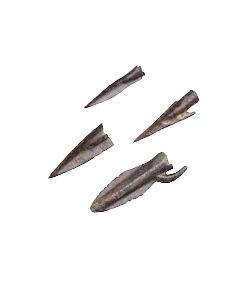 Four Greek or Scythian arrow heads
Group of four bronze socketed arrowheads, three with triangular cross-section and one leaf-shaped. Excellent condition, beautiful patina. From an old British collection, acquired before 1980.
Price: on request Three arrow heads
Two bronze arrow heads from the 1st Millenium AD. One stone arrow head from the Neolithic.
Price: on request Four Roman iron artefacts
Arrow heads, chisel and blade made of Iron. Finds from the Roman city of Novaesium, today's Neuss in Germany.
Price: on request Four Greek or Scythian arrow heads
Group of four bronze socketed arrowheads with triangular cross-section. Excellent condition, beautiful patina. From an old British collection, acquired before 1980.
Price: on request Celtic spear head - found in 1970s near Radstock, UK
Iron, about 2nd century BC - 1st century AD. With export permit by the Arts Council of England.
Price: on request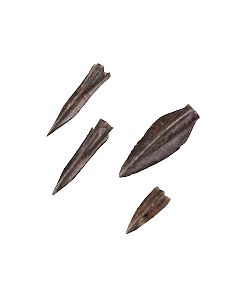 Four Greek or Scythian arrow heads
Group of four bronze socketed arrowheads, three with triangular cross-section and one leaf-shaped. Excellent condition, beautiful patina. From an old British collection, acquired before 1980.
Price: on request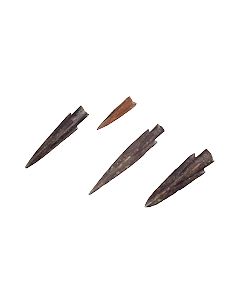 Four Greek or Scythian arrow heads
Group of four bronze socketed arrowheads with triangular cross-section. Excellent condition, beautiful patina. From an old British collection, acquired before 1980.
Price: on request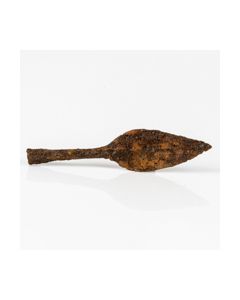 Celtic spear head - found in 1970s near Warminster, UK
Made of iron, about 1st century BC - 1st century AD. With export permit by the Arts Council of England.
Price: on request