
Sold antiquities
Archive of sold antiquities
All artefacts sold in our gallery are fully documented in our online archive and database. Being a specialist ancient art dealer, preserving also the more recent history of each and every piece sold in our shop is at our heart. That is particularly useful for artefacts that changed owners in the meantime. Information that may have been lost in the process can be easily restored from our archives. Please do not hesitate to contact us if you need further information about ancient items that have been sold in our gallery. We can help you with reconstructing the history of ownership for those items. All information about our customers will be kept confidential, of course.-
 Disc-headed pin from Luristan
Important and unique pin type of Luristan. This specimen is decorated by bumps forming a seven-pointed star.
Price: on request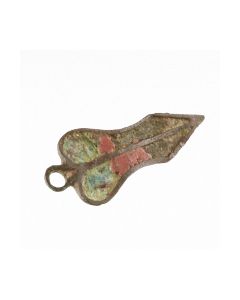 Roman brooch in dagger shape
Interesting variant of the more common sandal brooch. The colourful enameled brooch has been made in the northern Roman provinces. 2nd cent. AD.
Price: on request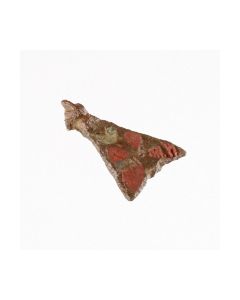 Roman cicada brooch
Brooch in the shape of an insect. Popular type in the northern Roman provinces during the 2nd century.
Price: on request Scarab with cross symbol
A piece from the Ramesside Period to the early Third Intermediate Period of ancient Egypt. Great early 20th century provenance.
Price: on request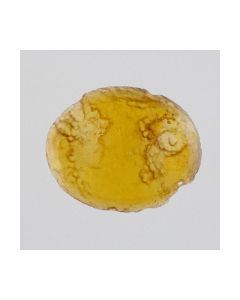 Roman intaglio with two facing heads
It shows Zeus Ammon facing another head. This is a highly interesting specimen for Roman intaglios.
Price: on request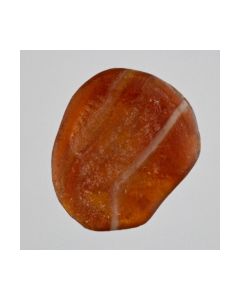 Roman intaglio with greek style bust
Full beard and curly hair held by a taenia or diadem. The portrait resembles posthumous representations of Philipp II. made by his son Alexander the Great.
Price: on request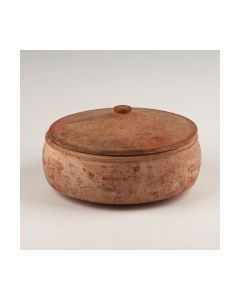 Large roman bowl with lid from Tunisia
Impressive, perfectly preserved bowl from old German collection
Price: on request Large roman terra sigillata jar from Tunisia
Impressive large vase from old German collection
Price: on request Elamite ceramic vessel with geometric frieze
Ceramic vessel in perfect condition with original painted frieze. Magnificent attest to the Middle Elamite civilization of Bronze Age Iran.
Price: on request Hellenistic core formed glass
Elaborate early glass vessel. Opaque blue body with white decorative bands forming spirals and feathers. Late 4th to 3rd cent. BC.
Price: on request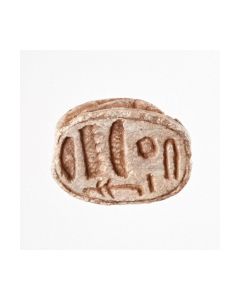 Scarab with inscription
The lower side bears a hieroglyph inscription. Nice piece from the Freemark collection. New Kingdom.
Price: on request Scarab with inscription Amun Re
Interesting scarab from the New Kingdom. With hieroglyphs reading Amun Re, main god of Theben, and lotus flower.
Price: on request Ramesside Scarab
Egyptian scarab from the 19th to 20th dynasty. With horse and hieroglyphs.
Price: on request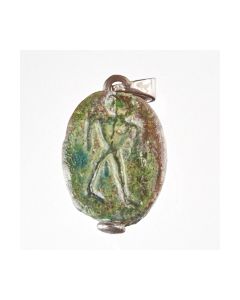 Scarab with standing figure
The scarab amulet dates to the Late Period. The lower side shows a stading figure, possibly the goddess Neith.
Price: on request Silver pin from Luristan
Iron Age silver pin with attractive engravings. Nice dark patina.
Price: on request Decorative pin from Luristan
The pin head is shaped like an open basket with a decorative knob. Bronze with attractive patina.
Price: on request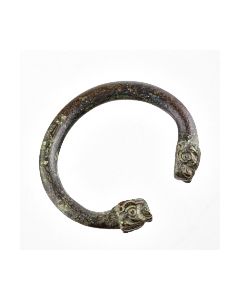 Bracelet from Luristan with lion terminals
Bronze braclet in perfect condition with beautiful dark patina. The terminals are stylized lion heads.
Price: on request Bracelet from Luristan with triangular terminals
The bronze braclet is band shaped and has linear engravings on the outer side. Late Iron Age.
Price: on request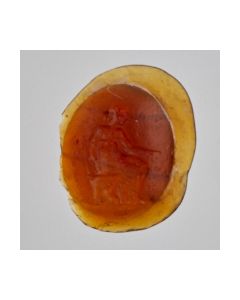 Roman intaglio with Muse
The goddess of art is engraved with rich details. She is sitting on a chair with the backrest shaped like a swan head.
Price: on request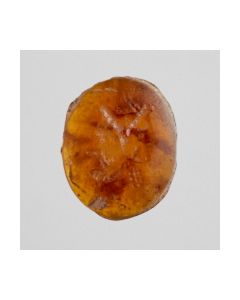 Roman intaglio with two theater masks
The intaglio shows two masks joint on the rear side. It is an interesting document of the Roman theatrical culture.
Price: on request Roman intaglio from rare dichroic glass
The lower half of the intaglio is intact and shows a woman in a long dress. Truely special about the piece is the blue reflecting glass that turns violet when light is passing through it.
Price: on request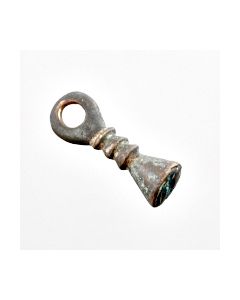 Western Iranian bronze stamp seal
Interesting bronze seal showing a bird and glyphs. From a collection of Iranian ancient artefacts.
Price: on request Cup of the Urnfield culture
Ceramic vessel dating to the transition period between Bronze Age and Iron Age in Central Europe. 1200 to 800 BC. Found in an urnfield in Austria.
Price: on request Big Cup of the Urnfield culture
Ceramic vessel dating to the transition period between Bronze Age and Iron Age in Central Europe. 1200 to 800 BC. Found in an urnfield in Austria.
Price: on request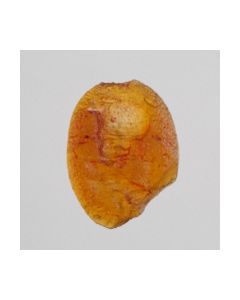 Roman intaglio with Eros as a child
The Greek god of love is engraved in the orange glass in rich detail. He presses a butterfly against his breast.
Price: on request Egyptian sarcophagus mask
Impressive wood relief of an idealized face. Polychrome paint. The mask was part of a sarcophagus lid from the Late Period of Ancient Egypt.
Price: on request Egyptian tomb relief from Memphis
The flat relief shows an offering scene and above a hieroglyphic text describing the deceased Ptah-nefer, the priest and the offerings. A translation has been made by the renowned Egyptologist professor Kurth. The work of art dates to the 26th dynasty. It is adopting the style of the Old Kingdom.
Price: on request Two Terra Sigillata sherds
Ein Stück mit schöner Verzierung aus Vogel und Ranken. Das andere Stück Teil einer kleinen Schale mit sogenannter Barbotine-Verzierung auf dem Rand.
Price: on request Egyptian fingerring from the Amarna period
Made of colourful turquoise fayence. Two fully modelled crocodiles adorn the plate. Perfect preservation including original black paint.
Price: on request Sumerian cuneiform clay tablet
Small tablet with drill hole. Cuneiform receipt for bricks or pottery. Very well preserved piece from the late 3rd millenium BC.
Price: on request Clay tablet with cuneiform script
Small tablet with well preserved cuneiform engravings. Interesting Bronze Age document from Mesopotamia.
Price: on request Cuneiform tablet from Umma
Record of beer and bread rations for laborers. Probably from the Bronze Age city of Umma. The cuneiform tablet was studied and conserved at Yale University.
Price: on request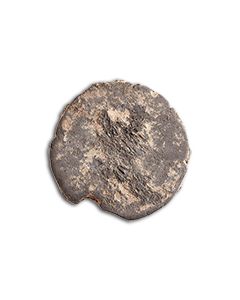 End piece for ancient terracotta forger's mould
The perfectly preserved mould was used to counterfeit coins with a FEL TEMP REPARATIO reverse and was used frequently. From time of Constantius II (337-361 AD) or slightly later.
Price: on request Ancient terracotta forger's mould
The mould was used to counterfeit coins with a FEL TEMP REPARATIO reverse and was used frequently
Price: on request Ancient terracotta forger's moulds, possibly from Trier
What makes this offer special is the fact that the two moulds are not only perfectly preserved withut damages, but also fit together.
Price: on request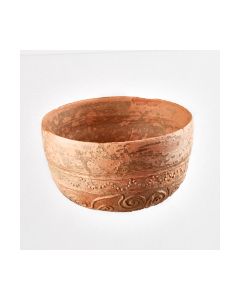 Megarian bowl with floral decoration
Nicely preserved piece from a private Columbus (Ohio, USA) collection
Price: on request