
Search results for: 'bei'
-
 Bronze Age Elamite ceramic vessel
Bowl from the Middle Elamite period with painted geometric design. From the area of ancient Iran.
Price: on request Isis / Aphrodite from the Fayum
Ovales Gesicht mit archaisierenden Zügen. Hoher Kranz, darauf ein mit Isis-Emblemen geschmückter Kalathos. Interessantes, ungewöhnliches Fragment.
Price: on request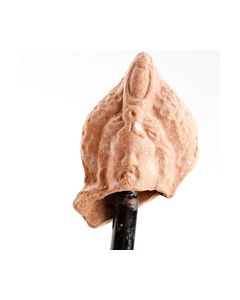 Clay figurine of Harpokrates from the Fayum
Exzellente Erhaltung. Sehr fein gearbeitetes Stück, auch kleine Details von Mimik und Kopfschmuck sind vollständig herausgearbeitet.
Price: on request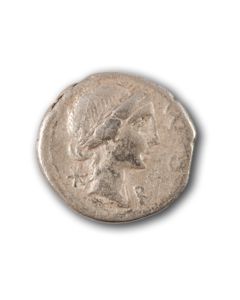 Aemilius Lepidus denarius - equestrian statue
Reiterstatue eines gepanzerten Reiters mit Lanze auf einem aus drei Bögen bestehenden Bau, in den Bögen L E P. Fast vz, schöne helle Patina.
Price: on request Luristan bronze base of a finial
Flaschenförmiger Sockel für eine Standarte. Luristan, Anfang 1. Jt. v. Chr. Aus der berühmten Sammlung Arthur M. Sackler.
Price: on request Missale Romanum - rare 1610 missal
Schweinsledereinband auf Holzdeckeln. Aus der Sammlung Prof. H. Brosch, Autor historischer Fachpublikationen und wissenschaftlicher Museumsbeirat. Träger des Bundesverdienstkreuzes.
Price: on request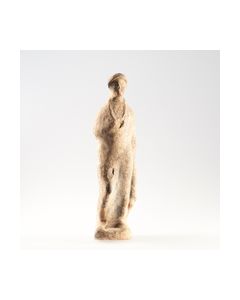 Große hellenistische Terrakottastatuette eines Manteljünglings
Bildnisstatuette mit Sockel. Aufrecht stehende Figur rechtes Knie ist leicht gebeugt, das Haar ist kunstvoll frisiert. Exzellenter Zustand, keine Schäden.
Price: on request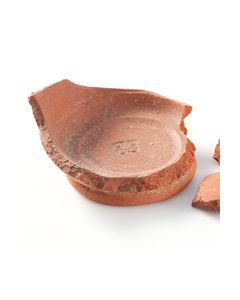 Terra Sigillata Boden mit Symbolstempel
Stempel aus fünf Punkten, quadratisch angeordnet. Vom mittleren Punkt gehen vier Strahlen aus, welche einen stilisierten Stern bilden.
Price: on request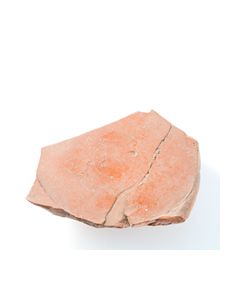 Terra Sigillata Boden mit Stempel COCVSF
Cocus arbeitete in den Argonnen und in Blickweiler, später dann auch in Trier. Restauriert aus 2 Stücken.
Price: on request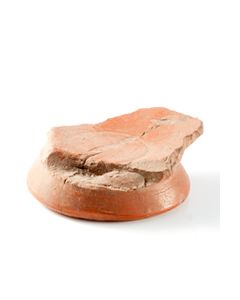 Terra Sigillata Boden mit Stempel CENSORIN
Mehrere Werkstätten, die einen Censorinos-Stempel benutzten, sind bekannt. Datierung damit 2. Hälfte 1. - Ende 2. Jh. n. Chr.
Price: on request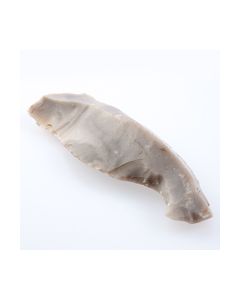 Klingensichel mit Schaftzunge, Jungsteinzeit
3400 v. Chr. bis 2800 v. Chr., Trichterbecher-Kultur, Ganggrab-Periode. Eine der ersten Sicheln, vermutlich als Erntesichel verwendet.
Price: on request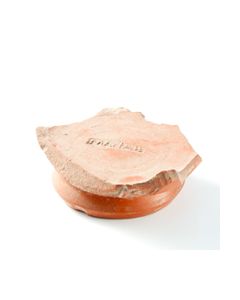 Terra Sigillata Boden mit Stempel MAITAFE
Doppelstempel. Römische Antike, möglicherweise 179 - 180 n. Chr. Sehr gute Erhaltung, Standring vollständig erhalten.
Price: on request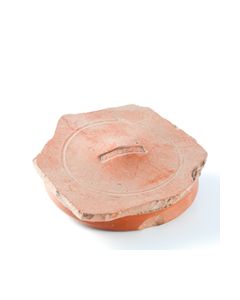 Terra Sigillata Boden mit Stempel MOXSIVSF
Aus der Werkstatt des Moxsius aus Trier. Großes, museumswürdiges Stück, Standring vollständig erhalten, tiefer Stempel.
Price: on request Ägyptisches Amulett der Isis
Amulett aus Fayence mit Darstellung der Isis. Die Göttin trägt ein Gewand und eine dreigeteilte Perrücke, auf dem Kopf den Thronsitz. Spätzeit des Alten Ägyptens.
Price: on request Kunstvoll verzierter Stilus
Römischer Wachstafelstift aus massiver Bronze. Hinten Ansatz für Radierungen. Hervorragender Zustand, originale Kette noch am Körper befestigt. 1. bis 3. Jh. n. Chr.
Price: on request Hellenistischer Fingerring aus Gold mit Intaglio
Ring aus massivem Gold. Intalgio aus türkisfarbenem Stein mit dunkelblauer Ader. Exzellent erhalten. Aus einer alten britischen Sammlung.
Price: on request Bronze Age Elamite ceramic vessel
Bowl from the Middle Elamite period with painted geometric design. From the area of ancient Iran.
Price: on request Bronze Age Elamite ceramic vessel
Bowl from the Middle Elamite period with painted geometric design. From the area of ancient Iran.
Price: on request Very large North African oil lamp
Early Christian oil lamp with Chi Rho christogram, below the letters alpha and omega. Large and impressive piece. From the very old German collection Becker.
Price: on request Bronze Age axe head
Very well preserved axe head. Late Bronze Age, 10th to 9th cent. BC.
Price: on request Bronze statuette of nursing Isis
Isis is shown in a very typical depiction as a mother, the archetype of the later Christian Nursing Madonna. The bronze figurine dates to the 22nd to 31st dynasty of Ancient Egypt.
Price: on request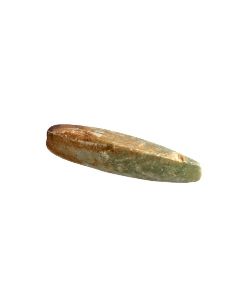 Neolithic chisel of green stone
The stone age tool of the younger Funnel beaker culture or Single Grave culture is exceptional because if its material. It is made of beautiful finely polished green stone.
Price: on request Vitae Caesarum - Compiled biographies of the Roman Emperors from the 16th century
Impressum large early print. The edition is not only basing on the standard work by Sueton, but includes many other partially rare ancient authors. H. Froben & N. Episcopius, Basel, September 1546
€1,900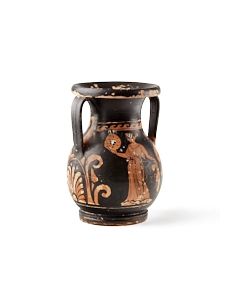 Perfectly preserved Apulian pelike
From the collection of Prof. Dr. Schmid, acquired 1977 at the Aloys Faust Gallery, Cologne. With ArtLoss Certificate.
Price: on request Neo-Assyrian cylinder seal
The seal made of blue frit shows mythological creatures. 7th cent. BC.
Price: on request Mochica stirrup vessel
The body is creatively shaped as a bird man. A wonderful testimony to the last bloom of the Mochica culture before its collapse.
Price: on request Egyptian ushabti for Ra-mes
The mummiform funerary figurine dates to the Late Period of ancient Egypt, 26th to 31st dynasty. It is remarkable that it probably originates from the burial of two brothers, Ra-mes and Somtus-tefnacht.
Price: on request Ushabti for Ra-mes
The mummiform funerary figurine dates to the Late Period of ancient Egypt, 26th to 31st dynasty. It is remarkable that it probably originates from the burial of two brothers, Ra-mes and Somtus-tefnacht.
Price: on request Egyptian ushabti for Somtus-tefnacht
The mummiform funerary figurine dates to the Late Period of ancient Egypt, 26th to 31st dynasty. It is remarkable that it probably originates from the burial of two brothers, Somtus-tefnacht and Somtus-tefnacht.
Price: on request Published cypriot milk bowl
1977 on exhibition in the Bielefeld Museum of Fine Arts. Nicely preserved piece, from an old German private collection, acquired prior to 1972. Coming with an ArtLoss certificate.
Price: on request Egyptian ushabti for Somtus-tefnacht
The mummiform funerary figurine dates to the Late Period of ancient Egypt, 26th to 31st dynasty. It is remarkable that it probably originates from the burial of two brothers, Somtus-tefnacht and Somtus-tefnacht.
Price: on request Egyptian ushabti for Somtus-tefnacht
The mummiform funerary figurine dates to the Late Period of ancient Egypt, 26th to 31st dynasty. It is remarkable that it probably originates from the burial of two brothers, Somtus-tefnacht and Somtus-tefnacht.
Price: on request Ushabti for Somtus-tefnacht
The mummiform funerary figurine dates to the Late Period of ancient Egypt, 26th to 31st dynasty. It is remarkable that it probably originates from the burial of two brothers, Somtus-tefnacht and Somtus-tefnacht.
Price: on request Egyptian ushabti for Somtus-tefnacht
The mummiform funerary figurine dates to the Late Period of ancient Egypt, 26th to 31st dynasty. It is remarkable that it probably originates from the burial of two brothers, Somtus-tefnacht and Somtus-tefnacht.
Price: on request Egyptian ushabti for Somtus-tefnacht
The mummiform funerary figurine dates to the Late Period of ancient Egypt, 26th to 31st dynasty. It is remarkable that it probably originates from the burial of two brothers, Somtus-tefnacht and Somtus-tefnacht.
Price: on request Egyptian ushabti for Somtus-tefnacht
The mummiform funerary figurine dates to the Late Period of ancient Egypt, 26th to 31st dynasty. It is remarkable that it probably originates from the burial of two brothers, Somtus-tefnacht and Somtus-tefnacht.
Price: on request