
Available - Recent acquisitions - Lehrsammlung - Photo gallery
Image database with photographs of ancient art and antiquities
Our image database provides photographs of ancient art and antiquities for press releases as well as for private use. All artefacts sold in our gallery are documented through professional photographs. The resulting image library contains numerous ancient Egyptian, Greek and Roman antiquities as well as ancient coins. The time span from Stone Age, over Bronze Age and Classical Antiquity until Late Antiquity is covered.The photo gallery aims at providing a vast visual archive equipped with filters and search tools. You are most welcome to search the constantly growing number of artefacts in the image library. We are also happy to authorize hyperlinks from your webpage / forum to the objects depicted in our gallery. For this purpose, please send us a short notification prior to placing a hyperlink. For almost every object high definition photographs are available and can be provided e.g. to document your collection or for scientific papers or popular science articles. If you are interested in using pictures for publications, print media or other purposes, please contact us and we will be happy to assist you.
-
 Etruscan votive head of a young lady
Nicely preserved. Very impressive, large and heavy object. Ex G. Hirsch Nachf. Auktion 168, 1990.
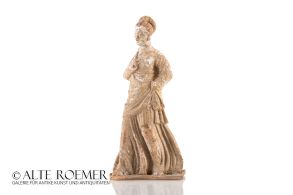 Hellenistic clay figurine of a standing woman
South Italian, following conception of Tanagra figurines. From a Swiss private collection, acquired in the early 1980s.
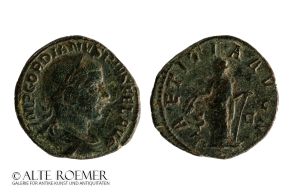 Very fine Gordianus III. sestertius
Nice portrait, beautiful green patina. Reverse is showing Laetitia. Ex Gerhard Hirsch Nachf. auction Nr. 116 (1979), lot 3083.
Price: on request Extremely fine Ariarathes IX Eusebes Philopator drachm
Very nice patina. Ex Gerhard Hirsch Nachf. Auktion 141 (1984), Lot Nr. 350.
 Large Italic serpentine fibula
Imposing bronze brooch of the Italic Iron Age. The piece is elaborately adorned by wonderful incised decorations.
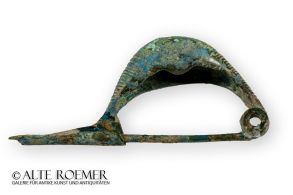 Early Etruscan sanguisuga fibula
The early Etruscan bronze brooch is characterized by its artistically decorated bow. A find from northern Italy.
 Early Etruscan fibula
The early Etruscan bronze brooch is characterized by its artistically decorated bow. A find from northern Italy.
 Neolithic flint dagger from Denmark
Double-edged blade and flat shaft made of beautiful flintstone. A status symbol from the transitional period between Late Neolithic and Early Bronze Age.
 Neolithic dagger blade from Denmark
Double-edged, pointed blade made of beautiful flint. The blade was for a dagger, the typical status symbol from the transitional period between Late Neolithic and Early Bronze Age.
 Neolithic flint sickle from Denmark
Crescent-shaped blade made of beautiful reddish-brown flintstone. This tool represents an intermediate state within the radical transition from Neolithic to Bronze Age.


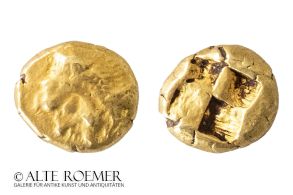 Electrum hekte from Herakleia Pontika
Gold coin from the early era of coinage. Showing the head of Herakles, wearing lion skin headdress. Very fine condition.
 Very long iron lance head
Excellent condition for an iron object, mainly intact with very nicely preserved surface. From an old German private collection, acquired in the early 1980s.
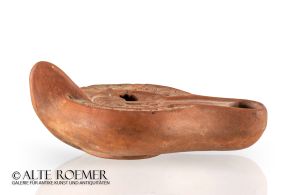 North African Roman oil lamp with duck
From the family collection of the internationally know "Tunisia painter" Bernhard (Bernd) Scheubert. Acquired between 1960 and 1974. Interesting motif.
 Rare silver obol with Poseidon and bull - ex Kuenker
Poseidonia (later Paestum), 5th century B.C. In Greek mythology, an obol was the fee to pay Charon for a passage across the river Styx.
Price: on request Hellenistic oil lamp from old German collection
Almost perfectly preserved, undamaged, decorated with geometric pattern. With handle.
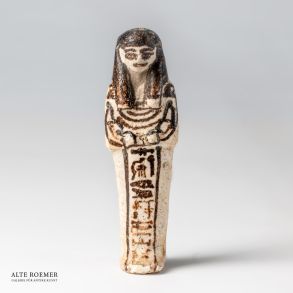 Egyptian ushabti for Viceroy Hori
One of only 30 known funerary statuettes from the tomb of Hori I, King's son of Kush. Viceroy of Kush in Nubia during the reign of the pharaohs Ramesses III and IV. An exhibited and repeatedly published piece.
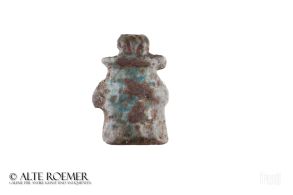 Egyptian amulet of a Bes mask
Protective amulet in the form of a mask of the god Bes made of turquoise faience. Nice specimen from Ptolemaic Egypt.
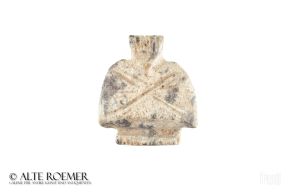 Stylized Bes mask
Highly stylized miniature mask of the god Bes from ancient Egypt. Stone with nice texturing.
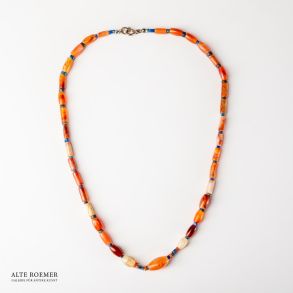 Necklace of Sumerian beads
Beautiful beads of orange-patterned carnelian, beige-banded agate, and pleasantly contrasting blue lapis lazuli. Similar to the jewelry of the Sumerian queen Puabi. Early Dynastic Period of Mesopotamia, around 2500 BC.
Early Etruscan sanguisuga fibulaThe early Etruscan bronze brooch is characterized by its artistically decorated bow. A find from northern Italy.
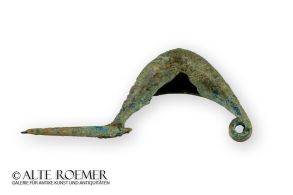 Early Etruscan sanguisuga fibula
The early Etruscan bronze brooch is characterized by its artistically decorated bow. A find from northern Italy.
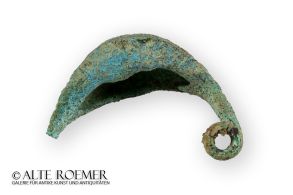 Early Etruscan sanguisuga fibula
The early Etruscan bronze brooch is characterized by its artistically decorated bow. A find from northern Italy.
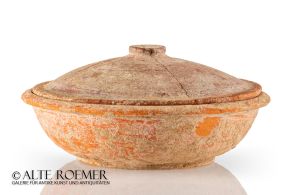 Roman pottery bowl with lid from El Djem in Tunisia
From the old German private collection Scheubert. Bernd Scheubert was internationally known as the "Tunisia painter".
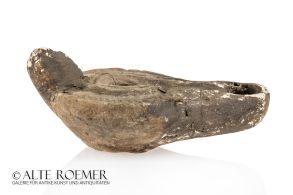
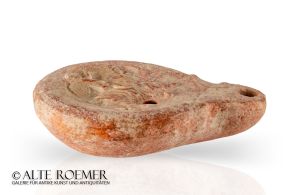 Roman oil lamp with rare scene
The mirror shows Eros riding a bull. Rare, no parallel found in the available specialist literature. From the old German private collection of the art historian Steinbock.
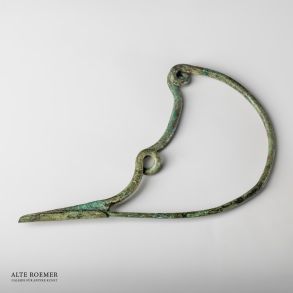 Large Villanovan fibula
Imposing bronze brooch of the italic Iron Age. Acquired 1986 at Casa Serodine.
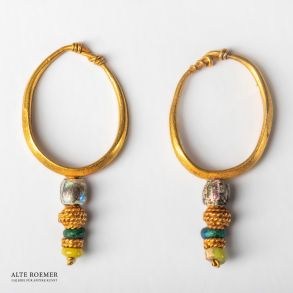 Pair of ancient gold earrings
A magnificently preserved piece of jewellery from the Late Roman to Early Byzantine era. Featuring glass and gold beads.
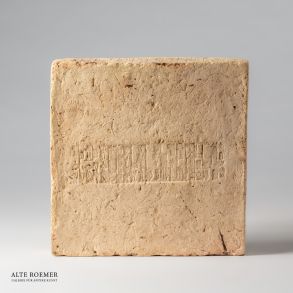 Sumerian brick with royal inscription
Clay tile from the temple of Eridu, donated around 2040 BC. Dedicated by Amar-Sin, king of the Third Dynasty of Ur. Studied for a research project in 1983.
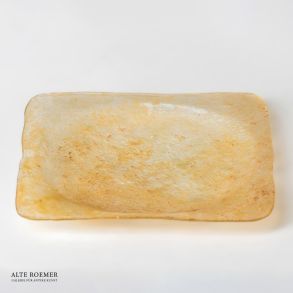
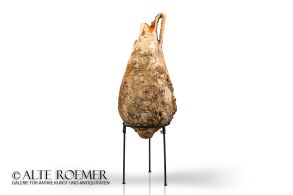 Roman amphora with nice sea encrustation
This type was used for the transportation of wine and fish sauce (Muria). Found 1967 in the sea in Croatia, exported with permit of the local authorities.
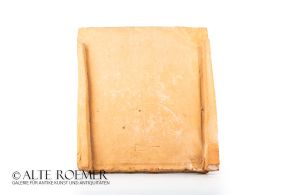 Large Roman legionary roof tile produced by Legio VI Victrix 70 - 104 A.D.
Excellently preserved, extremely rare for an object of this size. Found near the Roman city of Novaesium, today's Neuss in Germany, an early Roman foundation and with this one of the oldest cities in Germany.
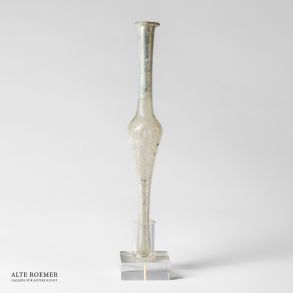 Spindle shaped Roman unguentarium
A tall and slender glass vessel made of almost colourless glass. Similar finds from the 4th century are known from the Balkans and Cyprus.
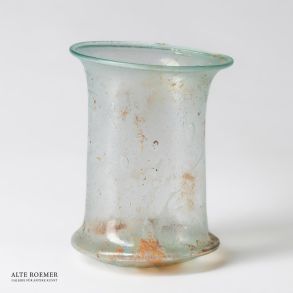 Roman glass beaker
Rare cup made of almost colourless, slightly turquoise glass. From the 2nd to 4th century AD.