
Search results for: 'bronzezeit'
-
 Großes Skarabäussiegel aus der Zeit des Amenophis III.
14. Jh. v. Chr. Heute noch erhaltene Überreste der Bautätigkeit Amenophis III. sind die Memnonkolosse, sowie der Hauptteil des Luxor-Tempels.
Price: on request Skarabäussiegel mit abstaktem Stempelmotiv
Die Stempelfläche trägt ein dekoratives Muster mit ästhetischer oder magischer Funktion. Sehr schöner und anschaulicher Skarabäus, in etwa aus der Zweiten Zwischenzeit des Alten Ägyptens. 2000 bis 1300 v. Chr.
Price: on request Ägyptisches Skarabäusamulett aus der 18. Dynastie
Ägyptisches Stempelsiegel-Amulett in der stilisierten Form eines Skarabäuskäfers. Die Stempelfläche trägt Hieroglyphen. Das Amulett datiert in die 18. Dynastie des Alten Ägyptens.
Price: on request Skarabäusamulett aus der Hyksoszeit
Ägyptisches Skarabäusamulett mit typischen Symbolen für die Herrschaftszeit der Hyksos. Aus der Zeit der Fremdherrschaft, ca. 1650 bis 1550 v. Chr.
Price: on request Skaraboides Stempelsiegel
Ägyptisches Stempelsiegel-Amulett in der stark stilisierten Form eines Skarabäuskäfers. Die Stempelfläche trägt eine symbolische Verzierung. 1. Jt. v. Chr.
Price: on request Ägyptisches Skarabäusamulett
Skarabäussiegel aus dem 2. Jt. v. Chr. mit ansprechender türkisfarbener Fayenceoberfläche. Die Stempelfläche trägt eine hieroglyphische Inschrift.
Price: on request Fayenceziegel vom Typ der Djoser-Pyramide
Ägyptischer Ziegel aus dem Alten Reich, 2. bis 3. Dynastie, intensiv-türkisfarbene Fayence. Ziegelform bekannt aus der berühmten Stufenpyramide von Djoser.
Price: on request Ägyptischer Skarabäus mit Knotenmuster
12. bis 18. Dynastie des Alten Ägypten, ca. 2000 v. Chr. bis 1300 v. Chr. Die Stempelfläche trägt ein Knotenmuster mit ästhetischer oder mutmaßlich magischer Funktion.
Price: on request Egyptian scarab with crocodiles
Amulet seal from Thebes with depiction of Sobek. From the 18th to 20th dynasty of ancient Egypt.
Price: on request Egyptian cowroid with knot design
Amulet seal with interesting top side markings. Second Intermediate Period of ancient Egypt.
Price: on request Egyptian cowroid with pseudo hieroglyphs
Amulet seal with papyrus trees and other signs on the bottom side. Second Intermediate Period of ancient Egypt.
Price: on request Egyptian alabaster vessel
Large container for this type of vessel. A thin-walled and very skilfully crafted specimen. Made between the 12th and 18th dynasty of Ancient Egypt.
Price: on request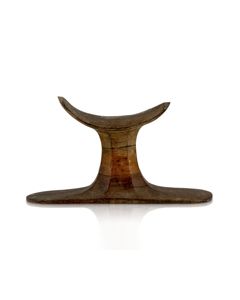 Egyptian headrest for a funeral or daily use
The well-preserved wood object is a rare example for this funenary ritual. The high quality piece was made around the Amarna Period in the late 18th dynasty of ancient Egypt.
€3,650 Egyptian stone bowl
This wonderful and relatively large bowl of banded stone was probably used for ritual purposes. From the Early Dynastic Period or Old Kingdom of ancient Egypt.
Price: on request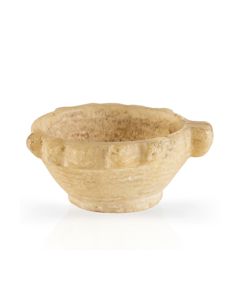 Egyptian alabaster bowl from Luxor
The small stone vessel is an offering bowl for libation. From the collection of Egyptologist Professor Wiedemann. 12th to 18th dynasty of Ancient Egypt
Price: on request Egyptian green stone vessel
The stone vessel is made of beautiful green serpentine. From the collection of Egyptologist Professor Wiedemann. Middle Kingdom of Ancient Egypt.
Price: on request Egyptian stone vessel from Luxor
The cosmetic vessel is of a rare type. From the collection of Egyptologist Professor Wiedemann. Middle Kingdom of Ancient Egypt
Price: on request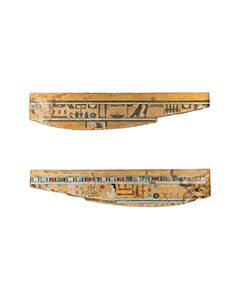 Fragments of an Egyptian coffin lid
Magnificently preserved, polychrome hieroglyphs from the 12th Dynasty. A prime example of the strict yet energetic art of the Middle Kingdom. With attribution by Professor Settgast of the Egyptian Museum in Berlin from 1979.
€26,400 Slender Egyptian stone beaker
The small and tall stone vessel is made of alabaster. From the collection of Egyptologist Professor Wiedemann.
Price: on request Egyptian chalice
The thin-walled stone cup is reminiscent of a lotus bud. From the collection of Egyptologist Professor Wiedemann. 18th dynasty of Ancient Egypt.
Price: on request Prädynastische ägyptische Keramikschale
Sehr seltene, frühe Keramik aus der prädynastischen Naqada-Zeit Ägyptens. Etwa 4000 bis 3200 v. Chr.
Price: on request Zoomorphe Tonfigur aus der Levanteregion
Abstrakte Ausführung, möglicherweise Antilope oder Gazelle. Wahrscheinlich rituelle Verwendung. Altersbedingt sehr gute Erhaltung.
Price: on request Ägyptisches Tongefäß aus Abydos, Altes Reich
Typische Alltagskeramik mit rotem Überzug. Einsatz z.B. als Geschirr für Lebensmittel. 3. Jt. v. Chr. Aus Ausgrabung des Egyptian Exploration Fund.
Price: on request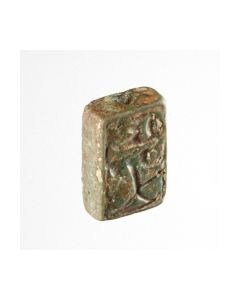 Ägyptisches Plättchen mit Kartusche des Sethos I.
Doppelseitige Platte aus grüner Fayence aus dem Neuen Reich, ramessidisch, um 1290 v. Chr. Sphinx und Kartusche (Men-Maat-Re) und Namens-Kartusche mit dem Eigennamen Meri-en-Ptah.
Price: on request Skarabäus mit Kartusche des Chaneferre
Skarabäus mit Namens-Kartusche des Königs Chaneferre (Sobekhotep IV.). 13. Dynastie des Alten Ägyptens, ca. 1700-1680 v. Chr.
Price: on request Cowroid with magical anra formula
The bottom side hieroglyphs of the anra type are to be interpreted as magical formula. The amulet dates to the Second Intermediate Period of ancient Egpyt.
Price: on request Scarab with cartouche of Thutmose III.
Amulet from the New Kingdom for one of the most popular rulers in ancient Egyptian history. This scarab is described in the catalogue of Irène Gautier-Vodoz.
Price: on request Scarab with sphinx
The stamp depicts a human headed sphinx walking towards the Ankh symbol of life. The amulet should exert a protective function on the one carrying or owning it.
Price: on request Scarab with falcon headed god
Interesting scarab amulet from the Second Intermediate Period. The seal shows a falcon headed creature facing an Egyptian cobra. This scarab can be found in the catalogue of Irène Gautier-Vodoz.
Price: on request Scarab from the Second Intermediate Period
The lower side shows a scarab, flanked by two uraeus snakes. 13th to 15th dynasty of ancient Egpyt. This scarab is described in the catalogue of Irène Gautier-Vodoz.
Price: on request Scarab with hieroglyphs arranged in a pattern
The lower side is skillfully decorated with hieroglyphs forming a geometric pattern. This scarab is described in the catalogue of Irène Gautier-Vodoz.
Price: on request Scarab with sphinx
The stamp depicts a sphinx with pharaoh headcloth walking towards the Ankh symbol of life. The amulet should exert a protective function on the one carrying or owning it.
Price: on request Scarab with the Red Crown of Lower Egypt
The scene can be seen as worship of the Deshret, the symbol of the kings of Lower Egypt during Hyksos times. An interesting piece of evidence of the Hyksos rule over Egypt.
Price: on request Egyptian scarab with papyrus plants
Scarab amulet made of bright, almost white steatite. 13th to 15th dynasty. This scarab is described in the catalogue of Irène Gautier-Vodoz.
Price: on request Egyptian faience ring showing Bes and Taweret
The finger ring with its scene on the plate must have served a protective function for an expectant mother. New Kingdom, approx. 1550 to 1070 BC.
Price: on request Scarab with geometric motive
The lower side exhibits wrapped cords. A nice example of Egyptian art during the Second Intermediate Period. This scarab is described in the catalogue of Irène Gautier-Vodoz.
Price: on request