
Ancient Near East - Fotogalerie - Sold antiquities
Archive of sold antiquities
All artefacts sold in our gallery are fully documented in our online archive and database. Being a specialist ancient art dealer, preserving also the more recent history of each and every piece sold in our shop is at our heart. That is particularly useful for artefacts that changed owners in the meantime. Information that may have been lost in the process can be easily restored from our archives. Please do not hesitate to contact us if you need further information about ancient items that have been sold in our gallery. We can help you with reconstructing the history of ownership for those items. All information about our customers will be kept confidential, of course.-
 Luristan point of a spear or arrow
Double-edged blade of a small spear or large arrow from the Early Iron Age of Iran.
Price: on request Near Eastern lance head
Double-edged blade of a lance from Bronze Age. Probably from Luristan in North Iran.
Price: on request Phoenician eye bead
Polychrome glass bead with stylized elements of a face as protection against the evil eye. Produced in Carthage or the Phoenician homeland, 4th to 3rd century BC.
Price: on request Phoenician eye bead
Polychrome glass bead with stylized elements of a face as protection against the evil eye. Produced in Carthage or the Phoenician homeland, 4th to 3rd century BC.
Price: on request Phoenician eye bead
Polychrome glass bead with stylized elements of a face as protection against the evil eye. Produced in Carthage or the Phoenician homeland, 4th to 3rd century BC.
Price: on request Anatolian clay pot with lid
The Bronze Age vessel rests on three legs and has a lid with a conical handle. Circa 2500 to 2000 BC.
Price: on request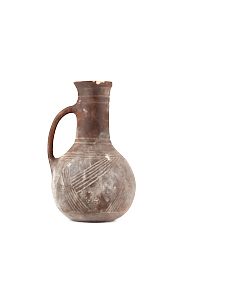 Anatolian clay jug with incised decoration
The Bronze Age vessel has wonderful linear decorative bands, the white filling of which contrasts with the dark slip. Circa 2500 to 2000 BC.
Price: on request Large Luristan horse pendant
The spectacular creature with conjoined horse bodies is characteristic for the bronze works of Luristan. From the early 1st Millenium BC.
Price: on request Bronze dagger with double-disc hilt
Elegant weapon of the Iron Age Amlash culture with broad and short blade. It is certainly a find from the province of Gilan in northern Iran.
Price: on request Phoenician eye bead
Polychrome glass bead with stylized elements of a face as protection against the evil eye. Produced in Carthage or the Phoenician homeland, 4th to 3rd century BC.
Price: on request Phoenician eye bead
Polychrome glass bead with stylized elements of a face as protection against the evil eye. Produced in Carthage or the Phoenician homeland, 4th to 3rd century BC.
Price: on request Phoenician eye bead
Polychrome glass bead with stylized elements of a face as protection against the evil eye. Produced in Carthage or the Phoenician homeland, 4th to 3rd century BC.
Price: on request Luristan bronze dagger with grip insert
Bronze weapon originating from the Luristan region during Iron Age. Note the grip insert in this dagger otherwise comprised of a single piece of bronze.
Price: on request Near Eastern lance head
Double-edged blade of a lance from Bronze Age. With a nice green patina.
Price: on request Large terra cotta female idol from Syria
Characteristic figure for the Bronze Age in the region that is today northern Syria. Dating to the 3rd or early 2nd Millennium BC.
Price: on request Luristan bronze spearhead
Double-edged blade of a large spear from the Luristan region in Ancient Iran. Impressive speciment with nice patina.
Price: on request Cylinder seal from Mitanni
Characteristic art of seal engraving from the Late Bronze Age state of Mittani in present-day Syria. With animals under band of waves.
Price: on request Mesopotamian cylinder seal with water creatures
The seal of light red stone shows two panels with interposed and stylized aquatic animals. Made around the onset of Bronze Age in Mesopotamia.
Price: on request Near Eastern cylinder seal with temple facade
The seal shows a stunning stylized scene with a Bronze Age temple facade next to a wild animal and eyes. From Mesopotamia or south-west Iran.
Price: on request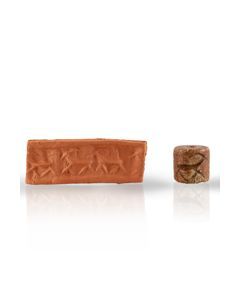 Mesopotamian cylinder seal with gazelles
The seal made of nice red stone shows three gazelles walking in line. A wonderful artefact from the Jemdet Nasr period.
Price: on request Mesopotamian cylinder seal with eyes
The seal made of light-colored stone dates from the Bronze Age of Mesopotamia. The stylization of the depicted eyes is reminiscent of the well-known eye idols.
Price: on request Mesopotamian cylinder seal
Made of beautiful red stone, worked with the drill. From the transitional period between Chalcolithic and Early Bronze Age in Mesopotamia.
Price: on request Mesopotamian cylinder seal with animals
The unusually long seal shows two horned animals with grain and eye symbols. A wonderful artefact from ancient Mesopotamia.
Price: on request Old Babylonian cylinder seal with gods and inscription
Scene with sun god Shamash and the Amorite god Amurru. The cuneiform writing names the owner of the seal, a faithful servant of these deities.
Price: on request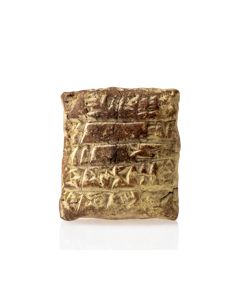 Sumerian cuneiform tablet
The clay tablet is a receipt of sheep and goats from the Sumerian city of Puzrish-Dagan. It was made during the reign of King Shu-Sin, 2037 to 2029 BC. From the Yale University Collection.
Price: on request Phoenician eye bead
Polychrome glass bead with stylized elements of a face as protection against the evil eye. Produced in Carthage or the Phoenician homeland, 4th to 3rd century BC.
Price: on request Phoenician eye bead
Polychrome glass bead with stylized elements of a face as protection against the evil eye. Produced in Carthage or the Phoenician homeland, 4th to 3rd century BC.
Price: on request Phoenician eye bead
Polychrome glass bead with stylized elements of a face as protection against the evil eye. Produced in Carthage or the Phoenician homeland, 4th to 3rd century BC.
Price: on request Akkadian cylinder seal with hero
The cylindrical seal boosts a hero protecting two horned animals from attacking lions. A nice symmetrical composition by the seal engraver. Old Akkadian, around 2300 BC.
Price: on request Near Eastern bronze sword
Double-edged blade of a Bronze Age sword, the hilt missing. From the middle of the 2nd Millennium BCE.
Price: on request Pair of ancient gold earrings
Interesting specimen with coil-like biconical cylinder and blue beads. From the first centuries AD, made in the eastern Mediterranean.
Price: on request Phoenician eye bead
Polychrome glass bead with stylized elements of a face as protection against the evil eye. Produced in Carthage or the Phoenician homeland, 4th to 3rd century BC.
Price: on request Phoenician eye bead
Polychrome glass bead with stylized elements of a face as protection against the evil eye. Produced in Carthage or the Phoenician homeland, 4th to 3rd century BC.
Price: on request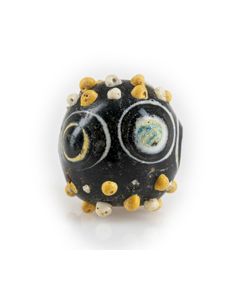 Large Phoenician eye bead
Dark and unusually large glass bead with stylized elements of a face as protection against the evil eye. Produced in Carthage or the Phoenician homeland, 4th to 3rd century BC.
Price: on request Phoenician eye bead
Polychrome glass bead with stylized elements of a face as protection against the evil eye. Produced in Carthage or the Phoenician homeland, 4th to 3rd century BC.
Price: on request Phoenician eye bead
Polychrome glass bead with stylized elements of a face as protection against the evil eye. Produced in Carthage or the Phoenician homeland, 4th to 3rd century BC.
Price: on request