
Jewellery - Sold antiquities
Archive of sold antiquities
All artefacts sold in our gallery are fully documented in our online archive and database. Being a specialist ancient art dealer, preserving also the more recent history of each and every piece sold in our shop is at our heart. That is particularly useful for artefacts that changed owners in the meantime. Information that may have been lost in the process can be easily restored from our archives. Please do not hesitate to contact us if you need further information about ancient items that have been sold in our gallery. We can help you with reconstructing the history of ownership for those items. All information about our customers will be kept confidential, of course.-
 Gold earrings in the shape of a reed boat
Matching pair of Late Bronze Age jewellery made of massive gold in the Eastern Mediterranean. The shape is reminiscent of boats made of budles of reed.
Price: on request Italic fibula with nice incised decoration
Large bronze brooch of a typical boat-shape from Iron Age Italy. A special feature and rarity are the three links of a chain still hanging on the pin.
Price: on request Villanovan fibula from the Hattatt collection
Serpentine bronze brooch of the Italic Iron Age. The piece is published in the standard work "Brooches of Antiquity".
Price: on request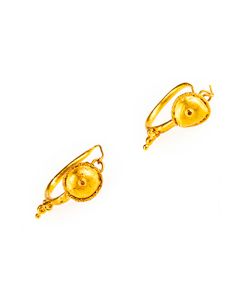 Roman earrings with shield
Matching pair of jewellery made of gold with shield and granulation. From the Roman Imperial period.
Price: on request Villanovan fibula from the Hattatt collection
Bronze brooch of the Italic Iron Age. The piece is published in the standard work "Brooches of Antiquity".
Price: on request Luristan horse pendant
The spectacular creature with conjoined horse bodies is characteristic for the bronze works of Lurstian. From the early 1st Millenium BC.
Price: on request Luristan ibex pendant
Massive bronze pendant in the shape of a standing ibex with curved horns. From Iron Age Luristan.
Price: on request Roman intaglio inscribed DIOGENOY
The gemstone made of red carnelian bears the inscription DIOGENOY. From the Roman period with original remains of the iron ring.
Price: on request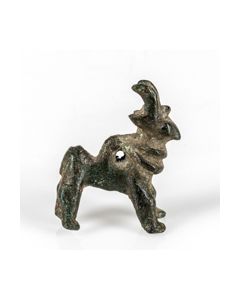 Luristan ibex pendant
Massive bronze pendant in the shape of a standing ibex with curved horns. From Iron Age Luristan.
Price: on request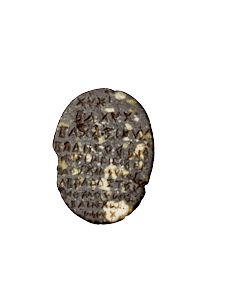 Gnostic intaglio with magic spell
The two sides show a woman with lion's head and a magical text. The piece is from the period of Gnosticism in the 2nd and 3rd century.
Price: on request
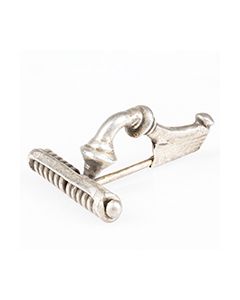 Roman silver fibula
Beautiful brooch from the eastern Roman provinces. Remains of an original gold plating can still be seen on the surface.
Price: on request Base plate of a Roman mirror
The bronze disc is the base plate of a Roman mirror. A handle and reflective metal coating were once part of the mirror. Typical for upper class Roman households during Imperial times.
Price: on request Roman glass fragments from the Rhineland
Fragments of glass vessels and rods, as well as two faience beads. Finds from the Roman city of Novaesium, today's Neuss in Germany.
Price: on request Eight Roman bronze artifacts
Various artifacts in different states of preservation. Finds from the Roman city of Novaesium, today's Neuss in Germany.
Price: on request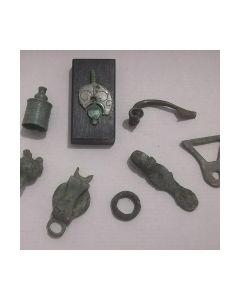 Eight Roman bronze artefacts
Various artefacts in different states of preservation. Finds from the Roman city of Novaesium, today's Neuss in Germany.
Price: on request Roman gold ring with eagle
The beautiful ring from Roman Imperial times is decorated by a black stone intaglio. The gem shows a standing eagle.
Price: on request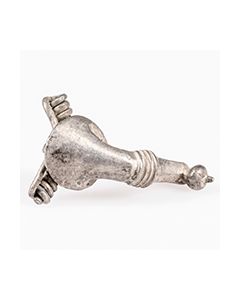 Pannonian trumpet brooch
Well preserved Roman fibula made of silver. The type is from the Pannonian provinces of Rome and dates to the 2nd century.
Price: on request Egyptian mummy beads necklace
Modern assembled and threaded necklace made from original ancient Egyptian beads. The socalled mummy beads are made of faience and date to the Late Period of ancient Egypt.
Price: on request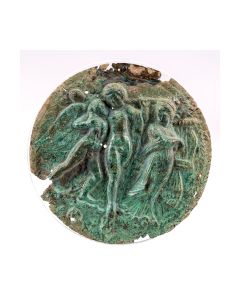 Published Etruscan mirror with Dionysian scene
Subject of extended scientific analysis, one of only about 34 known specimen. High quality work, excellent condition. Described by Prof. Jucker as "small piece of art". From an old Swiss private collection. Overall in exceptional condition with thoroughly worked details.
Price: on request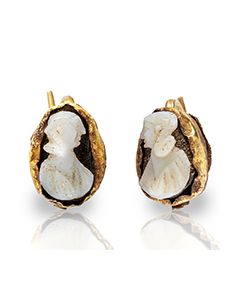 Pair of Roman gold earrings
The gold bodies are decorated with portrait busts made of black and white layered onyx. The jewellery was made in the 2nd century AD in the Danube provinces of the Roman Empire.
Price: on request Jama-Coaque roller stamp
Clay roller stamp with relief of plants to be applied as skin decoration. This tool was used in the early phase of the ecuadorian Jama-Coaque culture.
Price: on request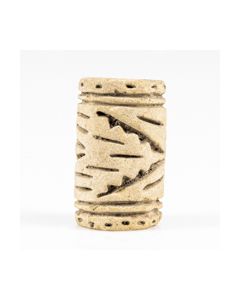 Jama-Coaque roller stamp
Clay roller stamp with relief of stylized plants used to apply skin decoration. This tool is from the early phase of the ecuadorian Jama-Coaque culture.
Price: on request Pannonian trumpet brooch
Well preserved Roman silver fibula with curved bow. The type is from the Pannonian provinces of Rome and dates to the 2nd century.
Price: on request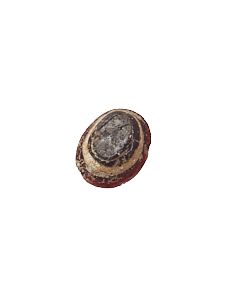 Roman glass insert for a fingerring
Banded glass imitating natural agate. The piece was once inserted into jewellery from the Roman Imperial period.
Price: on request Roman glass insert for a pendant
Typical glass jewellery from one of the Eastern Mediterranean glass factories. This popular type was made with a motif stamped into each side of the glass disc. Late 4th to 5th century AD.
Price: on request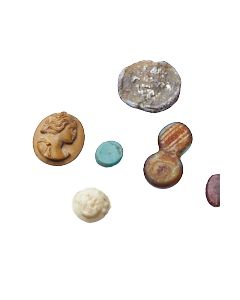 Six ancient artefacts and one modern cast
Interesting group of objects from the Professor Brosch collection of ancient gems. It has two intaglios, one cameo, two glass decorations, a lead bulla and a modern cast of a quality ancient gem.
Price: on request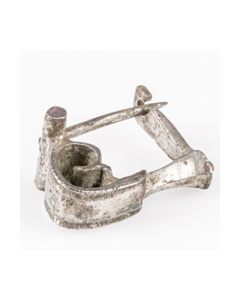 Roman silver fibula from Pannonia
Interesting brooch type from the Roman Pannonian provinces. A very similar piece was found near the Roman camp and settlement of Carnuntum in what is now Austria.
Price: on request Egyptian hippopotamus amulet
Made in the style of a scarab but with a hippopotamus on the upper side. It was a protective amulet during the 18th or 19th dynasty of Ancient Egypt. It might have protected a pregnant woman. The amulet comes from the famous Matouk collection and is published in his 1971 book.
Price: on request Roman anchor fibula
Magnificent silver brooch from the Roman Imperial period. Such fibulae were made in the Danube area Roman provinces.
Price: on request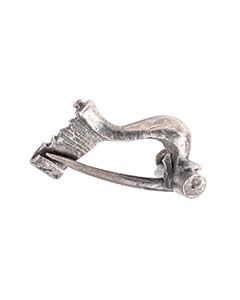 Roman silver knee brooch
Nice specimen with characteristic bend in its bow and attached loop and ring. From the Danubian provinces of the Roman Empire.
Price: on request Syrian amulet in animal shape
Small amulet of nice red stone in the stylized shape of a pig. From the 3rd Millenium BC.
Price: on request Roman bracelet with hunting scene
This rare and elaborate silver repoussé is analyzed in a 1970 publication and attributed to a workshop in Antioch or Palmyra. Late 3rd century AD.
Price: on request Etruscan "a baule" type earrings
Skilfully made pair of gold earrings with filigree. The ancient jewellery is from the Golden Age of the Etruscans around the 6th century BC.
Price: on request Pair of early Byzantine gold earrings
Beautiful jewellery with beads made of emerald and garnet. Made in the eastern part of the Mediterranean during the 6th to early 7th century.
Price: on request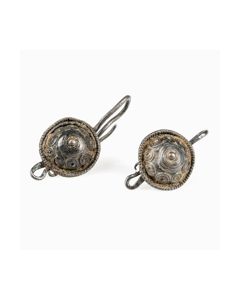 Roman silver earrings with shield
Belonging pair of earrings from the late Roman Imperial period. With nice filigree decoration.
Price: on request