
Sold antiquities
Archive of sold antiquities
All artefacts sold in our gallery are fully documented in our online archive and database. Being a specialist ancient art dealer, preserving also the more recent history of each and every piece sold in our shop is at our heart. That is particularly useful for artefacts that changed owners in the meantime. Information that may have been lost in the process can be easily restored from our archives. Please do not hesitate to contact us if you need further information about ancient items that have been sold in our gallery. We can help you with reconstructing the history of ownership for those items. All information about our customers will be kept confidential, of course.-
 Large prehistoric hand axe
Massive Paleolithic stone tool. It was the universal tool of the older Stone age and could be used as a borer or a cutter. From a Swiss museum collection. Found in Algeria, North Africa.
Price: on request Paleolithic hand axe or borer
Prehistoric stone tool. It was the universal tool of the older Stone age and could be used as a borer or chisel. From a Swiss museum collection. Found in the Algerian Sahara desert.
Price: on request Stone Age bow scraper from Egypt
The Paleolithic tool is of beautiful shape and color. Thebes has been handed down as the place of origin. From an old museum collection.
Price: on request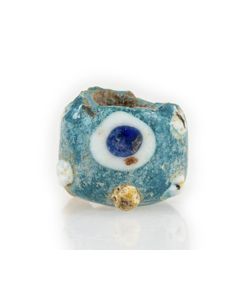 Phoenician eye bead
Polychrome glass bead with stylized elements of a face as protection against the evil eye. Produced in Carthage or the Phoenician homeland, 4th to 3rd century BC.
Price: on request Phoenician eye bead
Polychrome glass bead with stylized elements of a face as protection against the evil eye. Produced in Carthage or the Phoenician homeland, 4th to 3rd century BC.
Price: on request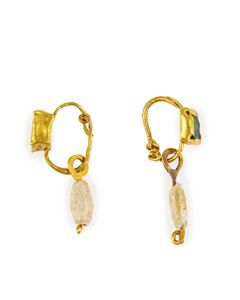 Pair of Roman gold earrings
The earrings belong together originally. They are nicely decorated by beads and glass inserts. A beautiful pair of jewellery from the 3rd century.
Price: on request Römisches Töpfchen
Geborgen in den Jahren 1966 bis 1981 in Zusammenarbeit mit lokalen Archäologen. Neuss, das römische Novaesium, war eine frühe römische Gründung in der Provinz Germania Inferior und ist somit eine der ältesten Städte Deutschlands.
Price: on request Three neolithic arrowheads from Egypt
The Stone Age points are finely crafted. From a 100 year old museum collection.
Price: on request Three neolithic arrowheads from Egypt
The Stone Age points are finely crafted. From a 100 year old museum collection.
Price: on request Disc brooch from Roman Britain
Nicely enameled brooch with a Romano-Celtic sunburst design. From the 2nd century AD. Published in two stardard works on ancient brooches by Richard Hattatt.
Price: on request Roman rosette brooch from Colchester
A nice brooch type from the 1st century with an especially well preserved decorative disc. From the famous Hattatt collection and published in two standard works on ancient brooches.
Price: on request Flying bird brooch from Roman Britain
A local British production from the 2nd century. It is taking up a continental brooch type. From the famous Hattatt collection and published in two standard works on ancient brooches.
Price: on request Roman glass bottle with handle
Nice and relatively large bottle from the late Roman imperial period. Probably from the Roman province Judaea.
Price: on request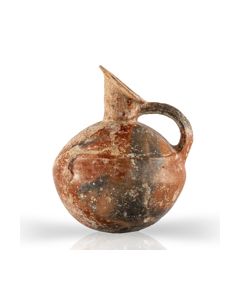 Spouted jug of the Yortan culture
The large jug has a spherical body, decorated with two stylized arms and hands. From Bronze Age Anatolia.
Price: on request Painted Bronze Age jug
The clay jug is decorated by an impressively well preserved geometric design. From Bronze Age Anatolia.
Price: on request Two Near Eastern weapon points
Group of two bronze points for small spears or large arrows from the Bronze or Early Iron Age. With a nice green patina.
Price: on request Iron Age spearhead from Sweden
Well-preserved iron weapon, a find from the Swedish province of Värmland. Acquired in 1894 into the collection of the Bally-Prior Museum.
Price: on request Luristan bronze dagger with tang
Double-edged blade of a short dagger from the Luristan region in Ancient Iran. An early type from the Middle Bronze Age.
Price: on request Mochica stirrup vessel as a shaman
Imposing Peruvian vessel shaped like a priest on a podest with rich adornments. Circa 100 to 500 AD. With documents form the 1980ies.
Price: on request Sassanian intaglio with griffin
Perfectly preserved ring stone made of orange carnelian. It shows a winged hybrid creature with the body of a lion. With inscription in Pahlavi, the Middle Persian script of the Sassanids.
Price: on request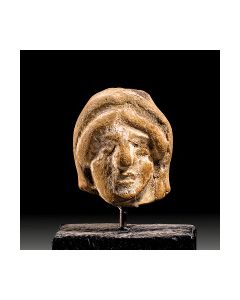 Greek clay head
Head of a female clay figurine. Classical Antiquity of Ancient Greece.
Price: on request Hellenistic clay cup
A pottery of daily use dating to the Hellenistic Roman period. From collection of the archaeologist and artist Erich Charlier.
Price: on request Celtic brooch from Iberia
The early Celtic brooch dates from the 6th century BC and was found in Spain. This specimen is published in two standard works on ancient brooches.
Price: on request Dolphin brooch from Roman Britain
The so-called dolphin brooch is very British. This specimen was probably made by the Celtic Corieltauvi tribe, shortly after the arrival of the Romans in the middle of the 1st century. Published in two works by Richard Hattatt.
Price: on request Brooch from Roman Britain
This rare variant of the T-shaped brooches was found in Lechlade, Gloucestershire. It dates to the 1st or 2nd century AR. From the famous Hattatt collection and published in two standard works for ancient fibulae.
Price: on request Sasanian stamp seal with winged horse
Dark orange Carnelian with engraved schematic depiction of the mythical creature. From the period of Sasanian rule in the Near East.
Price: on request Small Roman Terra Sigillata bowl with potters' mark from the Rhineland
Found near the Roman city of Novaesium, today's Neuss in Germany, an early Roman foundation and with this one of the oldest cities in Germany.
Price: on request Marc Antony legionary Denarius from Wishanger hoard
Found 2021 in East Hampshire, UK. The hoard is a very impressive proof of the fact that coins were in circulation for up to several centuries in the Roman era.
Price: on request Two Roman tile fragments from the Rhineland
With grid pattern. Found 1966 till 1981 near the Roman city of Novaesium, today's Neuss in Germany. Novaesium was an early Roman foundation and with this is one of the oldest cities in Germany.
Price: on request Islamic glass lamp
Lamp in the form of a slender glass cylinder. From Egypt or the Eastern Mediterranean. Ex Sotheby's.
Price: on request Roman iron pilum (javelin) head from the Rhineland
Found near the Roman city of Novaesium, today's Neuss in Germany, an early Roman foundation and with this one of the oldest cities in Germany.
Price: on request Group of ancient eye beads
6 magnificent polychrome glass beads with stylized eyes as protection against the evil eye. Made around the mid 1st millennium BC in the eastern Mediterranean. Ex Christie's.
Price: on request Neolithic axe head
Finely crafted tool made of nice dark grey flint. From the New Stone Age of Europe. A specimen of the thick butted type with thin blade.
Price: on request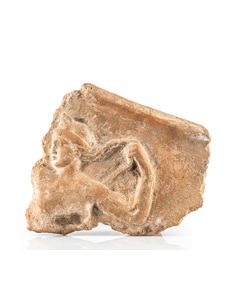 Fragment of a Hellenistic or Roman relief
Very finely worked depiction of a woman with long hair. From the German private collection Dr. Dietrich, acquired in the 1950s from an antiquities gallery in Cologne, Germany.
Price: on request Tiberius denarius (Tribute Penny) from Wishanger hoard
Found 2021 in East Hampshire, UK. The hoard is a very impressive proof of the fact that coins were in circulation for up to several centuries in the Roman era.
Price: on request Necklace of ancient eye beads
Modernly threaded necklace made of more than 100 ancients beads dating to the 1st millennium BC. From the eastern Mediterranean. Ex Christie's.
Price: on request