
Sold - Sold antiquities
Archive of sold antiquities
All artefacts sold in our gallery are fully documented in our online archive and database. Being a specialist ancient art dealer, preserving also the more recent history of each and every piece sold in our shop is at our heart. That is particularly useful for artefacts that changed owners in the meantime. Information that may have been lost in the process can be easily restored from our archives. Please do not hesitate to contact us if you need further information about ancient items that have been sold in our gallery. We can help you with reconstructing the history of ownership for those items. All information about our customers will be kept confidential, of course.-
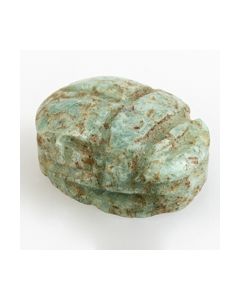 Egyptian scarab
The scarab is made of beautiful green stone. Schematical upper side, unengraved bottom side. From the New Kingdom of Ancient Egypt.
Price: on request Bowl of the Ica culture
Appealing pottery made by the precolumbian Ica culture and decorated with a linear pattern. Around 1000 AD.
Price: on request Beaker of the Nazca culture
Vessel made by the precolumbian Nazca culture and painted in bright colours. From the early phase between the 1st and 5th century
Price: on request Black figure Etruscan Stamnos from Toledo Museum collection
Ex collection Prof. G. Olcott, the first Columbia University professor for Roman archeology. Acquired from his estate 1912 by the Toledo Museum (Ohio), in the museum collection until 2017. Found in Bolseno area, Italy.
Price: on request Small bronze amulet of a dog
A nice amulet from Ancient Egypt. The rare depiction shows a crouching canid with alert head and ears. A piece from the famous Fouad Matouk collection.
Price: on request Egyptian ibis amulet
Nice figurine of an ibis dating to the Late Period of Ancient Egypt. From the famous collection of Fouad S. Matouk.
Price: on request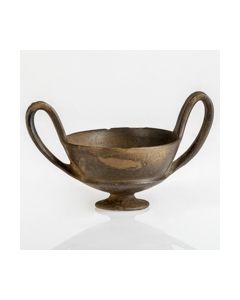 Etruscan kantharos with high handles found at Tarquinia
Finely worked cup with high flat handles. From an old German collection, acquired in the 1950s. Said to have been found at Tarquinia.
Price: on request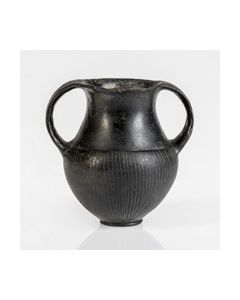 Etruscan amphora with flat handles found at Tarquinia
Finely worked jar with ovoid body and trumpet-shaped mouth. From an old German collection, acquired in the 1950s. Said to have been found at Tarquinia.
Price: on request Roman bronze figurine of a horseman
Beautiful massive figurine, very well preserved, great dark green patina.
Price: on request Bronze figurine of a horse from Roman era
Beautiful small figurine, very well preserved, great green patina.
Price: on request Roman bronze figurine of a horse with base
Beautiful massive figurine, very well preserved, great dark green patina.
Price: on request Scarab with magic formula
The stamp shows the anra formula in a cartouche. The amulet should thus serve a magic or ritual purpose for its owner.
Price: on request Egyptian Eye of Horus
Small amulet in form of the Eye of Horus. Popular type of protective amulet from Ancient Egypt.
Price: on request Egyptian Eye of Horus
Small amulet in form of the Eye of Horus. Popular type of protective amulet from Ancient Egypt.
Price: on request Egyptian Eye of Horus
Small amulet in form of the Eye of Horus. Popular type of protective amulet from Ancient Egypt.
Price: on request Melon bracelet from the Hallstatt period
The massive bronze bracelet was found in Mintraching, Germany. The piece is published in an archeological report. Around 600 BC.
Price: on request Egyptian Eye of Horus, New Kingdom
Small amulet in form of the Eye of Horus. Popular type of protective amulet from Ancient Egypt.
Price: on request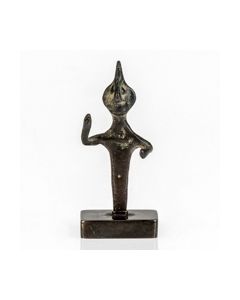 Anatolian bronze idol
The bronze figurine is a nail idol that can be attributed to the Hittite culture. Late 2nd Millenium BC.
Price: on request Near Eastern bronze idol
The unusual bronze figurine is a Near Eastern idol. Possibly a god or priest. 2nd Millenium BC.
Price: on request Mummyform Near Eastern idol
The unusual bronze figurine is an idol from Anatolia or the Near East. Around 1000 BC.
Price: on request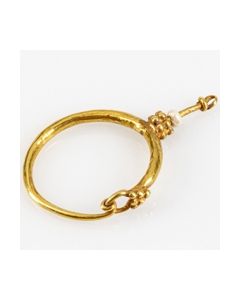 Roman gold earring
Fine specimen from the eastern provinces during late Roman Imperial times. From the collection of the orientalist N. Giron.
Price: on request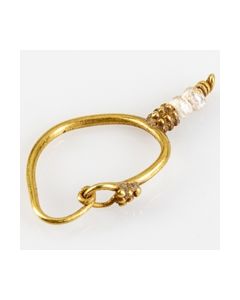 Roman gold earring with pearls
Fine specimen from the eastern provinces during late Roman Imperial times. From the collection of the orientalist N. Giron.
Price: on request Juglet from Iron Age II
This vessel from the Holy Land was made between construction and destruction of the First Temple in Jerusalem. From the well-known Dr. Steve Adler collection.
Price: on request Juglet from Iron Age II
This vessel from the Holy Land was made between construction and destruction of the First Temple in Jerusalem. From the well-known Dr. Steve Adler collection.
Price: on request Roman bronze figurine of a horse
Beautiful massive figurine, very well preserved, great dark green patina.
Price: on request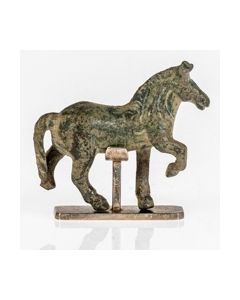 Roman bronze figurine of a horse
Beautiful massive figurine, perfectly preserved, great patina. With modern 925 silver base.
Price: on request Bronze figurine of a horse
Nicely preserved massive bronze figurine. 2nd - 1st half 1st millenium BC. Western Asia.
Price: on request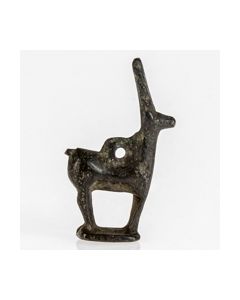 Bronze figurine of a deer or stag
Nicely preserved massive bronze figurine. End of 2nd - 1st half 1st millenium BC. Iron Age culture, Western Asia.
Price: on request Bronze votive figurine of a bull
Nicely preserved bronze figurine. 2nd - 1st half 1st millenium BC. Bronze or Iron Age, Western Asia, probably Hittite.
Price: on request Juglet from Iron Age II
This vessel from the Holy Land was made between construction and destruction of the First Temple in Jerusalem. From the well-known Dr. Steve Adler collection.
Price: on request Greek guttos with Triton on sea monster
From the Austrian collection of Prof. Ritschel, carrier of the Large Cross of Honor of the Austrian Republic and many other prizes and honors. Very nicely preserved, interesting unusual piece.
Price: on request Cylinder seal from the Uruk period
Seal of beautiful white marble. It shows a frieze of highly stylized water creatures.
Price: on request Mesopotamian cylinder seal
The long seal is engraved with a highly stylized scene in linear design. A quadruped is reared by a lion. From Early Bronze Age of Mesopotamia.
Price: on request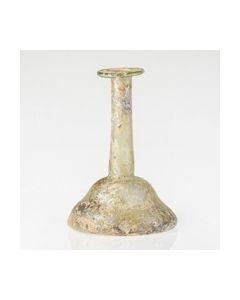 Roman glass flask
The big ancient glass is a nice example of the production of the eastern Roman provinces. Ex Sotheby's auction 1970, previously in the Nancy Cunard collection.
Price: on request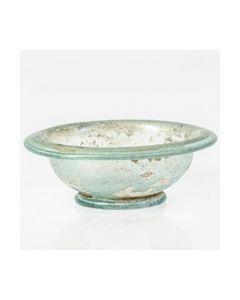 Roman glass bowl
The nice bowl is made of pale blue green glass. It dates to the late Roman Imperial period.
Price: on request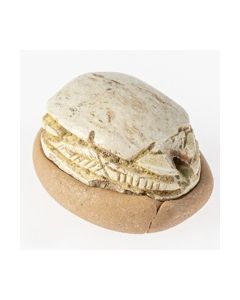 Canaanite scarab
Local levantine production during the 13th to 15th dynasty of Egypt. With an export permit from the Israel Antiquities Authority.
Price: on request